What Is a Lithium Iron Phosphate Battery? The Complete 2026 Engineering Guide
What Is a Lithium Iron Phosphate Battery?
Lithium batteries are now found everywhere—from residential solar systems and RVs to forklifts, telecom infrastructure, and data centers. Yet many people still assume that every lithium battery is the same.
In reality, lithium-ion refers to a family of battery chemistries, each designed with different performance characteristics. Among them, Lithium Iron Phosphate (LiFePO₄ or LFP) has emerged as the preferred choice for applications requiring long service life, high safety, and dependable deep-cycle performance.
Unlike consumer electronics that prioritize maximum energy density, stationary energy storage systems and commercial equipment demand reliability over thousands of charging cycles, consistent power delivery, and stable operation across varying environmental conditions. These requirements have made LiFePO₄ the dominant chemistry in many residential, commercial, and industrial applications.
Quick Answer
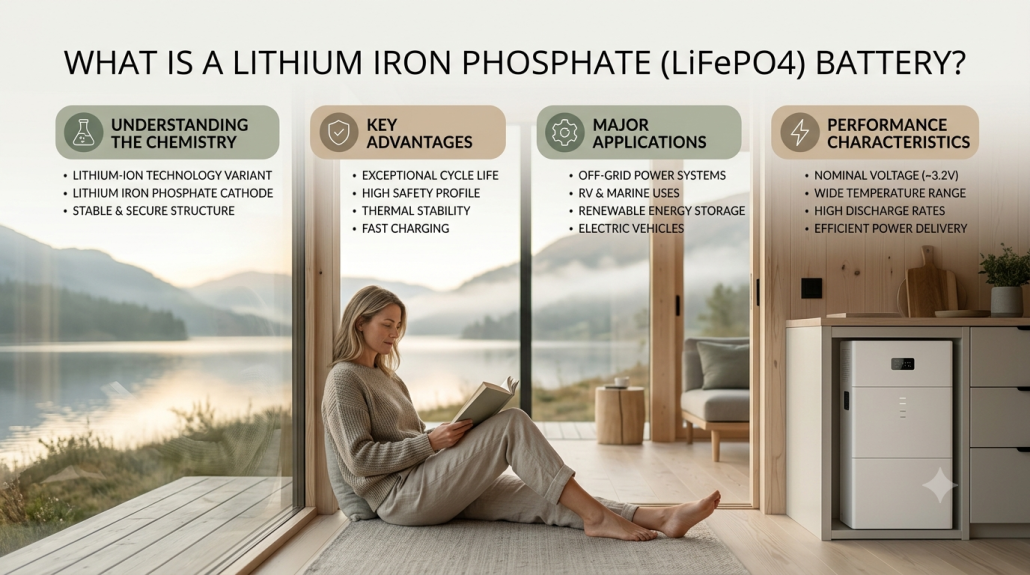
A lithium iron phosphate battery (LiFePO₄ or LFP battery) is a type of lithium-ion battery that uses lithium iron phosphate as its cathode material. Compared with conventional lithium-ion chemistries such as Nickel Manganese Cobalt (NMC), LiFePO₄ batteries offer exceptional thermal stability, a service life of 4,000–6,000+ charge cycles, up to 100% usable Depth of Discharge (DoD), and excellent safety. These advantages make LiFePO₄ the preferred battery technology for residential energy storage, RVs, marine systems, golf carts, forklifts, telecommunications, and industrial backup power.
What Is the Difference Between Lithium-Ion and Lithium Iron Phosphate?
One of the most common misconceptions is that lithium-ion and lithium iron phosphate are different battery technologies.
They are not.
Lithium-ion is the umbrella category that includes several cathode chemistries, each optimized for different applications.
The most common lithium-ion chemistries include:
| Chemistry | Abbreviation | Primary Strength | Common Applications |
| Lithium Iron Phosphate | LiFePO₄ (LFP) | Safety, long lifespan | Solar storage, RVs, UPS, golf carts, forklifts |
| Nickel Manganese Cobalt | NMC | High energy density | Electric vehicles, portable power stations |
| Nickel Cobalt Aluminum | NCA | High energy density | Premium EVs |
| Lithium Cobalt Oxide | LCO | Compact size | Smartphones, laptops |
| Lithium Manganese Oxide | LMO | High power output | Medical equipment, power tools |
The 2026 Evolution: Enter LMFP (Lithium Manganese Iron Phosphate)
As of 2026, the LFP architecture has evolved. While standard LiFePO₄ remains the undisputed king of stationary storage, the commercial sector is rapidly adopting LMFP (Lithium Manganese Iron Phosphate)
This chemical upgrade yields a 15% to 20% increase in energy density without sacrificing the thermal safety or 4,000+ cycle life that makes traditional LFP so reliable. For heavy-duty applications—like Class 8 electric trucks and compact marine house banks—LMFP bridges the gap between standard LFP durability and NMC energy density.
How Does a LiFePO₄ Battery Work?
Like all rechargeable lithium-ion batteries, a LiFePO₄ battery stores energy through the movement of lithium ions between two electrodes.
During charging, lithium ions migrate from the cathode to the graphite anode, where they are stored. During discharge, the ions travel back to the cathode, releasing electrical energy that powers connected equipment.
Unlike lead-acid batteries, which rely on chemical reactions that gradually degrade the plates, lithium-ion cells experience significantly less structural wear during each cycle. This contributes to their much longer service life.
Basic Charging Process
| Step | Process | What Happens |
| ① Charger supplies DC power | A compatible charger delivers controlled voltage and current. | Charging begins under BMS supervision. |
| ② BMS checks battery health | The Battery Management System monitors voltage, current, and temperature. | Charging is allowed only if operating conditions are safe. |
| ③ Lithium ions move | Lithium ions travel from the cathode (LiFePO₄) to the graphite anode through the electrolyte. | Electrical energy is stored as chemical energy. |
| ④ Cell balancing | The BMS equalizes voltage across all cells near full charge. | Prevents overcharging of individual cells and extends battery life. |
| ⑤ Charging complete | Charger switches to standby or stops charging. | Battery reaches approximately 100% State of Charge (SOC). |
Basic Discharging Process
| Step | Process | What Happens |
| ① Device requests power | An inverter, motor, UPS, or load draws electricity. | Battery begins supplying energy. |
| ② Lithium ions return | Lithium ions migrate from the graphite anode back to the LiFePO₄ cathode. | Stored chemical energy converts into electrical energy. |
| ③ Electrons flow | Electrons travel through the external circuit. | The connected equipment receives usable DC or AC power. |
| ④ Continuous BMS monitoring | The BMS tracks voltage, current, temperature, and State of Charge. | Protects against over-current, overheating, and deep discharge. |
| ⑤ Low-voltage protection | When the minimum voltage is reached, the BMS disconnects the load. | Prevents permanent battery damage and preserves cycle life. |
This reversible ion movement enables LiFePO₄ batteries to support thousands of charge and discharge cycles while maintaining stable voltage and capacity.
Why Has LiFePO₄ Become the Industry Standard?
The growing adoption of LiFePO₄ is driven by engineering advantages rather than marketing claims. Compared with traditional lead-acid batteries and many other lithium-ion chemistries, LiFePO₄ delivers a unique combination of safety, longevity, and operational efficiency.
Exceptional Thermal Stability
LiFePO₄ features an olivine crystal structure, which is inherently more stable than layered oxide chemistries such as NMC. This structure strongly binds oxygen atoms, making the material far less prone to oxygen release at elevated temperatures—a key factor in reducing the risk of thermal runaway.
For applications such as residential energy storage, telecom backup, and industrial equipment, this stability contributes to safer long-term operation.
Long Cycle Life
Battery lifespan is typically measured in charge cycles rather than calendar years.
A quality LiFePO₄ battery commonly delivers:
- 4,000–6,000+ cycles under standard operating conditions
- 10–15 years of service in many applications
- Even longer life in systems with moderate daily cycling
By comparison, flooded lead-acid batteries generally provide 300–700 cycles, while AGM batteries typically reach 500–1,000 cycles.
Higher Usable Capacity
Lead-acid batteries are usually limited to around 50% Depth of Discharge (DoD) to avoid accelerating degradation.
LiFePO₄ batteries, however, can routinely operate at 90–100% DoD, allowing users to access significantly more usable energy from the same nominal capacity.
For example, a 100Ah LiFePO₄ battery can provide nearly its full rated capacity, whereas a 100Ah lead-acid battery may effectively deliver only about 50Ah if long service life is desired.
Fast Charging
LiFePO₄ batteries accept higher charging currents than lead-acid batteries and exhibit minimal performance loss during rapid charging.
Many commercial systems support charging rates up to 1C, enabling a fully depleted battery to recharge in approximately one hour under appropriate conditions. This capability is particularly valuable for forklifts, automated guided vehicles (AGVs), and backup power systems where minimizing downtime is critical.
Maintenance-Free Operation
Unlike flooded lead-acid batteries, LiFePO₄ batteries require:
- No watering
- No equalization charging
- No acid spill management
- No corrosion cleanup
- No ventilation for hydrogen gas
This reduces maintenance labor and simplifies installation across residential, commercial, and industrial environments.
LiFePO₄ vs. Lead-Acid vs. NMC
| Performance Metric | LiFePO₄ (Lithium Iron Phosphate) | Lead-Acid (Flooded/AGM) | NMC Lithium |
| Safety | Excellent thermal stability; very low thermal runaway risk | Stable but contains corrosive acid | Higher thermal runaway risk than LiFePO₄ |
| Typical Cycle Life | 4,000–6,000+ cycles | 300–800 cycles | 1,000–2,500 cycles |
| Expected Service Life | 10–15 years | 3–5 years | 8–10 years |
| Usable Depth of Discharge | 80–100% | 50% recommended | 80–90% |
| Energy Density | High | Low | Very High |
| Weight | Lightweight | Heavy | Light |
| Maintenance | Maintenance-free | Regular watering (flooded) and terminal cleaning | Maintenance-free |
| Charging Speed | Fast (typically 2–4 hours) | Slow (6–10+ hours) | Fast |
| Operating Temperature | Excellent; suitable for demanding environments with appropriate BMS protection | Reduced performance in extreme temperatures | Good, but more sensitive to heat |
| Round-Trip Efficiency | 95–98% | 70–85% | 90–95% |
| Environmental Impact | Cobalt-free; long service life reduces waste | Mature recycling infrastructure but contains lead and acid | Often contains cobalt and nickel |
| Common Applications | Energy storage systems, RVs, marine, golf carts, forklifts, UPS, telecom, solar | Automotive starting batteries, backup power, industrial equipment | Electric vehicles, consumer electronics, portable power |
Key Advantages at a Glance
| If You Need… | Best Choice | Why |
| Longest service life | LiFePO₄ | Up to 6,000+ charge cycles |
| Highest safety | LiFePO₄ | Excellent thermal and chemical stability |
| Lowest upfront cost | Lead-acid | Lowest purchase price |
| Highest energy density | NMC | More energy in a smaller, lighter package |
| Best lifetime value | LiFePO₄ | Lower total cost of ownership despite higher initial investment |
| Renewable energy storage | LiFePO₄ | Deep cycling, long life, and high efficiency |
| Heavy-duty commercial use | LiFePO₄ | Reliable performance with frequent charging and discharging |
Where Are Lithium Iron Phosphate Batteries Used?
LiFePO₄ batteries have expanded well beyond renewable energy systems. Their combination of safety, long cycle life, and deep-cycle capability makes them suitable for a broad range of applications.
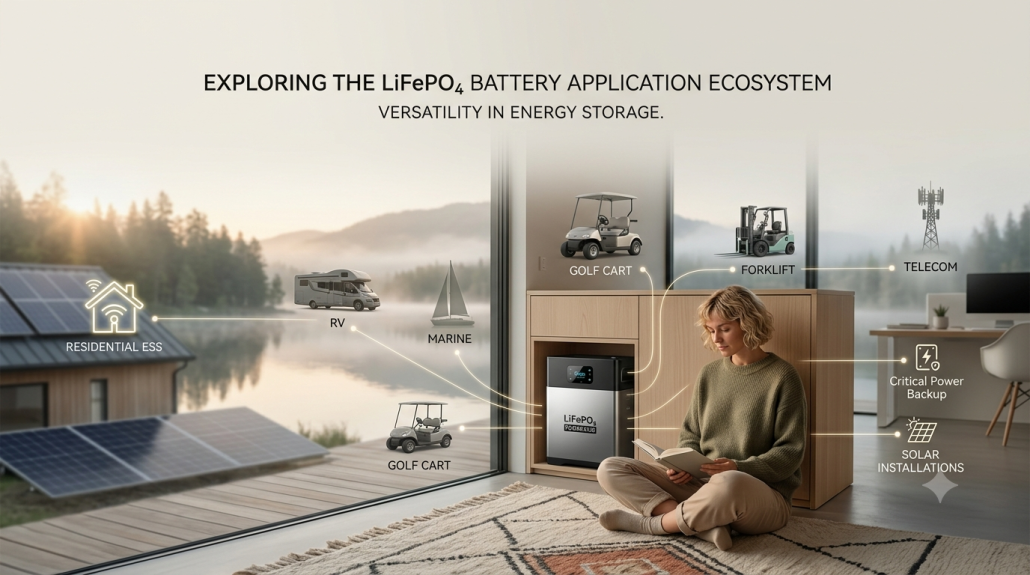
Residential Energy Storage
Homeowners pair LiFePO₄ batteries with rooftop solar systems to store excess daytime generation and provide backup power during outages. Modern systems also enable time-of-use optimization by charging during off-peak hours and discharging when electricity prices are highest.
Check some related blogs to help figure out the best solutions for your house:
Recreational Vehicles (RVs)
LiFePO₄ batteries are widely used in motorhomes because they deliver more usable capacity while reducing weight compared with lead-acid batteries. Their ability to support deep cycling and fast charging makes them ideal for extended off-grid travel.
Related reading: The Best Lithium Batteries for RVs
Marine Applications
Marine battery systems benefit from LiFePO₄’s sealed construction, resistance to corrosion, and stable voltage output, making them well suited for house loads, trolling motors, and onboard electronics.
Golf Carts
Replacing lead-acid batteries with LiFePO₄ reduces vehicle weight, improves acceleration, extends driving range, and minimizes maintenance. These advantages have made lithium the preferred choice for many golf courses, resorts, and neighborhood electric vehicles.
Related reading: The Ultimate Guide to Lithium Batteries for Golf Carts
Forklifts and Material Handling
Industrial forklifts increasingly rely on LiFePO₄ batteries because they support opportunity charging, eliminate battery swapping, and reduce downtime in multi-shift warehouse operations.
Related reading: The Ultimate Guide to Battery Lithium Forklift Solutions for Cold Storage
UPS and Telecom Backup
Data centers, telecom sites, and mission-critical facilities are transitioning to LiFePO₄ battery systems to reduce maintenance requirements while increasing service life and improving energy efficiency.
Related reading: Uninterruptible Power Supply Hours: How Long Can a UPS Really Last?
How to Choose the Right LiFePO₄ Battery
Selecting the right battery depends on more than voltage alone. Consider the following engineering factors:
- Voltage: Match the battery to your system requirements (typically 12V, 24V, 36V, or 48V).
- Capacity (Ah): Higher amp-hour ratings provide longer runtime but increase size and cost.
- Continuous and Peak Discharge Current: Ensure the battery can support both sustained loads and temporary surge demands.
- Battery Management System (BMS): Look for comprehensive protections, including cell balancing, overcharge, over-discharge, short-circuit, and temperature protection.
- Expansion Capability: Some systems support series and parallel configurations, making future capacity upgrades easier.
- Operating Temperature: Verify that the battery is suitable for your environmental conditions, particularly if it will be used in cold climates or outdoor installations.
- Communication Interfaces: Bluetooth, CAN bus, and RS485 connectivity can simplify monitoring and integration into larger systems.
The LiFePO₄ Battery Voltage Chart
Understanding the discharge curve of a lithium iron phosphate battery is critical for system sizing. Unlike lead-acid batteries, which experience a linear voltage drop as they discharge, LiFePO₄ maintains a highly stable, flat voltage curve until it is nearly depleted.
Here is the typical resting voltage for a 12V (4S) LiFePO₄ battery at various States of Charge (SoC):
- 100% SoC:6V (Resting)
- 99% – 80% SoC:4V – 13.3V
- 70% – 30% SoC:2V – 13.1V
- 20% – 10% SoC:0V – 12.8V
- 0% SoC (Depleted):0V (BMS Cutoff)
Engineering Note: Because the voltage remains between 13.1V and 13.3V for roughly 60% of the battery’s capacity, voltage alone is a poor indicator of remaining capacity. For accurate monitoring, systems should utilize a battery monitor equipped with a smart shunt that measures coulomb counting (current over time).
Why the Battery Management System (BMS) Matters
The Battery Management System (BMS) is the intelligence behind a modern LiFePO₄ battery. Rather than simply storing energy, the BMS continuously monitors battery health and ensures safe operation.
A high-quality BMS typically provides:
- Cell voltage balancing
- Overcharge protection
- Over-discharge protection
- Overcurrent protection
- Short-circuit protection
- High- and low-temperature protection
- State of Charge (SOC) monitoring
- State of Health (SOH) estimation
Commercial and industrial batteries may also include CAN bus, RS485, Bluetooth, or cloud connectivity for remote diagnostics and fleet management.
Charging a Lithium Iron Phosphate Battery
LiFePO₄ batteries use a constant current/constant voltage (CC/CV) charging profile. While they can often be charged more quickly than lead-acid batteries, using a charger with a lithium-compatible charging algorithm is recommended to ensure optimal performance and battery longevity.
Can LiFePO₄ Batteries Freeze? Yes, but how the BMS handles freezing temperatures dictates the battery’s survival. Discharging a LiFePO₄ battery in sub-zero temperatures is perfectly safe and will not damage the cells. However, charging a LiFePO₄ battery below 32°F (0°C) forces the lithium ions to plate onto the surface of the graphite anode rather than intercalating into it, causing permanent, irreversible capacity loss.
Modern, high-tier 2026 batteries solve this by integrating internal self-heating pads. When connected to a charger in freezing conditions, the BMS automatically diverts the incoming current to the heating pads first. Once the core temperature rises above 35°F (2°C), the BMS seamlessly routes the current back to the cells to begin the charging cycle.
Frequently Asked Questions
Is LiFePO₄ the same as lithium-ion?
No. LiFePO₄ is one chemistry within the broader lithium-ion battery family. It is optimized for safety, long cycle life, and deep-cycle performance, making it especially suitable for energy storage and commercial applications.
Are lithium iron phosphate batteries safe?
Yes. LiFePO₄ is widely regarded as one of the safest lithium-ion chemistries due to its stable crystal structure and strong resistance to thermal runaway. When paired with a well-designed Battery Management System (BMS), it is commonly used in residential, commercial, and industrial environments.
How long do lithium iron phosphate batteries last?
Most quality LiFePO₄ batteries deliver between 4,000 and 6,000 full charge cycles, which often translates to 10–15 years of service under normal operating conditions.
Can LiFePO₄ batteries be fully discharged?
Most LiFePO₄ batteries support up to 100% Depth of Discharge (DoD), although maintaining a modest reserve charge may further extend battery lifespan depending on the application and manufacturer recommendations.
Are LiFePO₄ batteries good for solar energy storage?
Yes. Their long cycle life, high round-trip efficiency, deep discharge capability, and excellent thermal stability make LiFePO₄ batteries one of the leading technologies for residential and commercial solar energy storage systems.
Conclusion
Lithium Iron Phosphate (LiFePO₄) technology has become the benchmark for modern deep-cycle energy storage. Its combination of long service life, exceptional safety, fast charging, and maintenance-free operation makes it a practical choice for a wide range of applications—from home energy storage and RVs to forklifts, golf carts, marine systems, telecommunications, and UPS installations.
As energy storage continues to play a larger role in residential, commercial, and industrial infrastructure, understanding the engineering principles behind LiFePO₄ batteries is essential for selecting the right solution. By evaluating factors such as voltage, capacity, BMS functionality, operating temperature, and application requirements, users can make informed decisions that maximize performance, reliability, and long-term value.
Need help choosing a reliable lithium battery partner? Connect with the battery specialists at LEOCH Battery, a US lithium manufacturer, to find the ideal solution for your next project.