
The Ultimate Guide to Lithium Batteries for Golf Carts: Conversions and Upgrades
Golf carts have evolved far beyond the fairway.
Today, they’re used as neighborhood electric vehicles (NEVs), resort shuttles, industrial utility vehicles, hunting buggies, campus transportation, and maintenance carts. These expanded applications demand more power, longer driving range, faster charging, and greater reliability than traditional battery technology was designed to deliver.
For decades, flooded lead-acid batteries powered the golf cart industry. While proven and affordable, they struggle to meet the expectations of modern users. Frequent watering, long charging times, voltage drop under load, and short service life all contribute to higher operating costs and increased maintenance.
As a result, more owners and fleet operators are upgrading to lithium batteries for golf carts, particularly Lithium Iron Phosphate (LiFePO₄) technology. With longer lifespan, lighter weight, and intelligent battery management, lithium has become the preferred solution for both recreational users and commercial fleets.
The Quick Answer
Upgrading to Lithium Iron Phosphate (LiFePO₄) batteries is one of the most effective ways to improve golf cart performance. A modern drop-in lithium conversion eliminates routine battery maintenance, reduces vehicle weight by up to 300 pounds (136 kg), charges in just a few hours, and can provide 40–60 miles (64–97 km) of driving range per charge. Compared with traditional flooded lead-acid batteries, lithium systems also last 3–5 times longer, making them a more economical long-term investment.
The Engineering Advantage: Why Lithium Outperforms Lead-Acid
While lighter weight and longer lifespan are widely recognized benefits, the real engineering advantage of lithium batteries lies in how they deliver power.
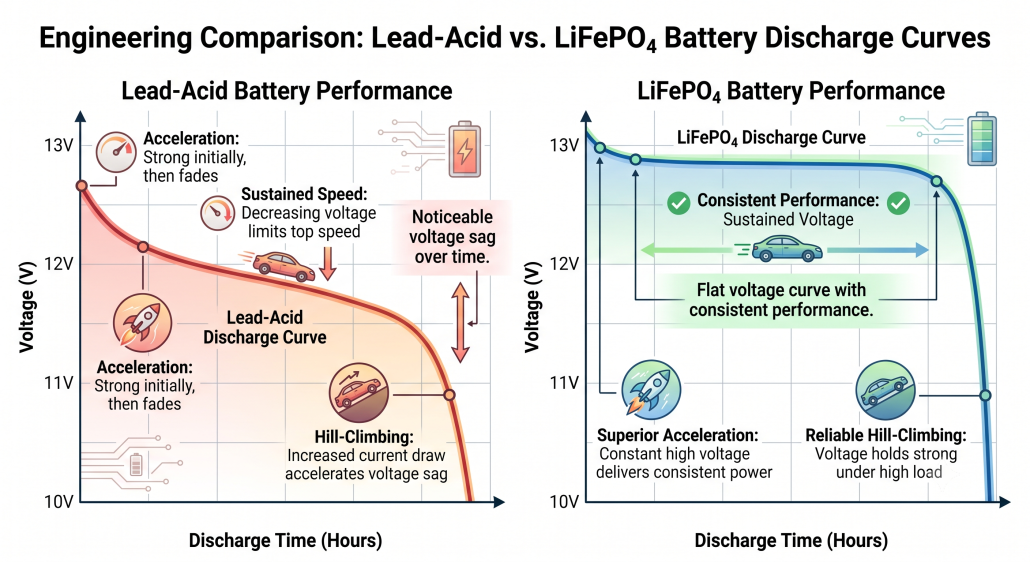
Two electrical characteristics—voltage stability and usable capacity under load—have a significant impact on real-world golf cart performance.
Voltage Sag: Why Hills Feel Easier with Lithium
Every electric motor demands higher current when climbing hills, accelerating, or carrying heavy loads.
In traditional lead-acid batteries, this increased current draw causes the battery voltage to drop—a phenomenon known as voltage sag.
As voltage decreases:
- Motor torque is reduced.
- Acceleration becomes sluggish.
- Top speed declines.
- Performance gradually worsens as the battery discharges.
Many golf cart owners notice this effect late in the day, when the cart feels noticeably weaker despite the battery still holding some charge.
LiFePO₄ batteries behave differently.
They maintain a much flatter discharge curve, delivering stable voltage throughout most of the discharge cycle. Whether the battery is at 100% or 10% state of charge, the motor continues receiving consistent power, resulting in smoother acceleration, stronger hill-climbing performance, and more predictable driving characteristics.
Peukert’s Law: Why Rated Capacity Doesn’t Tell the Whole Story
Another limitation of lead-acid batteries is described by Peukert’s Law.
As discharge current increases, the usable capacity of a lead-acid battery decreases.
For example, a 100Ah flooded lead-acid battery powering a golf cart under heavy load may deliver only around 60Ah of usable capacity before voltage falls below practical operating levels.
A LiFePO₄ battery, by contrast, experiences far less capacity loss under high-current discharge.
A 100Ah lithium battery can typically deliver nearly its full rated capacity even during demanding acceleration or continuous hill climbing.
The result is greater usable energy, longer driving range, and more consistent vehicle performance.
Lithium vs. Lead-Acid: The 2026 Golf Cart Battery Matrix
Choosing the best lithium battery for a golf cart requires understanding how lithium compares with traditional flooded lead-acid technology across the metrics that matter most.
| Performance Metric | Premium Lithium (LiFePO4) | Traditional Flooded Lead-Acid |
| Total Battery Bank Weight | ~60 – 90 lbs (Increases cart speed & handling) | ~300 – 400 lbs (Accelerates tire and suspension wear) |
| Expected Cycle Lifespan | 3,000 – 6,000+ Cycles (10+ Years) | 300 – 700 Cycles (3–5 Years) |
| Safe Depth of Discharge (DoD) | 80% – 100% Usable Capacity | 50% Maximum (To avoid permanent damage) |
| Charge Time (0 to 100%) | 2 – 3 Hours | 8 – 10 Hours |
| Routine Maintenance | Zero Maintenance (Solid-state dry cell) | High (Requires monthly distilled water top-offs and terminal cleaning) |
While lithium batteries generally have a higher purchase price, their longer service life and lower maintenance requirements often result in a substantially lower total cost of ownership over the vehicle’s lifetime.
Sizing Your Lithium Upgrade: The 105Ah Sweet Spot
Choosing the correct lithium battery involves more than matching physical dimensions.
Both system voltage and battery capacity must be considered to achieve the desired performance.
Voltage Must Match the Vehicle
The first rule of any lithium golf cart battery conversion is maintaining electrical compatibility.
The battery voltage must match the golf cart’s electrical system, including the:
- Motor controller
- Solenoid (contactor)
- Motor
- Charger
For example:
- A 36V golf cart requires a 36V battery system unless the electrical components are upgraded.
- A 48V golf cart requires a 48V battery system.
Installing a 48V lithium battery into a stock 36V cart without replacing compatible electrical components can result in equipment damage and unsafe operating conditions.
Why 48V 105Ah Has Become the Industry Sweet Spot
While voltage determines compatibility, amp-hour (Ah) capacity determines driving range.
One of the most popular configurations in today’s market is a 48V 105Ah LiFePO₄ battery.
This configuration provides approximately:
48V × 105Ah = 5.04 kWh
Under typical operating conditions, a 48V 105Ah system can reliably deliver:
- 40–60 miles (64–97 km)of driving range
- Full-day operation for many golf courses and resorts
- Consistent performance across varying terrain
Actual range depends on several variables, including passenger weight, terrain, tire size, driving style, and accessory usage.
For many commercial fleets and personal golf carts, 48V 105Ah offers an excellent balance of range, weight, charging time, and cost.
Essential Installation Requirements (GC2 Drop-In Sizing)
One of the biggest advantages of modern lithium upgrades is that installation has become significantly easier than many owners expect.
GC2 Drop-In Battery Sizing
Most premium lithium batteries for golf carts are manufactured using the industry-standard GC2 battery case size.
This allows them to fit directly into the original battery tray without requiring custom fabrication or structural modifications.
In many cases, replacing a lead-acid battery bank with lithium becomes a straightforward drop-in installation using the existing battery compartment.
Why a Smart Battery Management System (BMS) Matters
The Battery Management System (BMS) is the intelligence behind every quality lithium battery.
It continuously monitors individual cells and automatically protects the battery against abnormal operating conditions.
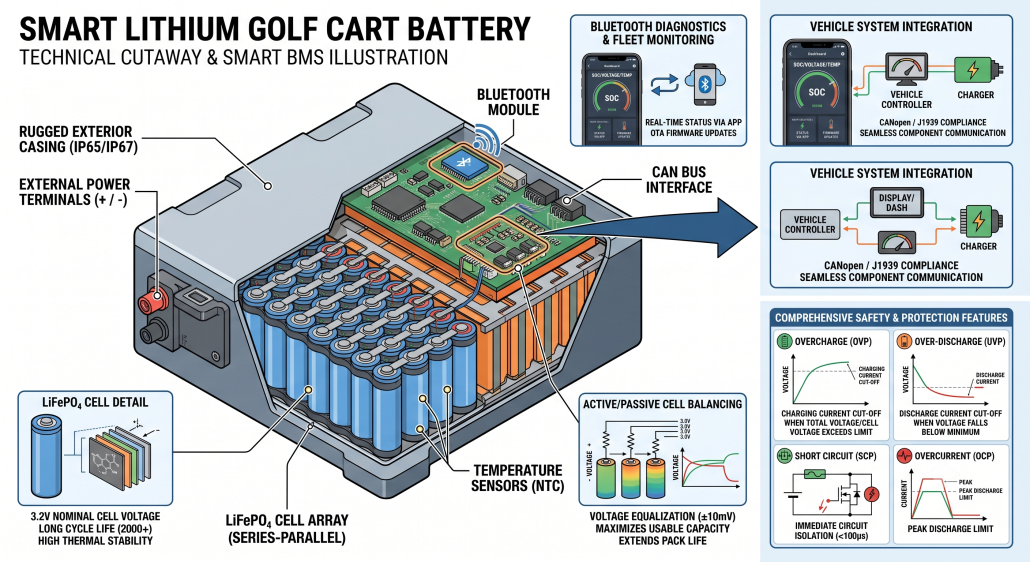
A modern BMS typically provides protection against:
- Overcharging
- Over-discharging
- Short circuits
- Overcurrent
- High temperatures
- Low temperatures
- Cell imbalance
For commercial fleet operators, many advanced lithium batteries also support:
- Bluetooth mobile monitoring
- CAN bus communication
- Real-time battery diagnostics
- Fleet telemetry integration
These capabilities simplify maintenance planning while improving operational reliability across multiple vehicles.
Always Use a Lithium-Compatible Charger
One of the most important steps during a lithium conversion is replacing the charger.
Traditional lead-acid chargers often include a desulfation mode, which periodically applies high-voltage pulses designed to remove sulfate buildup from lead-acid battery plates.
These voltage spikes are incompatible with lithium batteries and can permanently damage the Battery Management System.
Always pair a LiFePO₄ battery with a lithium-specific smart charger designed for the correct system voltage.
Fleet Procurement Resource
If you manage a golf course, resort, municipality, university campus, or industrial vehicle fleet, upgrading to lithium can significantly reduce total operating costs by eliminating battery watering, minimizing maintenance labor, shortening charging times, and reducing vehicle downtime.
Explore our Golf Cart Battery solutions to compare drop-in GC2 replacements, high-capacity fleet batteries, CAN bus communication options, and scalable lithium systems designed for demanding commercial applications.
Frequently Asked Questions
Are lithium batteries for golf carts worth the cost?
Yes.
Although lithium batteries typically require a higher upfront investment, they provide substantially greater long-term value.
With an expected lifespan of 3,000–6,000+ charge cycles, a lithium battery can often outlast several generations of lead-acid batteries.
When reduced maintenance, lower charging costs, improved efficiency, and fewer battery replacements are considered, the total cost of ownership (TCO) is generally much lower than traditional flooded lead-acid systems.
For commercial fleets, this often translates into measurable reductions in operating expenses and vehicle downtime.
Can I leave my lithium golf cart battery plugged in all winter?
Yes—provided you are using a LiFePO₄-compatible smart charger.
Quality lithium chargers automatically switch to maintenance or standby mode once the battery reaches full charge, preventing overcharging during long-term storage.
Alternatively, because lithium batteries have an extremely low self-discharge rate, many manufacturers recommend charging the battery to approximately 50% state of charge, disconnecting it from the vehicle, and storing it in a cool, dry, temperature-controlled environment until the next season.
Always follow the battery manufacturer’s storage recommendations for optimal long-term performance.
Future-Proof Your Golf Cart with Lithium
Golf carts have evolved into versatile electric vehicles used across recreation, transportation, hospitality, and commercial operations. As their responsibilities have grown, so too have the demands placed on their power systems.
Modern lithium batteries for golf carts provide the performance, efficiency, and reliability that today’s applications require. Compared with traditional lead-acid batteries, LiFePO₄ technology delivers longer range, faster charging, consistent power output, dramatically lower maintenance, and a service life measured in thousands of charge cycles.
Whether you’re planning a simple drop-in replacement or a complete lithium golf cart battery conversion, selecting the right battery capacity, ensuring proper voltage compatibility, and pairing the system with a quality BMS and lithium charger will help maximize both performance and long-term value.
Ready to upgrade your golf cart? Contact our battery specialists to discuss drop-in GC2 lithium batteries, fleet conversion strategies, and customized LiFePO₄ solutions tailored to your vehicle and application.