
Uninterruptible Power Supply Hours: How Long Can a UPS Really Last?
The runtime of a commercial uninterruptible power supply (UPS) typically ranges from a few minutes to several hours, depending heavily on configuration, battery chemistry, and real-world load conditions. However, the concept of backup power duration is frequently misunderstood by infrastructure planners, facility managers, and procurement teams responsible for maintaining mission-critical uptime.
In reality, UPS runtime is not a static specification; it is a dynamically calculated outcome. Understanding how to accurately project these hours is essential for avoiding premature system shutdowns, unnecessary capital expenditures, or over-sizing penalties.
What Does “UPS Runtime Autonomy” Actually Mean?
At its core, backup power autonomy refers to the exact duration a UPS can sustain its connected operational load during a complete utility grid failure. It is a variable result shaped by internal conversion efficiency, active load demand, and available battery energy capacity.
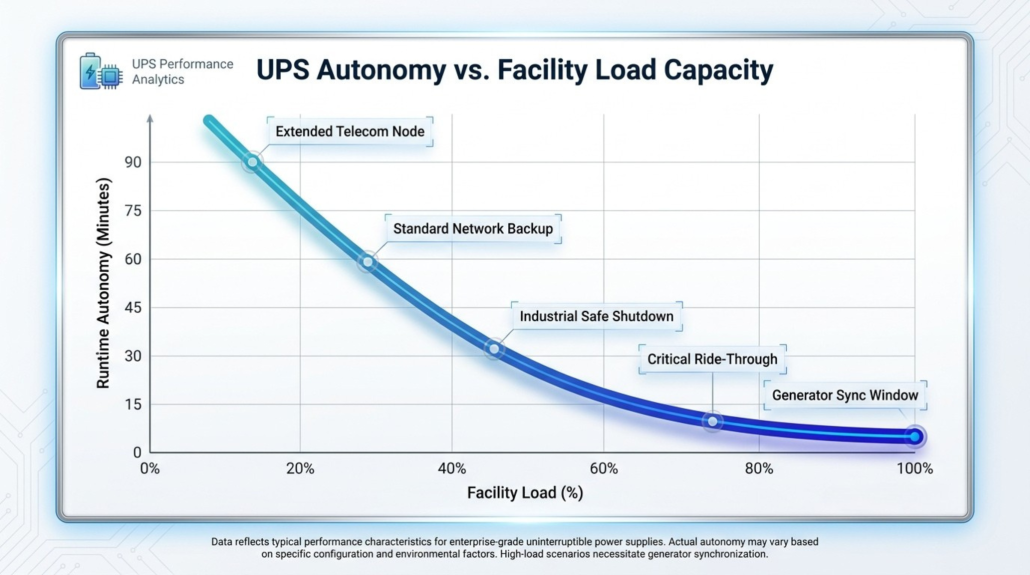
For commercial and industrial (C&I) operators, the strategic objective is rarely to achieve maximum indefinite duration. Instead, the goal is to engineer a precise runtime window aligned with specific operational protocols: executing a controlled, safe shutdown of sensitive infrastructure, or providing a seamless, transient bridge until backup diesel generators can assume the full facility load.
How to Calculate True UPS Runtime: The Engineering Formula
Basic online estimation tools often oversimplify calculations by merely dividing total battery capacity by total load. To design an enterprise-grade power architecture, engineers must utilize a comprehensive formula that accounts for real-world system losses:
Runtime (Hours) = (E * DoD * η)/(P / PF)
Where:
- E = Total battery capacity in Watt-hours ($Wh$)
- DoD= Permissible Depth of Discharge (%)
- η= Inverter efficiency (%)
- P= Connected equipment load in Watts ($W$)
- PF= Power Factor of the system
The Impact of Battery Chemistry on Calculations
When evaluating these variables, the chosen battery chemistry radically alters the performance output.
Traditional Valve-Regulated Lead-Acid (VRLA) configurations suffer from Peukert’s Law: as the discharge rate increases, the usable capacity of the battery dramatically decreases. Furthermore, VRLA systems typically limit usable DoD to 50% to prevent rapid degradation.
Conversely, modern Lithium Iron Phosphate (LFP) battery cabinets maintain a highly stable discharge curve, allowing facilities to safely exploit up to 90% to 100% DoD without structural degradation, while operating at a sustained conversion efficiency (η) exceeding 95%.
Typical Runtime Profiles Across Commercial Applications
UPS runtime expectations vary based on the specific recovery and resilience strategy of the facility:
| Application | Typical Runtime Window | Primary Operational Objective |
| Enterprise Data Centers | 5 – 15 Minutes | Provides immediate ride-through power until diesel generators synchronize. |
| Telecom & Network Hubs | 1 – 4 Hours | Sustains remote infrastructure networks during localized grid blackouts. |
| Industrial Processing Plants | 30 – 60 Minutes | Protects programmable logic controllers (PLCs) to prevent manufacturing line damage. |
| Commercial Edge IT | 10 – 20 Minutes | Allows automated cloud migration and orderly local data backup. |
Scaling System Sizes: From Distributed Nodes to Centralized Lithium Cabinets
As facility infrastructure expands, the physical space consumed by the backup system becomes a critical financial KPI.
- Distributed Edge Systems: Small commercial configurations deployed in remote closets or localized server racks. Historically reliant on small, sealed lead-acid modules, these are rapidly transitioning to compact lithium modules to reduce routine maintenance labor costs.
- Centralized Infrastructure Enclosures: Large-scale commercial facilities require highly centralized, megawatt-level protection. Deploying legacy lead-acid strings at this scale requires reinforced flooring to manage weight limits and massive HVAC allocations to control thermal runoff.
By upgrading to integrated Lithium-Ion UPS Battery Cabinets, enterprise facilities can slash their backup system footprint by up to 60%. This massive reduction in physical space directly frees up premium corporate real estate, allowing data centers to scale up revenue-generating server racks rather than housing heavy batteries.
Why High-Availability Data Centers Favor Managed Transition Over Extended Runtime
A common industry misconception is that data centers require hours of standalone battery runtime. In practice, relying exclusively on batteries for extended periods introduces massive capital inefficiencies and spatial burdens.
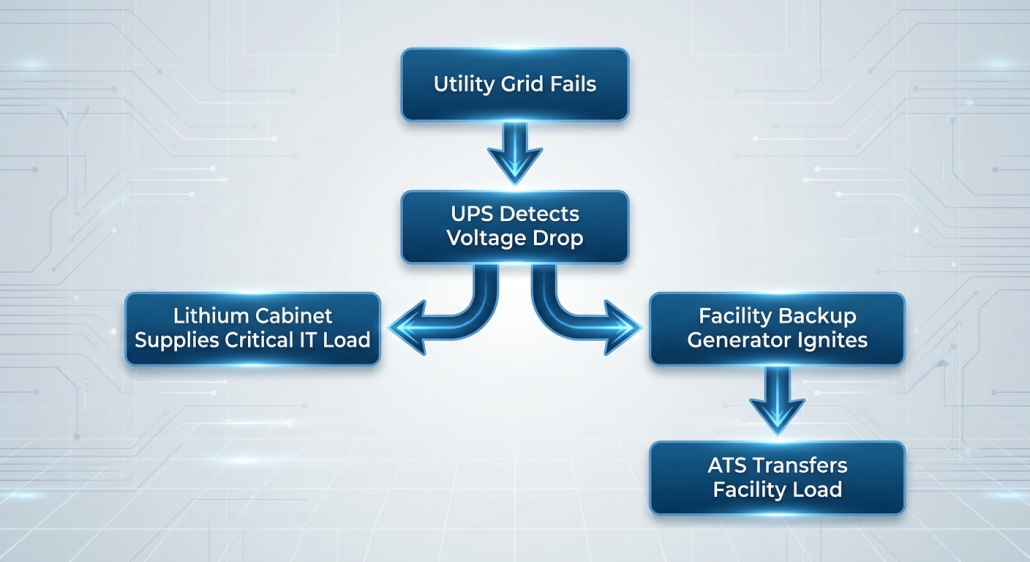
Modern facilities utilize a strictly layered power architecture. The lithium UPS cabinet acts as the ultra-fast, zero-millisecond shield that handles the initial shock of grid instability. Within seconds of a power disruption, automated control links signal the facility’s backup generators to turn over. Once the generators achieve steady-state synchronization, the automatic transfer switch (ATS) transitions the main facility load over, returning the UPS to standby charging mode.
Overcoming System Vulnerabilities Through Proactive Design
Relying purely on theoretical performance ratings listed on a data sheet often leads to unexpected site failures during real-world utility drops. To protect the integrity of your backup timeline, engineering workflows must account for real-world environmental impacts:
- Thermal Management Overhead: High ambient temperatures accelerate chemical degradation within power cells. While lithium chemistries exhibit significantly higher thermal tolerance than legacy lead-acid, designing optimized cabinet ventilation remains vital for sustaining optimal runtime longevity.
- Advanced Smart BMS Integration: Modern systems utilize smart, automated Battery Management Systems (BMS) that monitor cell voltage and internal impedance in real-time. This eliminates the risk of an unmonitored cell failing in series and unexpectedly compromising the entire runtime chain during a critical power event.
To review your facility’s current power architecture and optimize your space efficiency with high-density infrastructure, explore our high-availability network power backup solutions or contact our US engineering application team for a detailed runtime analysis and system sizing consultation.