How to Choose the Right Lithium Battery for Freezer Forklifts in Cold Storage Environments
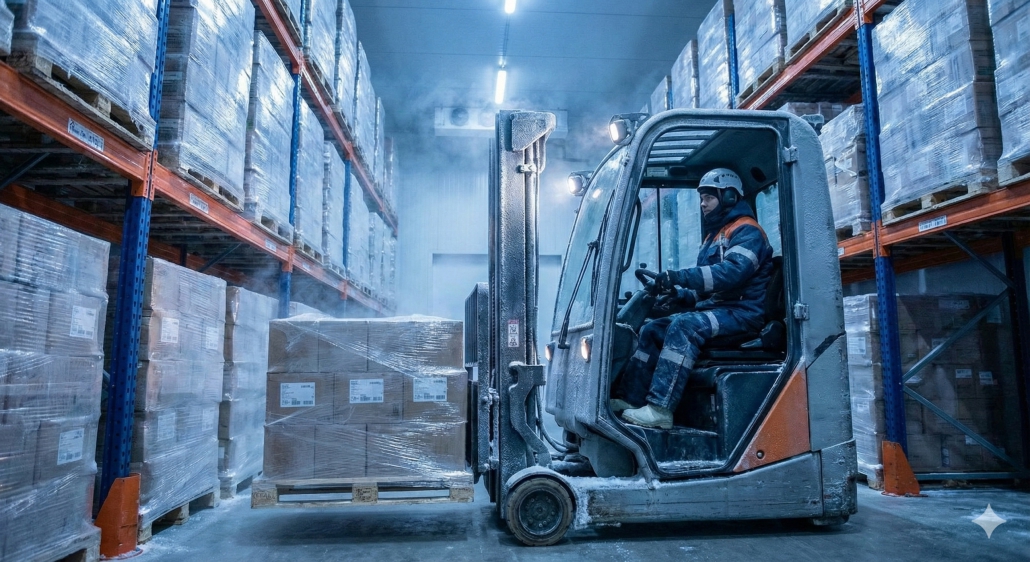
Modern cold storage and warehousing facilities operate around the clock, moving thousands of pallets every day while maintaining strict temperature control. Whether handling frozen food, pharmaceuticals, or temperature-sensitive chemicals, material handling equipment must remain productive despite operating in one of the harshest industrial environments.
Unfortunately, traditional lead-acid forklift batteries were never designed for prolonged sub-zero operation. As temperatures fall, battery capacity drops rapidly, charging efficiency declines, and operators are forced to perform frequent battery swaps that interrupt productivity and increase operating costs.
Today, many warehouse operators are replacing conventional battery systems with battery lithium forklift cold storage solutions. Built around Lithium Iron Phosphate (LiFePO₄) technology, intelligent Battery Management Systems (BMS), and optional thermal management, these batteries deliver consistent power, rapid opportunity charging, and maintenance-free operation even in demanding freezer environments.
The Quick Answer
A specialized battery lithium forklift cold storage system combines a fully sealed LiFePO₄ battery with an intelligent Battery Management System (BMS) to deliver reliable performance in extreme temperatures. Unlike traditional lead-acid batteries that experience significant capacity loss in freezer applications, modern lithium batteries operate effectively from -20°C to 60°C, feature optional thermal management for ultra-cold environments, achieve up to 95% energy conversion efficiency, and support opportunity charging that maximizes fleet uptime across cold storage and warehousing operations.
Wide Temperature Tolerance: Engineered for -20°C Operation
Temperature is one of the biggest factors affecting forklift battery performance.
As ambient temperatures fall below freezing, traditional lead-acid batteries experience increased internal resistance. This causes voltage to drop more quickly under load, reducing available runtime and making forklifts feel sluggish during acceleration and lifting operations.
For warehouses operating multiple shifts, the result is lower productivity and more frequent battery replacements throughout the day.
Why Lead-Acid Struggles in Freezer Applications
Inside freezer environments, conventional batteries often experience:
- Significant capacity loss
- Reduced lifting performance
- Longer charging times
- Increased battery change frequency
- Higher labor requirements
Many facilities compensate by purchasing additional battery sets, investing in battery changing equipment, and dedicating valuable floor space to battery rooms.
Engineered for Extreme Environments
A battery lithium forklift cold storage solution is specifically engineered to maintain stable performance across a much wider operating range.
Designed for environments from -20°C to 60°C, these batteries continue delivering reliable discharge performance where conventional technologies begin to struggle.
For facilities operating in deep-freeze environments, optional thermal management systems help maintain optimal cell temperatures by warming the battery during extremely cold conditions. This protects the battery chemistry while ensuring stable voltage, consistent lifting performance, and predictable runtime throughout the shift.
The result is higher equipment availability and fewer interruptions in demanding cold storage applications.
To guarantee drop-in compatibility across your entire cold chain fleet, these systems are built to precise voltage architectures. Our configurations include 24V systems for motorized pallet jacks, 36V and 51.2V for narrow-aisle reach trucks, and 73.6V systems for heavy-duty sit-down lifts.
Rapid Charging and 95% Energy Efficiency
Warehouse productivity depends on equipment availability.
Every minute a forklift spends sitting in a charging room instead of moving pallets reduces operational throughput.
Lithium battery technology addresses this challenge through significantly higher charging efficiency and flexible opportunity charging.
Higher Energy Conversion Efficiency
Traditional lead-acid batteries typically convert only 70–80% of incoming electrical energy into usable stored power.
The remaining energy is lost as heat during charging, increasing electricity consumption while placing additional demand on facility cooling systems.
By comparison, lithium forklift batteries achieve approximately 95% energy conversion efficiency, allowing more electricity to be converted into productive operating time.
Higher charging efficiency translates directly into lower energy costs and faster turnaround between shifts.
Opportunity Charging Eliminates Battery Swapping
One of the greatest operational advantages of lithium technology is its ability to support frequent opportunity charging.
Instead of removing depleted batteries midway through the day, operators simply recharge during natural work breaks.
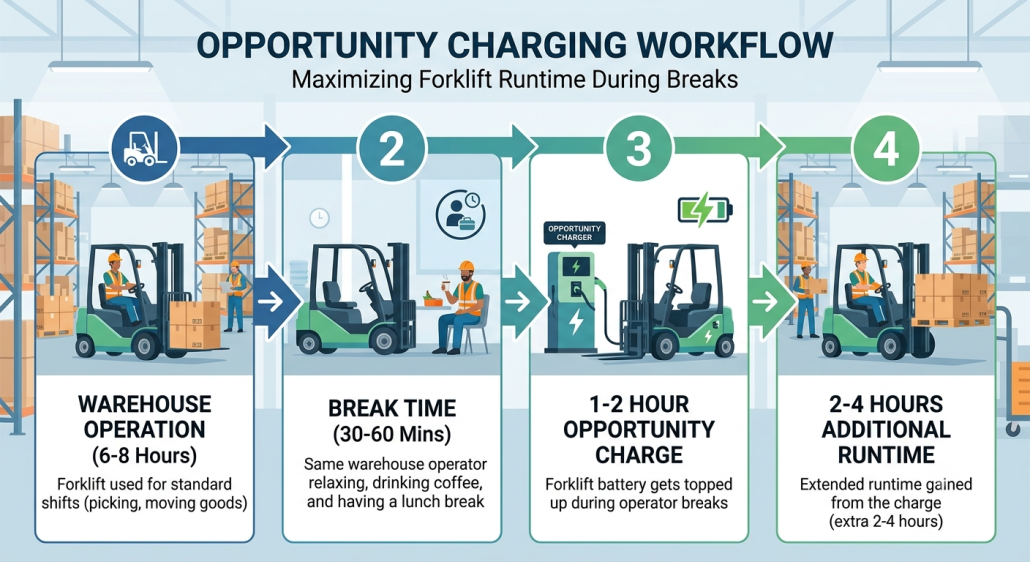
Typical operating performance includes:
- 1–2 hours of charging
- Providing 2–4 hours of continuous operation
Modern lithium systems are also capable of:
- Charging at up to 1C
- Discharging at up to 2C
This high-rate performance allows batteries to safely accept rapid charging without reducing lifespan, enabling facilities to eliminate dedicated battery changing rooms and significantly reduce equipment downtime.
The Maintenance-Free BMS Advantage
Battery maintenance represents a substantial hidden cost in warehouse operations.
Traditional flooded lead-acid batteries require ongoing attention to maintain performance and safety.
Typical maintenance tasks include:
- Weekly distilled water refilling
- Terminal cleaning
- Corrosion inspection
- Equalization charging
- Electrolyte level monitoring
These procedures consume labor hours while introducing safety risks associated with handling corrosive electrolyte.
A Fully Sealed, Maintenance-Free Design
Lithium forklift batteries eliminate these maintenance requirements entirely.
Their sealed construction means there is:
- No watering
- No acid spills
- No corrosion
- No gas emissions during charging
This not only reduces maintenance costs but also improves workplace safety and cleanliness throughout the warehouse.
Intelligent Battery Management System (BMS)
Every premium lithium battery incorporates an advanced Battery Management System (BMS) that continuously monitors battery health.
The BMS automatically manages:
- Cell voltage balancing
- Charging current
- Discharge current
- Temperature monitoring
- State of Charge (SOC)
- Fault detection
It also provides automatic protection against:
- Overcharging
- Deep discharging
- Overcurrent
- Short circuits
- Excessive temperatures
- Low-temperature operation
By continuously balancing individual cells and adjusting operating parameters in real time, the BMS maximizes battery lifespan while ensuring safe, reliable operation in demanding warehouse environments.
Lead-Acid vs. Lithium: The 2026 Logistics Data Matrix
When comparing forklift battery technologies for cold storage applications, the operational differences quickly become apparent.
| Operational Metric | Battery Lithium Forklift Cold Storage | Traditional Flooded Lead-Acid |
| Operating Temperature | -20°C to 60°C (with optional thermal management) | Capacity drops significantly in sub-zero zones |
| Energy Efficiency | 95% Energy Conversion Rate | ~70% to 80% (High heat loss during charging) |
| Opportunity Charging | Rapid 1C charge / 2C discharge (1–2 hrs charge = 2–4 hrs operation) | Limited but possible (Requires 8+ hour charge cycles) |
| Routine Maintenance | Fully sealed; Zero maintenance required | High (Requires weekly watering and equalization) |
For facilities operating multiple shifts, these advantages translate directly into improved productivity, reduced maintenance labor, and lower operating costs.
Evaluating Total Cost of Ownership (TCO) for Cold Storage and Warehousing Fleets
The purchase price of a forklift battery represents only a small portion of its lifetime operating cost.
For warehouse operators, the true financial impact comes from factors such as:
- Equipment uptime
- Labor efficiency
- Electricity consumption
- Maintenance requirements
- Battery replacement frequency
- Facility infrastructure
Although lithium batteries generally require a higher upfront investment, their maintenance-free design, rapid charging capability, superior energy efficiency, and significantly longer service life often result in a substantially lower Total Cost of Ownership (TCO) over the battery’s operational lifespan.
For high-throughput cold storage facilities, minimizing downtime often delivers far greater value than reducing initial capital expenditure.
Procurement Resource
In high-throughput cold storage and warehousing, evaluating uptime is more important than comparing purchase prices alone.
Read our 2026 Forklift Battery Guide and ROI Analysis to calculate lifecycle operating costs, maintenance savings, charging efficiency, and long-term return on investment for your specific fleet.
Conclusion
Cold storage operations demand forklift batteries that perform consistently under conditions where traditional lead-acid technology struggles. Sub-zero temperatures, multi-shift operations, and demanding productivity targets require power systems capable of delivering stable performance without frequent maintenance or battery changes.
A battery lithium forklift cold storage solution addresses these challenges through LiFePO₄ chemistry, intelligent Battery Management Systems, optional thermal management, and high-efficiency opportunity charging. Together, these technologies increase equipment availability, reduce maintenance costs, and improve overall warehouse productivity.
Whether you’re operating a regional freezer warehouse or managing a global cold-chain logistics network, upgrading to lithium can help lower your total cost of ownership while supporting safer, more efficient material handling operations.
Looking to optimize your cold storage fleet? Contact our forklift battery specialists to discuss lithium battery solutions engineered for freezer environments, multi-shift warehousing, and demanding logistics applications.