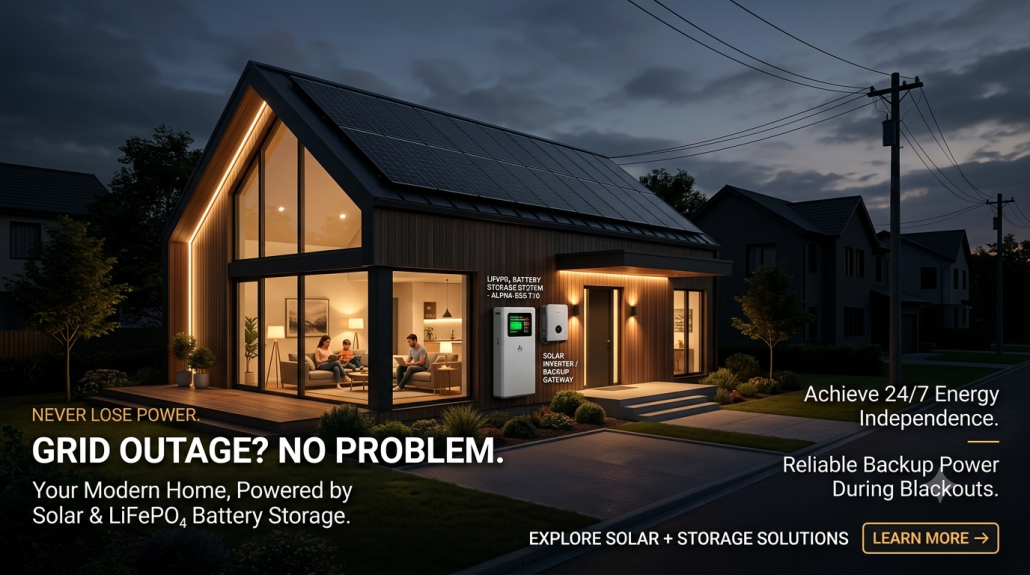
Best Solar Battery Backup System for Home: 2026 Buyer & Engineering Guide
Residential energy storage has evolved from an optional upgrade into a critical part of modern home energy systems. As electricity prices fluctuate, Time-of-Use (TOU) tariffs become more common, and extreme weather events place greater stress on utility grids, homeowners increasingly want a battery system that can do more than simply store solar energy.
The best solar battery backup system for home should maximize self-consumption, provide seamless backup power during outages, and integrate efficiently with rooftop solar generation. However, choosing the right system involves far more than comparing battery capacity alone.
This guide explains the engineering principles behind modern residential battery systems, compares key technical specifications, and helps homeowners determine which configuration best suits their energy needs.
Quick Summary: The Top Residential Solar Batteries
Quick Answer
The best solar battery backup system for most homes in 2026 uses Lithium Iron Phosphate (LiFePO₄) chemistry paired with a hybrid inverter supporting black start microgrid capability. LiFePO₄ offers superior thermal stability, 4,000–6,000+ charge cycles, and 100% usable Depth of Discharge (DoD) without the thermal runaway risks of older chemistries. When comparing systems, homeowners should evaluate usable energy (kWh), continuous and surge power output (kW), round-trip efficiency (RTE), system architecture (AC or DC coupled), and warranty coverage, rather than focusing solely on battery size.
| System Type | Battery Chemistry | Usable Capacity | Continuous Power | Round-Trip Efficiency | Best Application |
| High-Capacity Modular System | LiFePO₄ | 10–20+ kWh | 7.6–11.5 kW | ~93% | Whole-home backup and high-power appliances |
| AC-Coupled Retrofit | LiFePO₄ | Around 13.5 kWh | 5–7 kW | ~90% | Existing rooftop solar systems |
| High-Efficiency DC-Coupled | LiFePO₄ | 9–15 kWh | 7.6–10 kW | Up to ~95% | New solar + storage installations |
Five Technical Specifications Every Homeowner Should Compare
While battery advertisements often emphasize capacity, engineers evaluate several parameters together to determine overall system performance.
1. Usable Capacity (kWh)
Battery capacity, measured in kilowatt-hours (kWh), indicates how much electrical energy can be stored.
Typical residential systems include:
- 5–10 kWh for essential backup loads
- 10–15 kWh for average family homes
- 20 kWh or more for whole-home backup and high electricity consumption
More capacity generally translates into longer backup duration, but only if the inverter can deliver sufficient output power.
2. Continuous vs. Peak Power Output (kW)
Capacity (kWh) answers how long a battery can operate. Power output (kW) answers what it can operate simultaneously.
Continuous power dictates whether multiple appliances can run together. In contrast, surge (or peak) power supports the massive temporary inrush current—known as Locked Rotor Amps (LRA)—required to start heavy inductive motor loads. An air conditioner compressor can temporarily demand three to six times its running watts upon startup. If your battery cannot meet this LRA surge, the system will overload and shut down.
Engineer’s Note on C-Rating: Power output is directly tied to a battery’s C-Rating (charge/discharge rate). A 10 kWh battery with a 0.5C rating provides 5 kW of continuous power. A 10 kWh battery with a 1C rating provides 10 kW of continuous power. Always match your battery’s peak kW output to your heaviest household motors (e.g., central AC, well pumps, heat pumps).
3. Battery Chemistry: LiFePO₄ vs. NMC
Lithium battery technology has largely standardized around two chemistries.
| Characteristic | LiFePO₄ (LFP) | NMC |
| Cycle Life | 4,000–6,000+ cycles | Typically 2,000–3,000 cycles |
| Thermal Stability | Excellent; significantly lower thermal runaway risk | Higher energy density but greater thermal sensitivity |
| Usable Depth of Discharge | Up to 100% (manufacturer dependent) | Typically lower recommended DoD |
| Residential Applications | Industry standard | Less common for stationary home storage |
Because residential energy storage prioritizes safety, longevity, and daily cycling over maximum energy density, LiFePO₄ has become the preferred chemistry for most home battery systems.
4. Depth of Discharge (DoD)
Depth of Discharge indicates how much stored energy can be used before recharging.
Many modern LiFePO₄ batteries support up to 100% usable DoD, allowing homeowners to maximize available backup energy without significantly affecting battery lifespan.
This contrasts with older battery technologies that require a substantial energy reserve to prevent accelerated degradation.
5. Warranty and Cycle Life
A quality residential battery should include:
- At least a 10-year warranty
- A cycle-life rating of 4,000–6,000+ cycles
- Performance guarantees retaining approximately 70% of original capacity after the warranty period or specified energy throughput
Warranty terms vary by manufacturer, so homeowners should compare both calendar years and throughput guarantees.
6. Battery Voltage: Low-Voltage (48V) vs. High-Voltage (200V+)
Residential batteries are generally categorized by their internal voltage.
- Low-Voltage (51.2V) LFP Systems: The industry standard for modular, rack-mounted, or wall-mounted battery blocks. They are highly compatible with a wide range of third-party off-grid and hybrid inverters, making them safer to install and easier to scale over time.
- High-Voltage (200V–400V+) Systems: Typically proprietary, closed-loop systems built to pair exclusively with a specific manufacturer’s hybrid inverter. They offer slightly higher efficiency over long cable runs but lack the cross-compatibility of 48V systems.
AC Coupling vs. DC Coupling: Which Architecture Is Right?
System architecture significantly influences efficiency, installation complexity, and project cost.
DC-Coupled Systems
In DC-coupled designs, electricity generated by solar panels charges the battery directly before being converted to AC power for household use.
Advantages include:
- Higher round-trip efficiency (typically 93–97%)
- Fewer energy conversion losses
- Simpler architecture for new installations
For newly constructed solar systems, DC coupling is often the most efficient option.
AC-Coupled Systems
AC-coupled batteries connect to the home’s AC electrical panel alongside an existing solar inverter.
Although this introduces additional conversion stages and slightly lower efficiency (typically around 85–90%), AC coupling offers significant retrofit advantages.
It allows homeowners to add battery storage without replacing their existing photovoltaic system, making it the preferred solution for many established solar installations.
How Much Does a Home Solar Battery Backup System Cost?
Installed cost depends on battery size, inverter selection, electrical upgrades, labor, and regional permitting requirements.
| System Size | Typical Installed Cost (2026) | Recommended Application |
| 5–8 kWh | $8,000–$12,000 | Essential backup |
| 10–15 kWh | $12,000–$18,000 | Average family home |
| 15–20+ kWh | $18,000–$30,000+ | Whole-home backup |
Installation costs generally include:
- Hybrid inverter
- Battery modules
- Automatic Transfer Switch (ATS)
- Critical loads panel
- Balance of System (BOS)
- Wiring and commissioning
- Installation labor
- Local permitting
2026 Incentives and Financial Return: Following the expiration of legacy residential direct-purchase tax credits at the end of 2025, the financial strategy for solar batteries has shifted. In 2026, homeowners maximize their return on investment (ROI) through Third-Party Ownership (TPO or Lease structures that pass down commercial tax savings), local utility rebates, and Time-of-Use (TOU) rate arbitrage. By charging the battery with free solar energy during the day and discharging it during expensive evening peak-tariff hours, the system actively pays for itself over time.
Virtual Power Plants (VPPs) & Grid Services
A major purchasing factor in 2026 is VPP compatibility. Many utility companies and grid operators now pay homeowners ongoing annual dividends to access a small portion of their stored battery power during extreme grid-stress events. By selecting a smart-managed, VPP-ready battery system, your home transforms from a passive energy consumer into an active grid asset, creating a new, automated revenue stream that accelerates your system’s payback period.
Sizing Your Battery: Critical Loads vs. Whole-Home Backup
The appropriate battery size depends on what you want to power during a grid outage.
Critical Loads Backup (5–10 kWh)
Designed to keep essential circuits operating, including:
- Refrigerator
- Internet equipment
- Lighting
- Medical devices
- Security systems
- Selected outlets
This configuration offers an economical solution while significantly improving energy resilience.
Whole-Home Backup (15–30+ kWh)
Whole-home systems support larger electrical loads such as:
- Central HVAC systems
- Electric water heaters
- Ovens
- Well pumps
- EV charging (limited depending on system size)
These installations typically require higher continuous inverter output and larger battery banks.
Black Start Capability and Residential Microgrids
One of the defining features of advanced home energy storage systems is black start capability.
During a utility outage, compatible hybrid inverters automatically disconnect from the grid, establish a local electrical reference, and create a self-contained residential microgrid.
This allows rooftop solar panels to continue generating electricity during daylight hours while simultaneously powering household loads and recharging the battery.
Without black start functionality, many grid-tied solar systems automatically shut down during outages for utility worker safety, even if sunlight is available.
For homeowners seeking true energy independence, black start capability is an increasingly important feature.
Frequently Asked Questions
Can a home solar battery run a central air conditioner?
Yes. However, the battery system must provide sufficient continuous output and surge power to accommodate the compressor’s starting current. Installing a soft starter can further reduce startup demand and improve compatibility.
How long will a 10 kWh battery power a house?
If essential household loads average approximately 1 kW, a fully charged 10 kWh battery can provide around 10 hours of backup without solar generation.
During daylight hours, solar production can recharge the battery while simultaneously supplying household loads, extending runtime significantly depending on weather conditions and energy consumption.
What is the lifespan of an LFP solar battery?
Most quality LiFePO₄ residential batteries are designed to operate for 10–15 years and typically achieve 4,000–6,000+ charge cycles before retaining approximately 70% of their original capacity.
Related Resources
Continue exploring residential energy storage with these engineering guides:
- Solar Batteries for Home: An Engineering Guide to Residential Storage
- Battery Energy Storage System (BESS): Utility-Scale Architecture Explained
- Balcony Solar: Why Your Urban System Needs a Smart Battery Hub
Conclusion
The best solar battery backup system is not necessarily the one with the largest battery—it is the one that best matches your home’s energy profile, electrical infrastructure, and resilience goals.
For most homeowners in 2026, LiFePO₄ battery systems offer the strongest balance of safety, cycle life, efficiency, and long-term value. By comparing capacity, power output, system architecture, warranty, and installed cost together, homeowners can make informed decisions that improve energy independence and reduce lifetime operating costs.
Whether your priority is protecting essential appliances during outages or achieving whole-home backup with rooftop solar, selecting a well-engineered battery system today will provide reliable performance for many years to come.
Need help choosing a reliable home battery system? Connect with the battery specialists at LEOCH Battery, a US lithium manufacturer, to find the ideal lithium solution for your resilient power backup and specific requirements.