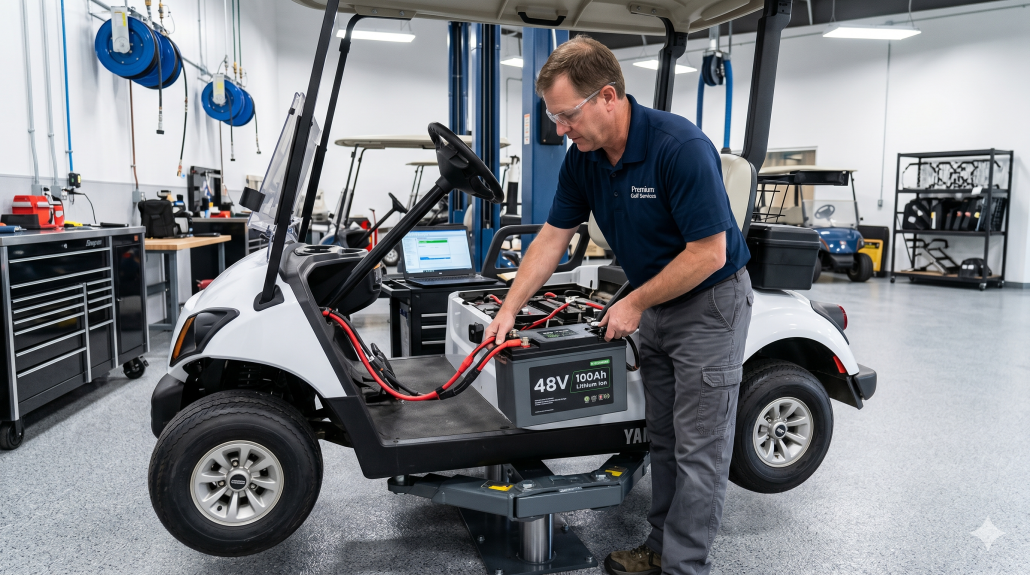
Yamaha Golf Cart Battery Replacement: How to Safely Upgrade Drive & Drive2 Models
Introduction: The Premium Japanese Engineering Standard
Few golf cart manufacturers have earned the reputation for reliability and engineering excellence that Yamaha enjoys across the United States. From the legendary G-Series to the highly successful Drive (G29) and modern Drive2 platforms, Yamaha carts are known for smooth suspensions, durable transaxles, and refined driving characteristics.
However, even the most sophisticated golf cart chassis can be limited by outdated battery technology.
As golf carts evolve into Neighborhood Electric Vehicles (NEVs), resort shuttles, utility vehicles, and personal transportation platforms, power demands continue to increase. Lifted suspensions, oversized tires, rear passenger seats, audio systems, lighting packages, and hilly terrain all place greater strain on traditional lead-acid batteries.
A properly executed Yamaha golf cart lithium upgrade can dramatically improve performance, range, charging speed, and long-term reliability. But unlike a simple battery swap, a successful lithium conversion requires understanding Yamaha’s unique electrical architecture, controller sensitivities, and battery tray configurations.
This guide explains everything you need to know before performing a Yamaha golf cart battery replacement on Drive (G29) and Drive2 models.
Yamaha Drive (G29) vs. Drive2: Understanding Your Electrical System
Before selecting a lithium battery, it’s important to identify which Yamaha platform you own.
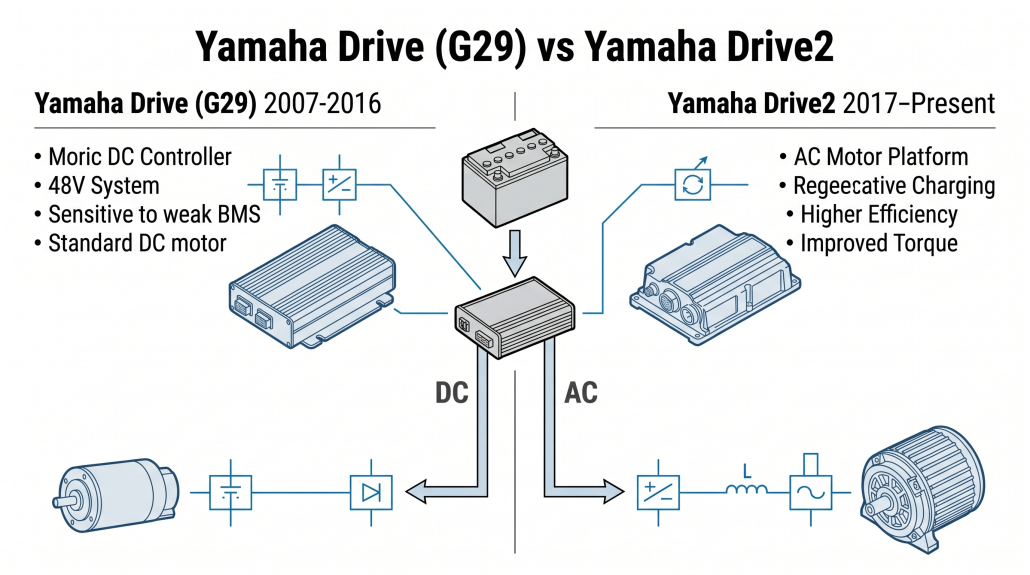
Yamaha Drive (G29) Platform (2007–2016)
The Yamaha Drive, commonly referred to as the G29, typically operates on a 48V electrical system and uses a factory Moric DC motor controller.
The Moric controller is known for efficiency and reliability, but it can also be sensitive to poor-quality lithium conversions.
The Technical Pitfall
Many budget lithium batteries use undersized Battery Management Systems (BMS) that cannot support sustained high-current demands.
When the cart encounters:
- Steep hills
- Heavy passenger loads
- Sudden acceleration
- Off-road conditions
the BMS may temporarily shut down to protect itself.
The factory Moric controller is programmed to pull quick spikes of up to 270A during initial acceleration. If you install a generic lithium battery with a cheap BMS capped at a 100A continuous output, the battery will instantly force a safety shutdown, throwing the Moric system into an unrecoverable fault state.
When this occurs, the Moric controller can register faults, trigger error codes, or completely disable vehicle operation.
For this reason, Yamaha Drive owners should only use lithium systems with sufficient continuous and peak discharge capability.
Yamaha Drive2 Platform (2017–Present)
The Drive2 introduced several advanced drivetrain options, including highly efficient AC motor systems and upgraded controller technologies.
These AC-powered platforms benefit significantly from lithium battery technology.
Why Lithium Works So Well with Drive2 AC Systems
AC motors perform best when supplied with stable voltage.
Traditional lead-acid batteries experience voltage sag under heavy load, reducing available torque and acceleration.
Lithium Iron Phosphate (LiFePO₄) batteries maintain a flat voltage curve, allowing:
- Stronger acceleration
- Better hill-climbing performance
- More consistent speed
- Improved regenerative charging efficiency
Because lithium batteries feature incredibly low internal resistance, they absorb reverse energy from Yamaha’s AC regenerative braking system far more efficiently than lead-acid, safely recycling that energy back into your range every time you lift your foot off the accelerator pedal. - Increased overall system responsiveness
For many owners, a Yamaha Drive2 lithium conversion feels like upgrading the entire drivetrain.
Will a Drop-In Lithium Battery Fit a Yamaha Golf Cart Tray?
One of the most overlooked aspects of a Yamaha golf cart lithium upgrade is battery tray design.
Unlike many Club Car and EZGO models that utilize deep, square battery compartments, Yamaha carts often feature:
- Four 12V battery configurations
- Offset battery layouts
- Model-specific tray dimensions
This creates a unique challenge during conversion.
The Challenge
A modern 48V lithium monoblock typically replaces the entire lead-acid battery bank.
After removing the original batteries, installers often discover significant unused space inside the battery tray.
Without proper support, the battery can shift during:
- Sharp turns
- Rough terrain
- Trailer transport
- Off-road operation
The Professional Solution
Use a Yamaha-specific mounting bracket, spacer kit, or hold-down system designed for lithium conversions.
Proper mounting:
- Prevents battery movement
- Protects internal connections
- Reduces vibration stress
- Improves long-term reliability
For fleet applications and commercial vehicles, secure mounting should be considered mandatory.
The Sizing Matrix: Matching Amp-Hours to Your Yamaha Profile
Selecting the correct battery capacity is just as important as choosing the right voltage.
| Yamaha Model & Setup | Recommended Voltage | Ideal Battery Capacity (Ah) | Best For |
| Stock Drive/Drive2 (Standard 2-Seater) | 48V | 50Ah – 60Ah | Fleet golf use, flat retirement communities |
| Lifted Drive2 PowerTech AC (4 to 6 Seater) | 48V | 100Ah – 105Ah | Neighborhood cruising, steep hills, heavy acceleration |
| Adventurer Sport / Commercial Utility | 48V or 72V | 150Ah+ | Extreme payloads, resort utility, facility maintenance |
Understanding Capacity
50Ah–60Ah Systems
Ideal for:
- Standard golf course operation
- Light-duty transportation
- Short-range community driving
100Ah–105Ah Systems
The most popular option for residential users.
Provides:
- Extended driving range
- Better performance on hills
- Support for rear-seat conversions
- Power for accessories and lighting
150Ah+ Systems
Recommended for:
- Commercial utility fleets
- Maintenance vehicles
- Hunting carts
- Resort transportation
- Heavy-duty payload applications
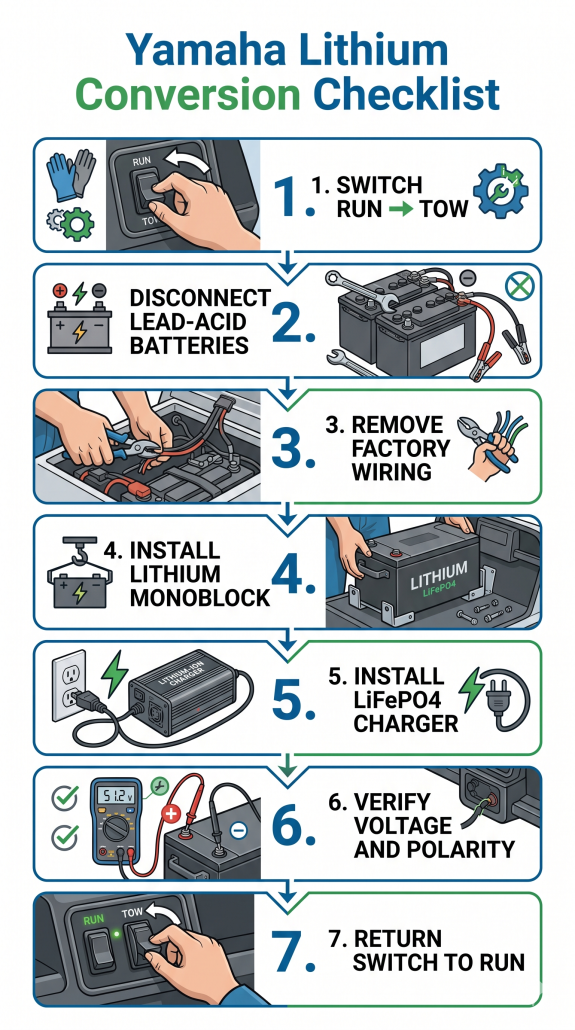
The Technical Step-by-Step Yamaha Conversion Checklist
A successful Yamaha golf cart battery replacement follows a clear process.
Step 1: Disconnect the Tow/Run Switch
Critical Safety Warning
Before touching any battery terminals, locate the Yamaha Tow/Run switch beneath the seat.
Move the switch from:
RUN → TOW
Failing to do so can damage the controller’s internal electronics and potentially destroy expensive components.
This step is especially important on Drive and Drive2 platforms.
Step 2: Remove the Existing Lead-Acid Batteries
Carefully disconnect:
- Battery cables
- Hold-down brackets
- Terminal hardware
Remove all batteries from the tray.
Many owners are surprised to discover they are removing over 300 pounds of battery weight.
Step 3: Remove Factory Interconnecting Cables
Lead-acid systems often use numerous heavy-gauge jumper cables connecting multiple batteries in series.
Remove:
- Old interconnect cables
- Corroded hardware
- Unnecessary wiring
This simplifies the electrical system and reduces potential failure points.
Step 4: Install and Secure the Lithium Monoblock
Position the lithium battery inside the tray.
Install:
- Spacer kits
- Mounting brackets
- Hold-down hardware
Verify that the battery cannot move during operation.
Step 5: Install a Dedicated LiFePO₄ Charger
This step is non-negotiable.
Lead-acid chargers use charging profiles that are incompatible with lithium batteries.
A dedicated lithium charger:
- Protects the BMS
- Prevents overcharging
- Maximizes battery lifespan
- Ensures proper cell balancing
Attempting to use the original lead-acid charger may damage the battery or significantly reduce performance.
Step 6: Verify System Voltage
Before powering up:
- Confirm all connections are secure
- Verify polarity
- Measure pack voltage
- Inspect fuse protection
Only after verification should the Tow/Run switch be returned to the RUN position.
Fleet & Residential Planning Note: Upgrading your Yamaha golf cart is only one part of a complete ownership strategy. To evaluate long-term operating costs, charging practices, battery lifespan, and climate performance, explore our cornerstone resource: The Ultimate Guide to Lithium Golf Cart Batteries.
What Are the Main Benefits of a Yamaha Golf Cart Lithium Upgrade?
The benefits extend well beyond battery lifespan.
A properly designed lithium conversion delivers:
Massive Weight Reduction
Replacing a lead-acid battery bank can eliminate over 300 pounds from the vehicle.
Benefits include:
- Improved acceleration
- Better handling
- Enhanced braking
- Reduced tire wear
- Lower suspension stress
Faster Charging
Lithium batteries can charge significantly faster than lead-acid systems, reducing downtime and increasing vehicle availability.
Consistent Performance
Unlike lead-acid batteries that gradually weaken during discharge, lithium systems maintain strong performance until nearly empty.
Zero Maintenance
No:
- Watering
- Corrosion cleanup
- Equalization charging
- Acid spills
Simply charge and drive.
Longer Lifespan
A quality LiFePO₄ battery can deliver:
- 3,500+ cycles
- 10+ years of service
This 10+ year longevity is especially critical in scorching climates like Florida, Arizona, and Texas, where high ambient garage temperatures rapidly accelerate lead-acid plate sulfation, often killing traditional batteries in less than three seasons. - Lower total cost of ownership
This often outlasts multiple lead-acid replacement cycles.
Frequently Asked Questions: Yamaha Lithium Upgrades
Can I use my factory Yamaha charger after a lithium upgrade?
No, you cannot use a factory lead-acid charger for a Yamaha lithium battery conversion. Lead-acid chargers utilize high-voltage charging profiles designed to desulfate lead plates, which can permanently damage Lithium Iron Phosphate ($\text{LiFePO}_4$) cells or cause the Battery Management System (BMS) to enter an unrecoverable safety lockout. A dedicated lithium smart charger is mandatory to ensure proper cell balancing and maximize battery lifespan.
Do I need to replace the Moric controller on my Yamaha G29 cart?
You do not need to replace the factory Moric controller when upgrading to lithium, provided you choose a high-quality battery with an advanced BMS. The Moric controller on legacy Drive (G29) models is highly sensitive to sudden current drops. To prevent the controller from registering faults or triggering error codes under load, always verify that your new lithium battery supports a high continuous output and can handle the high peak current demands of the vehicle.
Why does my Yamaha golf cart slow down on hills with lead-acid batteries?
Traditional lead-acid batteries suffer from voltage sag, meaning their voltage drops steadily as the battery discharges or encounters heavy loads like climbing steep hills. This drop in voltage directly reduces the torque and acceleration delivered by the motor. Upgrading to a lithium battery eliminates this issue entirely; its flat voltage curve ensures your Yamaha cart maintains maximum torque and consistent acceleration even at a low state of charge.
How much weight do you save by converting a Yamaha golf cart to lithium?
Performing a Yamaha golf cart lithium conversion eliminates approximately 300 pounds of dead weight from the vehicle. A standard 48V lead-acid battery bank weighs between 350 and 400 pounds, whereas a single, drop-in 48V lithium monoblock typically weighs less than 100 pounds. This massive reduction improves acceleration, braking responsiveness, and fuel or energy efficiency while lowering overall stress on the suspension.
Conclusion: Maximize Your Yamaha’s True Potential
Yamaha golf carts have earned their reputation through exceptional engineering, durability, and performance. But even the most refined Drive or Drive2 platform can only perform as well as the battery powering it.
A properly engineered Yamaha golf cart lithium upgrade unlocks the full capability of the motor system by delivering stable voltage, higher efficiency, faster charging, and dramatically reduced maintenance requirements.
Whether you’re upgrading a fleet vehicle, a neighborhood cruiser, or a commercial utility cart, choosing the right lithium system—and installing it correctly—can transform the ownership experience for years to come.
Ready to upgrade? Explore LEOCH’s US-stocked lithium golf cart battery solutions or contact our engineering team to discuss fleet conversions, dealer programs, and wholesale partnership opportunities.