
Data Center Battery System Design: Reliability and Scalability Guide
Data center battery system design is not simply a choice between VRLA and lithium-ion or a calculation of amp-hours. It is the engineering of a temporary energy source within a complete continuity architecture. The design must support the right loads, for the right duration, through normal operation, an outage, a fault, maintenance, and future expansion.
|
Quick answer Start with the protected load and the operational outcome: bridge the generator, complete an orderly shutdown, or support a defined period without another source. Then align the battery with the UPS DC bus, redundancy and maintenance strategy. Size it at specified load, temperature, end voltage, and end-of-life condition using manufacturer discharge data. Finally, engineer protection, thermal conditions, monitoring, commissioning, service, and expansion as one system. Chemistry matters, but it should follow the duty and risk requirements. |
Design the Availability Objective Before the Battery
A useful design brief states which IT and facility loads are battery-backed, their continuous and peak kW and kVA, growth allowance, allowable interruption, generator sequence, and response to a long outage. It also defines maintainability and fault tolerance. N, N+1, and 2N describe capacity and distribution objectives at a system level; they do not automatically prove that the battery layer has the same resilience.
| Decision | Engineering question | Evidence before approval |
| Load boundary | What must remain powered, and in which failure or maintenance state? | Approved load list, measured profile, one-line diagram |
| Autonomy | Is the battery bridging generator start, enabling shutdown, or carrying a defined outage? | Sequence of operations and time budget |
| Sizing basis | At what load, temperature, end voltage, age, and conversion efficiency? | Manufacturer discharge data and calculation record |
| Fault domains | What can be isolated without losing the required capacity or path? | Protection study, isolation plan, failure-mode review |
| Environment | Can the room or enclosure maintain safe product conditions? | Thermal, ventilation, structural, clearance, and site review |
| Operations | How will deterioration, alarms, maintenance, and replacement be controlled? | Monitoring points, procedures, baseline, service plan |
| Growth | How can capacity expand without unsupported mixing or new common points? | Approved expansion blocks, space, power, cooling, and commissioning plan |
1. Set Autonomy from the Operating Sequence
There is no universal data center runtime. A generator-backed site may need enough battery time for detection, generator start, stabilization, transfer, and reasonable contingency. Another facility may require workload migration or an orderly shutdown. Extended autonomy increases stored energy, space, fault current, cooling and safety demands, so more runtime is not automatically the lower-risk choice.
2. Size with Product Discharge Data and End-of-Life Conditions
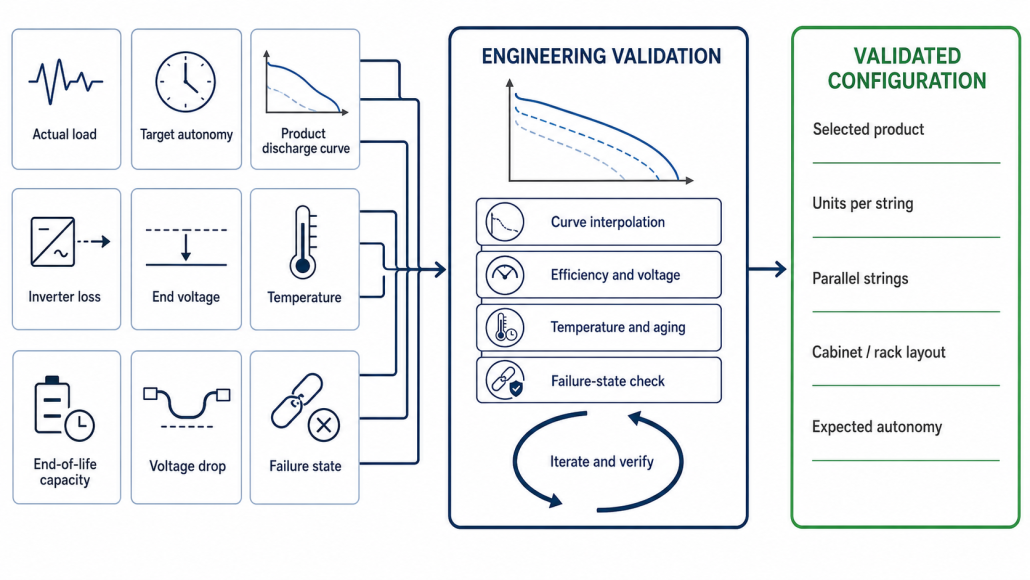
Do not size a UPS battery with nominal volts multiplied by amp-hours and divided by load watts. Available energy changes with discharge duration, end voltage, temperature, age, and battery design. The calculation should include the actual protected load, UPS conversion losses, DC-bus limits, product discharge curves, conductor and protective-device voltage drop, expected end-of-life capacity, and the required fault or maintenance state. Use the UPS and battery manufacturers’ approved sizing method, then retain the calculation assumptions for commissioning and later expansion.
3. Align Battery Fault Domains with the UPS Architecture
Centralized batteries can simplify environmental control and service access, while distributed cabinets may shorten DC runs or support phased deployment. Either approach can introduce shared rooms, buswork, controls, protection, or procedures. Map every string, cabinet, disconnect, monitoring controller, and connection to the UPS one-line. Ask what happens when each element is removed for maintenance or fails.
Parallel strings can add energy and flexibility, but they also change fault current, current sharing, isolation, monitoring, and replacement practice. Use only manufacturer-approved quantities and configurations. A spare string is not useful redundancy if a common disconnect, DC bus, room event, or unsafe maintenance step can remove all strings together.
For the wider power-path decision, use the UPS application vs. UPS topology selection guide and the online UPS vs. offline UPS comparison. Battery redundancy must be evaluated inside that complete architecture.
4. Choose Chemistry as a System Decision
| Technology | Potential design value | Engineering controls |
| VRLA | Established UPS ecosystem, familiar service practices, and often lower initial cost | More floor loading and replacement activity for a given design may be required; elevated temperature and charge conditions can accelerate aging |
| Lithium-ion | Higher energy density and potentially longer service intervals in an approved UPS package | Requires compatible charging, BMS communications, protection, enclosure and thermal design, firmware, approvals, and trained service |
The useful comparison is product-specific: power at the required duration, service conditions, footprint, weight, replacement strategy, monitoring, warranty, safety documentation, and total lifecycle cost. Lithium-ion is not a drop-in substitute for VRLA simply because nominal voltage appears similar. Likewise, VRLA remains appropriate where its approved configuration, service model, and economics fit the site.
5. Engineer Protection, Environment, and Safety Together
The design must address DC overcurrent protection and isolation, conductor ampacity and voltage drop, short-circuit contribution, working clearances, structural and seismic needs, ventilation, thermal conditions, detection, emergency procedures, and safe service access. Apply the locally adopted electrical, fire, building, and occupational requirements with the authority having jurisdiction. Standards such as IEC 62485-2 for stationary lead-acid installations and IEC 62619 for industrial lithium batteries may inform a project, but their exact scope, edition, and adoption must be verified.
6. Make Monitoring Actionable
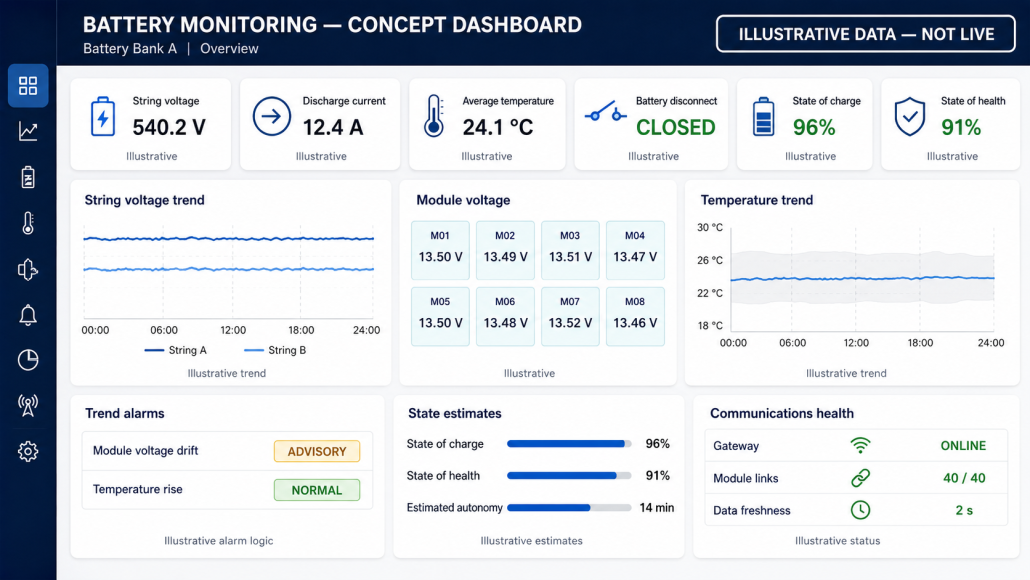
Monitoring may include string, module, or cell voltage; current; temperature; disconnect status; and resistance, conductance, or impedance trends where supported. Lithium packages also rely on BMS protection, state estimates, alarms, and communications. Define alarm thresholds, ownership, escalation, data retention, calibration, and response procedures. Networked controllers should follow the site’s access-control, segmentation, firmware, backup, and change-management practices. Monitoring does not replace inspection, functional testing, or capacity validation.
7. Design Scalability as Controlled Capacity Blocks
Reserve electrical, thermal, structural, monitoring, and service capacity before it is needed. Expansion may require new UPS modules, DC protection, cabinets, cable routes, monitoring channels, and revised settings—not just more batteries. Do not mix models, chemistries, firmware, or materially different ages unless the manufacturers explicitly approve the arrangement. Grow by documented blocks with their own isolation, commissioning, and refresh boundary.
8. Commission the System and Preserve the Baseline
Acceptance should verify installation, polarity, torque, protection settings, charger behavior, alarms, communications, bypass and generator sequence, and performance under the agreed load cases. Use factory, site, and integrated-system testing appropriate to the project. Record the initial voltage, temperature, condition, and performance data so later trends have a credible baseline. The lifecycle plan should also define inspections, capacity tests where required, spares, safe replacement, disposal or recycling, and change control.
Common Design Mistakes
Frequent errors include sizing only for day-one load, treating runtime as a fixed nameplate value, assuming extra strings remove every single point of failure, choosing chemistry before the duty, relying on a BMS alone, ignoring hot spots and maintenance states, and adding new batteries beside aged ones without approval. Another mistake is comparing purchase price while excluding floor loading, cooling, service labor, replacement outages, monitoring, spares, and disposal from lifecycle cost.
Frequently Asked Questions
How much battery runtime does a data center need?
It depends on the continuity plan. Establish the time needed for generator start and stabilization, transfer logic, retry or contingency, workload migration, or shutdown. Validate the target with a time-based sequence of operations rather than an industry rule of thumb.
Is lithium-ion always better than VRLA for data centers?
No. Lithium-ion can reduce footprint and service frequency in an approved system, while VRLA may offer a familiar ecosystem and lower initial cost. Compare the exact products at the required discharge rate, environment, service model, approvals, and lifecycle horizon.
Does adding another battery string create N+1 redundancy?
Not by itself. Confirm usable capacity after isolating a string, then test every shared DC component, protection device, room, control, and maintenance procedure against the availability objective.
Final Recommendation
Reliable data center battery system design begins with the protected load, continuity objective, and failure model. It converts those requirements into product-specific autonomy, compatible battery and UPS architecture, controlled fault domains, safe environmental conditions, actionable monitoring, verified commissioning, and planned expansion. That system view is more scalable—and more defensible—than selecting chemistry or runtime in isolation.
To evaluate a project, review LEOCH UPS battery solutions and discuss your data center battery project with the load profile, UPS and DC-bus details, target autonomy, redundancy objective, generator sequence, environment, monitoring, approvals, growth horizon, and service plan.