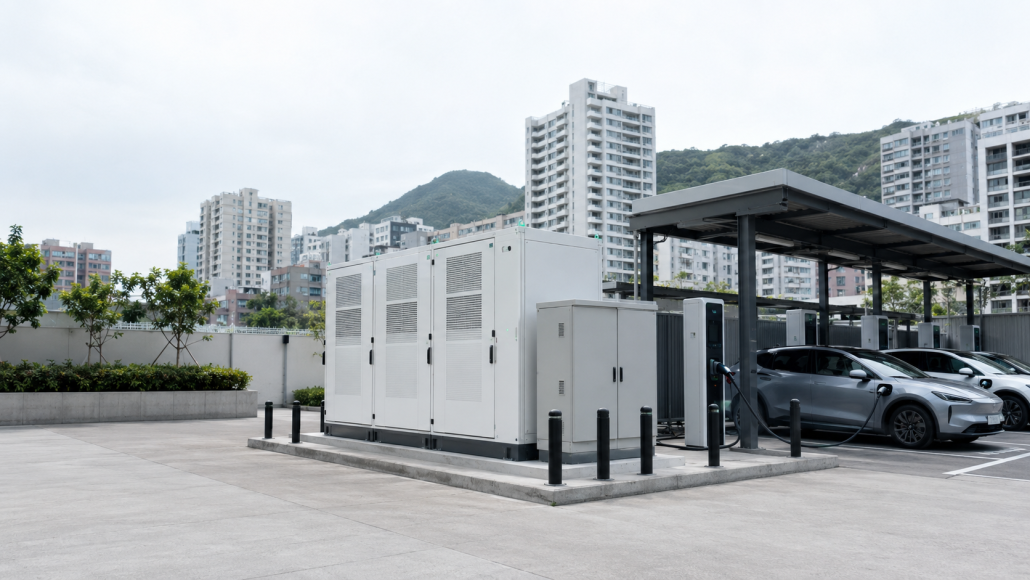
BESS Project for EV Charging in Hong Kong: A 300 kW/645 kWh Case Study
This BESS project supports an electric vehicle charging application in Hong Kong. The supplied project brief identifies a 300 kW/645 kWh configuration and an order quantity of 10 sets. A battery energy storage system can buffer charging demand by drawing energy from the grid at a controlled rate and discharging when chargers need additional power. The brief does not identify the total project rating, charger load, grid limit, battery chemistry, commissioning status, or measured savings, so those details should not be inferred.
|
Quick answer For an EV charging site, a BESS acts as a controllable energy buffer. It can reduce short demand peaks, help keep grid import within a defined limit, and shift some energy use to another time. The result depends on the charger profile, available grid power, storage power and usable energy, control strategy, efficiency, recharge window, and site constraints—not on the battery rating alone. |
Project at a Glance
| Project field | Supplied information |
| Application | Electric vehicle charging |
| Location | Hong Kong |
| Configuration | 300 kW/645 kWh; confirm whether this is per set or aggregate |
| Quantity | 10 sets |
| Evidence supplied | Project summary and equipment photographs |
| Not supplied | Charger schedule, grid limit, one-line diagram, chemistry, controls, commissioning data, savings, and customer publication approval |
Why Pair a BESS with EV Charging?
EV chargers can create high, variable loads. Several vehicles may connect at once, while charging power can rise and fall as batteries approach their limits or vehicles leave. If the charging peak is higher than the desired grid-import limit, a BESS may discharge to cover part of the difference. When demand falls, the system can recharge within the available electrical capacity.
This is often called battery-buffered charging. The battery does not create energy and does not automatically enlarge the utility connection. It changes when and how quickly energy is drawn. A workable design therefore needs enough grid energy over time to replenish the battery, plus controls that protect reserve limits and prevent repeated operation outside approved conditions. NREL describes this behind-the-meter concept as charging storage at a lower rate and discharging at higher power when needed.
Hong Kong’s updated EV roadmap reported approximately 16,500 public charging units in early 2026 and targets at least 4,000 fast chargers by 2030. The government has also recognized that energy-storage-based charging can improve operating flexibility and reduce the time or cost associated with some power-infrastructure work. These are market-level drivers, not measured outcomes for this project. See the Hong Kong Government’s updated EV roadmap and its fast-charging infrastructure response.
What 300 kW and 645 kWh Mean
The two numbers describe different design dimensions. Power, measured in kilowatts, is the rate at which the BESS can charge or discharge under specified conditions. Energy, measured in kilowatt-hours, is the stored quantity available over time. Dividing 645 kWh by 300 kW gives a nominal energy-to-power ratio of about 2.15 hours.
That ratio is not guaranteed runtime. Actual support depends on the allowable state-of-charge window, conversion efficiency, temperature, degradation, auxiliary loads, reserve settings, power limits, and simultaneous grid contribution. The 300 kW figure should not be presented as charger output unless the approved one-line diagram and equipment schedule establish that relationship.
A Typical EV Charging BESS Architecture
A project of this type normally coordinates the utility connection, metering, switchgear and protection, a power conversion system, battery enclosures, chargers, and control layers. The battery management system monitors and protects the battery. The energy management system reads site demand, charger requests, grid limits, state of charge, and alarms, then sends operating commands within the equipment’s approved limits. The final project one-line and control narrative must confirm the actual arrangement.
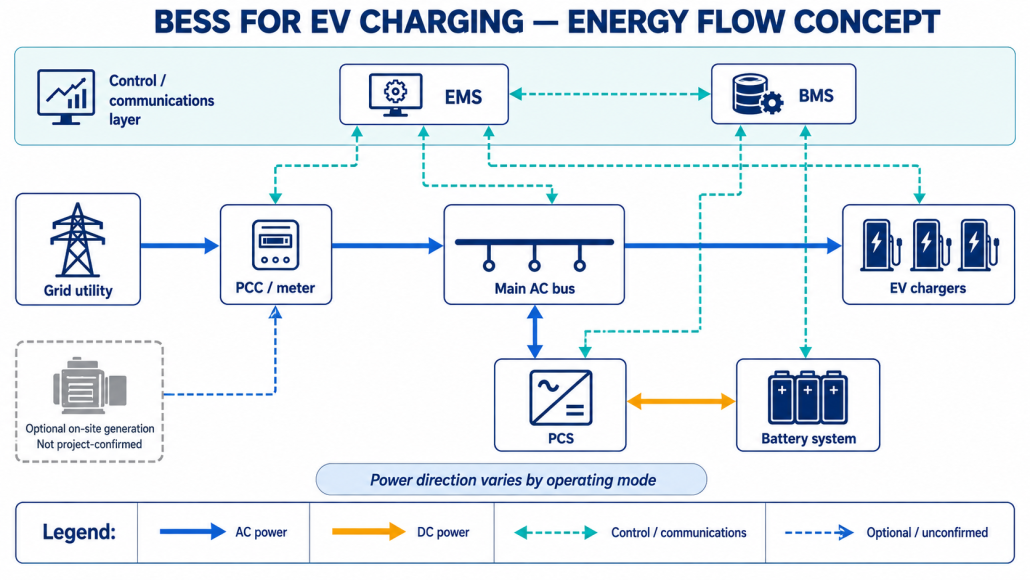
The operating objective should be explicit. Peak limiting holds grid import near a defined threshold. Load smoothing reduces rapid changes. Time shifting charges or discharges according to a tariff or operating window. Renewable self-consumption coordinates available on-site generation where present. Backup or islanded charging is a separate function that requires compatible switching, protection, grounding, controls, and an approved sequence; it should never be assumed from the presence of a BESS.
What a Ten-Set Deployment Can—and Cannot—Tell Us
Multiple sets can support phased installation, service access, physical distribution, or fault containment when the electrical and control design provides suitable boundaries. They can also introduce shared switchgear, communications, protection, cooling, or control dependencies. Quantity alone does not prove redundancy or scalability.
The supplied brief does not say whether 300 kW/645 kWh describes one set or the complete configuration. For that reason, the project total must not be calculated by multiplying the rating by ten. Before publishing an aggregate figure, confirm the bill of materials, equipment schedule, single-line diagram, and signed project record.
Safety, Reliability, and Commissioning
A dense urban charging site requires coordinated review of electrical protection, earthing, fault current, cable routes, working clearances, ingress protection, structural loading, thermal management, emergency shutdown, access control, fire strategy, and first-responder procedures. Networked controls also need defined user roles, segmentation, firmware management, alarm ownership, and fail-safe behavior.
IEC 62933-5-1 and IEC 62933-5-2 provide safety frameworks for grid-integrated energy storage, but the applicable editions, equipment scope, local adoption, and project requirements must be confirmed. In Hong Kong, qualified local professionals should verify the current Electricity (Wiring) Regulations code of practice and all applicable electrical, fire, building, utility, and approval requirements.
Commissioning should verify equipment ratings, installation, protection settings, communications, meter direction, charge and discharge control, state-of-charge limits, alarms, thermal behavior, charger response, and the defined grid-import limit. Tests should also cover loss of communications, abnormal conditions, emergency shutdown, and recovery. A credible baseline makes later performance and degradation analysis possible.
How to Prove the Project’s Value
Performance should be demonstrated with time-synchronized data rather than a marketing estimate. Useful records include grid import, BESS charge and discharge power, state of charge, charger demand and delivered energy, temperatures, alarms, curtailment, availability, and the control setpoints in effect. Interval demand and tariff data are needed to calculate peak reduction or cost savings. Carbon claims require a defined energy source, baseline, boundary, and calculation method.
Engineering Lessons from This BESS Project
The project brief supports four facts: application, location, configuration, and quantity. The engineering lesson is broader. Start with the charging profile and grid headroom, size both power and usable energy for the intended operating window, design the EMS around a measurable objective, map shared components and failure modes, and preserve commissioning data. Separating verified facts from intended functions makes the case study more useful to customers—and more reliable for search and AI answers.
Frequently Asked Questions
What is a BESS project?
A BESS project integrates batteries, power conversion, protection, controls, thermal systems, and site electrical infrastructure to store and dispatch energy for defined operating objectives. The equipment, software, installation, and operating sequence must be designed as one system.
How does a BESS support EV charging?
It can recharge when grid capacity is available and discharge when charger demand rises. This can help limit grid peaks or support charging power for a defined period, subject to the BESS rating, usable energy, efficiency, controls, and recharge opportunity.
Does 645 kWh guarantee 2.15 hours at 300 kW?
No. About 2.15 hours is the nominal energy-to-power ratio. Usable duration is lower or otherwise different when SOC limits, efficiency, temperature, degradation, auxiliary demand, reserve settings, and the operating profile are included.
What is the total capacity of the ten-set project?
The supplied brief does not define whether 300 kW/645 kWh is a per-set rating or an aggregate configuration. The total should remain unpublished until the project team confirms the rating boundary in approved technical records.
Plan the Next EV Charging BESS Project
A successful EV charging BESS project begins with a measured load profile, a clear grid constraint, and a defined control objective. From there, the battery, PCS, EMS, protection, thermal design, commissioning plan, and lifecycle strategy can be engineered around evidence instead of assumptions.
Explore LEOCH lithium battery solutions or contact the technical team to discuss an EV charging BESS project. Share the charger schedule, grid limit, connection voltage, load profile, operating objective, site conditions, required approvals, and project timeline so the conversation can begin with engineerable inputs.