Reserve Power Definition: What It Means in Battery Systems
The reserve power definition used in industrial battery systems is straightforward: reserve power is stored electrical energy kept ready to support a load when its normal power source becomes unavailable or falls outside acceptable conditions. It is commonly supplied by stationary rechargeable batteries integrated with chargers, rectifiers, uninterruptible power supplies (UPSs), protection, controls, and monitoring. Reserve power describes a duty and system role—not a specific chemistry, voltage, runtime, or certification.
|
Quick answer During normal operation, the utility or another primary source supplies the load while the charging system maintains the battery at an approved state of charge. When that source is interrupted, the battery releases stored energy to the protected load. After normal power returns, the system transfers or returns to its normal path and recharges the battery under controlled conditions. |
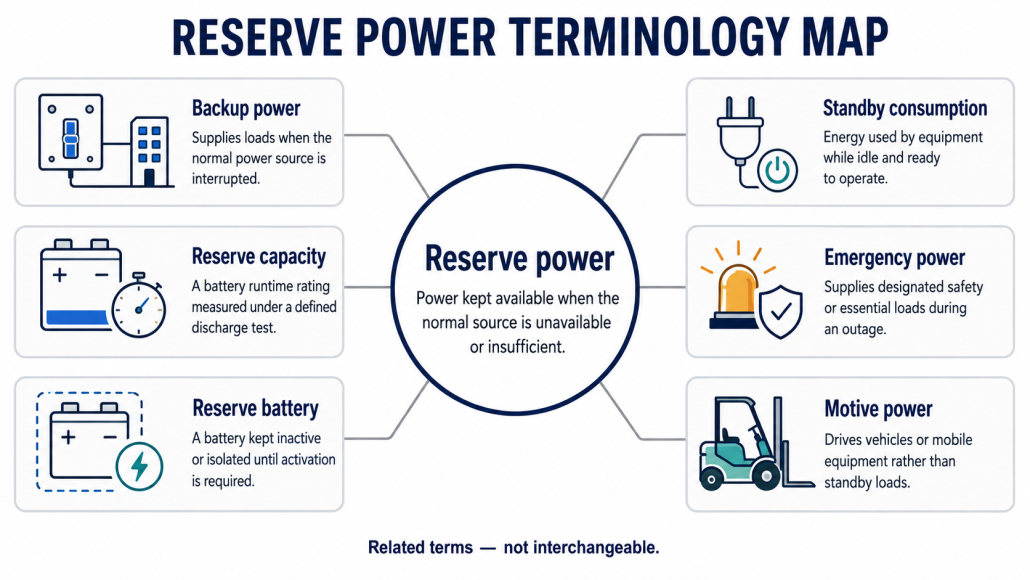
Reserve Power Terms That Should Not Be Confused
| Term | Meaning in context |
| Reserve power | A standby duty: stored energy held ready to support a load when normal supply is lost or unacceptable. |
| Backup power | The broader continuity function, which may combine batteries, UPS equipment, generators, fuel cells, switching, and controls. |
| Reserve capacity | An automotive or deep-cycle battery rating expressed in minutes under a defined discharge test; it is not the name of a stationary power category. |
| Reserve battery | A specialized battery that may remain inactive until it is activated, often for long-storage, one-time, or mission-specific use; not the same as a rechargeable reserve power battery. |
| Standby power consumption | Electricity a device consumes while idle or waiting for a command; unrelated to the energy held for backup. |
| Motive power | Battery power used to move equipment or vehicles, normally with repeated cycling rather than long standby periods. |
| Emergency power | A code- or regulation-defined safety function in some projects; a battery becomes part of such a system only when the complete design and installation meet applicable requirements. |
These distinctions matter because search results often collapse different industries into one answer. Battery Council International defines reserve capacity as a timed 25-amp discharge rating under specified conditions. By contrast, manufacturers use reserve power for stationary applications such as telecommunications, utilities, UPS systems, and other critical stored-energy duties. A remotely activated reserve battery is a separate technical category altogether.
How a Reserve Power System Works
A reserve power installation is more than a row of batteries. In a DC plant, a rectifier may normally power the DC bus and maintain the battery, allowing the battery to support the bus when AC input is lost. In a UPS, the battery supplies DC energy to an inverter or DC link when required. The exact transfer behavior depends on UPS topology, operating mode, controls, and bypass state; zero transfer time should never be assumed for every system.
The operating sequence must also cover recovery. When normal power returns, the charger must support the load while restoring battery charge within approved current, voltage, temperature, and time limits. Generator capacity, charger walk-in, inrush, load steps, and recharge demand can all affect the wider continuity design.
Where Is Reserve Power Used?
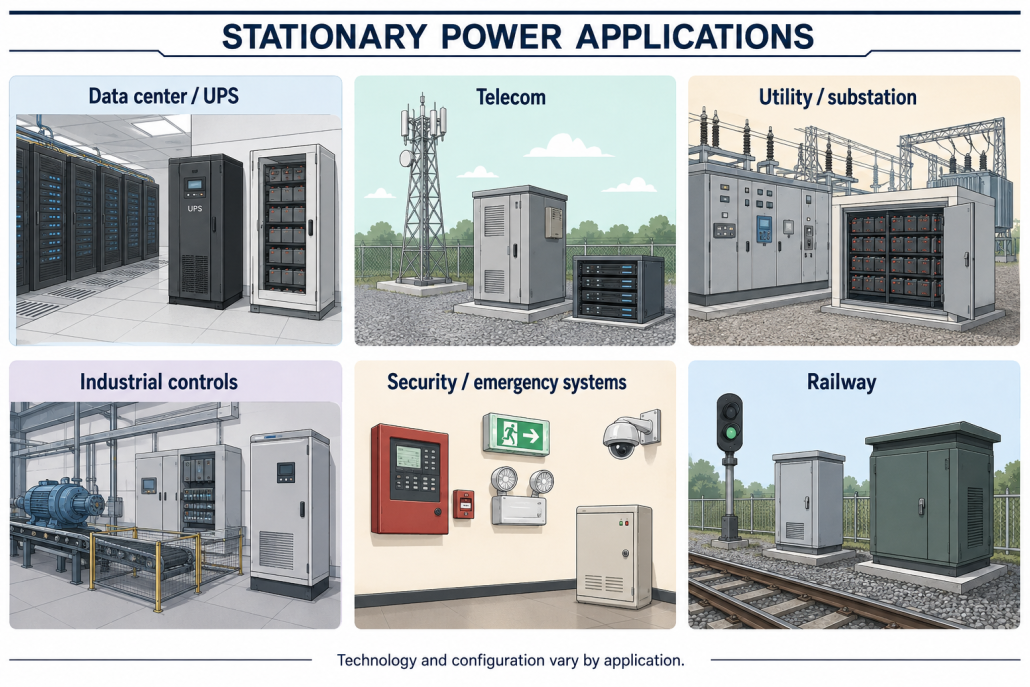
Reserve power supports loads where an unexpected interruption could stop communications, processing, protection, control, safety functions, or essential services. Common applications include telecom networks and remote sites, data centers and enterprise UPS systems, utility substations and switchgear controls, railway signaling, industrial process controls, security and access systems, emergency lighting, and selected medical or public-infrastructure systems.
The duty varies sharply. A data center battery may bridge generator start or enable an orderly shutdown. A telecom DC system may require longer autonomy at a remote site. A substation battery may support protection, control, and breaker operations. Those differences determine the discharge rate, end voltage, redundancy, maintenance strategy, and testing plan.
LEOCH groups many of these applications within its network power battery portfolio, including products designed for UPS and communication backup duties. Exact suitability must be confirmed from the application requirements and approved product data.
Reserve Power vs. Energy Storage
Traditional reserve power batteries spend much of their life ready for an interruption and may operate on float or charge-maintenance service. An energy storage system may cycle routinely for peak shaving, renewable integration, load shifting, or grid services. The categories can overlap: a modern system may perform daily energy functions while preserving a backup reserve. That hybrid duty requires an explicit state-of-charge policy, cycle-life model, control priority, recharge plan, and failure response. A product designed only for infrequent standby service should not be assigned a heavy cycling duty without manufacturer approval.
Which Battery Technologies Are Used?
Vented lead-acid (VLA) batteries offer established stationary-power service and maintainable flooded cells, but require suitable rooms, ventilation, electrolyte maintenance, and trained service. Valve-regulated lead-acid (VRLA) designs, including AGM and gel types, reduce routine watering requirements and can simplify installation, yet still require temperature control, inspection, testing, and replacement planning.
Lithium-ion systems can provide compact footprints, high power, integrated monitoring, and cycling capability in approved designs. They also require a compatible charger or UPS, battery management system (BMS), communications, protection, thermal and enclosure design, firmware control, safety documentation, and trained service. Nickel-cadmium remains relevant in some demanding stationary environments, subject to project-specific maintenance, environmental, and regulatory requirements. There is no universally best chemistry; the correct choice follows the duty, site, risk, and lifecycle plan.
How Is a Reserve Power Battery Sized?
Begin with the protected load, system voltage, and required autonomy. Then define the worst credible operating or maintenance state, conversion losses, end voltage, temperature, cable voltage drop, battery aging or end-of-life capacity, growth allowance, and recharge window. The final configuration should be selected with the exact manufacturer’s constant-current or constant-power discharge data at the required duration.
Nominal voltage multiplied by amp-hours is useful only as a rough energy description. It does not prove delivered runtime, especially for short, high-rate UPS duty. Amp-hour capacity is stated at a particular discharge rate, end voltage, and temperature; changing those conditions changes the available performance. The sizing record should preserve every assumption so commissioning and later replacement can be checked against the original design basis.
Safety, Monitoring, and Maintenance
A reliable reserve power system coordinates electrical protection, isolation, fault current, conductors, grounding, working clearances, structural loading, ventilation, thermal conditions, fire strategy, signage, emergency procedures, and safe service access. Apply the adopted electrical, fire, building, occupational, utility, and application-specific requirements for the project location.
Monitoring may include string, module, or cell voltage; current; temperature; disconnect status; trend alarms; state estimates; and communications health. Define thresholds, ownership, escalation, data retention, cybersecurity, and response procedures. Monitoring does not replace inspections, functional testing, baseline measurements, or capacity verification. IEC 62485-2 addresses safety for stationary secondary battery installations, while IEEE 1188 covers maintenance, testing, and replacement practices for stationary VRLA batteries; exact scope and adopted editions must be verified.
Frequently Asked Questions
Is reserve power the same as backup power?
They overlap, but backup power is broader. A reserve battery may supply stored energy inside a UPS or DC plant, while the complete backup system can also include rectifiers, inverters, generators, switching, distribution, controls, and protection.
How long should reserve power last?
There is no universal duration. Runtime follows the operating objective: bridge generator start, maintain a telecom site, complete an orderly shutdown, or support a code-defined function. Size it from the load profile, sequence of operations, product discharge data, environment, aging, losses, and contingency.
What is the difference between reserve power and motive power?
Reserve power is held ready for a stationary load during a supply problem. Motive power operates vehicles or mobile equipment and is usually designed for repeated cycling, traction demands, and a different charging and service pattern.
Can lithium batteries replace lead-acid reserve batteries?
Sometimes, but not as a nominal-voltage swap. Confirm compatibility with the charger, UPS or rectifier, DC limits, BMS communications, protection, enclosure, thermal design, approvals, operating sequence, service capability, and warranty.
Final Definition
Reserve power is stored energy kept ready to maintain a defined load when its normal source is interrupted or unacceptable. A dependable design connects that duty to the complete system: load, autonomy, battery performance, charger or UPS, protection, environment, monitoring, testing, maintenance, and recovery.
Explore LEOCH network power and lithium battery solutions, or contact the technical team to discuss a reserve power requirement. Share the application, load, voltage, autonomy, environment, existing equipment, redundancy objective, approvals, service expectations, and project schedule so the selection can begin with engineerable inputs.