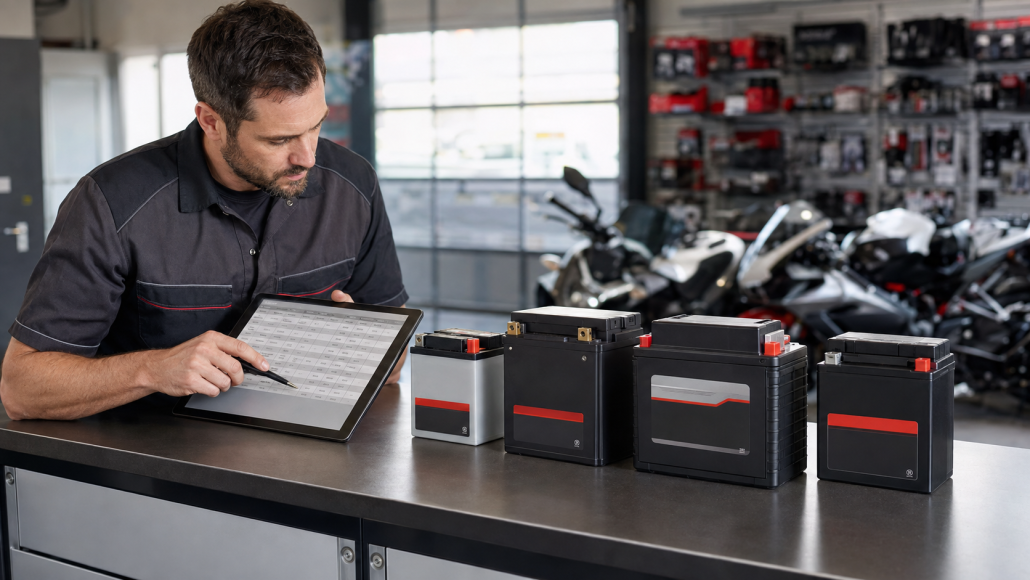
Lithium-Ion Motorcycle Batteries: A Smarter Inventory Guide for Dealers
A profitable lithium-ion motorcycle battery inventory is not simply a smaller collection of SKUs. It is a validated range that covers the motorcycles your customers actually service, fits physically and electrically, survives local operating conditions, and gives staff a clear installation and warranty process. Dealers should rationalize stock only after confirming fitment, charging-system compatibility, demand, supplier evidence, and return risk.
For repair shops and parts distributors, that distinction matters. A battery that starts several models successfully can improve inventory turns. A battery treated as universally compatible can create misfit installations, charging problems, avoidable returns, and lost trust. The goal is controlled coverage, not aggressive SKU reduction.
What Does ‘Lithium-Ion Motorcycle Battery’ Mean?
Lithium-ion is a broad family of rechargeable chemistries. In motorcycle starting applications, the product is often based on lithium iron phosphate, written as LiFePO4 or LFP, because it can deliver high starting current in a compact package. Dealers should still verify the chemistry on the product label and datasheet rather than assuming every battery described as lithium uses the same cells, BMS, charging limits, or cold-temperature behavior.
A 12.8V LiFePO4 starter battery is also different from the large traction battery that powers an electric motorcycle. This guide concerns low-voltage starter batteries for internal-combustion motorcycles and other compatible powersports equipment. Keeping that entity distinction explicit helps customers, technicians, and search systems understand the product category.
Why Dealers Add Lithium Without Abandoning AGM
Lithium starter batteries can create a strong premium option where lower weight, compact size, low self-discharge, and high starting output are valued. Performance riders, race customers, custom builders, seasonal riders who follow the correct storage procedure, and owners replacing a compatible premium battery may accept a higher upfront price for those benefits.
That does not make lithium the automatic answer for every customer. AGM remains a practical choice where the purchase price is decisive, the motorcycle or accessory package has not been validated for lithium, the charging system is unstable, the customer uses an incompatible lead-acid recovery charger, or proven cold-weather and reserve-capacity behavior matters more than weight. A credible dealer portfolio usually gives staff a defensible choice rather than forcing one chemistry into every replacement.
For a chemistry-level comparison, see lead-acid vs lithium motorcycle batteries. Use the selected product’s approved datasheet—not a generic comparison—to make the final recommendation.
Lithium Motorcycle Battery Fitment: Validate Six Factors
A cross-reference chart is the starting point, not the entire decision. Before assigning a lithium battery to a motorcycle, validate the replacement against the battery manufacturer’s application guide and the vehicle requirements. At minimum, the review should cover the following six factors.
| Fitment check | What to verify | Dealer action |
| Physical envelope | Case length, width, height, hold-down and clearance | Confirm the installed battery cannot move, contact the seat or bodywork, or strain cables; use only approved spacers |
| Polarity and terminals | Positive/negative orientation, terminal type and cable reach | Prevent crossed leads, improvised cable routing, loose hardware and terminal stress |
| Starting output | CCA, CA/PCA or manufacturer cranking rating and test method | Match the engine and application using comparable ratings; do not equate Ah with starting current |
| Usable capacity | Actual Ah, accessory loads and reserve needs | Account for alarms, trackers, ECUs, heated accessories and storage parasitic draw |
| Charging system | Regulator-rectifier condition and battery charging limits | Measure the vehicle charging system and follow the selected battery’s approved voltage and charger guidance |
| Environment and use | Temperature, vibration, storage pattern and duty cycle | Choose a product whose documented operating, charging and storage limits suit the customer |
Dealer fitment principle
Never present a lithium battery as plug-and-play solely because its nominal voltage or case size looks similar. Use a current fitment map, an approved cross-reference, and the product manual. Record any permitted spacer or alternate-terminal configuration as part of the SKU, not as an informal workshop workaround.
How to Reduce Motorcycle Battery SKUs Without Losing Coverage
Start with twelve months of counter sales, workshop jobs, lost sales, special orders, and warranty returns. Group demand by OE reference, case family, terminal position, starting requirement, season, and customer type. This reveals which applications drive real volume and which SKUs occupy cash without protecting service levels.
Next, build validated fitment clusters. Some lithium designs can cover more than one conventional case size through approved spacers, multi-position terminals, or a documented cross-reference. That can reduce duplicate stock, but only within the manufacturer’s tested application range. A BMS does not create this coverage; physical design and verified application data do.
Use an ABC approach for value and velocity, then add variability. High-volume, predictable references deserve local safety stock. Low-volume, erratic references may be better served by a fast supplier replenishment agreement. Review the map before peak riding season and after major model-year or product-range changes. The result should improve first-time fit and inventory turns together, not one at the expense of the other.
A BMS Protects the Battery; It Is Not a Universal Diagnostic Tool
A battery management system may monitor cell voltage, temperature, current, or state conditions and may protect against events such as over-charge, over-discharge, short circuit, or excessive cranking. The exact functions vary by model. Some starter batteries have no customer-facing data connection; others may offer an indicator, Bluetooth, CAN, a wake-up feature, or a service-specific interface.
For technicians, this means a zero terminal-voltage reading can sometimes indicate that a protection circuit has disconnected the cells, but it can also have other causes. Do not promise instant diagnosis from the BMS or skip the manufacturer’s recovery and test procedure. Stock records should identify each model’s protection functions, approved wake-up method, charger limits, and warranty exclusions.
Prevent Returns at Receiving, Installation and Handover
Return prevention begins before the battery reaches the workshop. At receiving, confirm the model, chemistry, manufacturing or lot identifier, terminal condition, label, required transport documents, and the product-specific acceptance check. Rotate inventory by the manufacturer’s storage guidance, isolate damaged units, protect terminals against short circuit, and keep lithium batteries away from incompatible chargers and uncontrolled temperature extremes.
At installation, verify the motorcycle’s charging system and parasitic draw when the service history or symptoms justify it. Secure the case with the approved hardware, torque terminals to specification, prevent cable strain, and record the installed model and date. A professional replacement workflow should also explain the customer’s charger, storage, cold-weather, accessory-load, and warranty responsibilities.
Use the professional motorcycle battery replacement workflow for procedural detail, and link seasonal customers to the guide on how to store a motorcycle battery during winter.
Choose Chargers by Approved Profile, Not by Connector
A charger that physically connects is not automatically suitable. Some lead-acid chargers use desulfation, repair, recondition, or recovery modes that raise voltage in ways a lithium starter battery manufacturer may prohibit. Other automatic chargers may be acceptable within a product’s documented limits. Use the selected battery’s manual as the controlling source and train staff to identify incompatible modes.
Cold charging also requires product-specific care. Some LiFePO4 battery manufacturers prohibit charging below freezing unless the battery design includes suitable protection or heating. Avoid universal statements such as ‘lithium works better in all cold weather.’ Separate cold starting from cold charging, and publish only the temperature limits approved for the exact LEOCH series.
For general charging context, see the motorcycle battery charging guide. The product manual must override generic guidance when limits differ.
Measure Profit per Fitment, Not Margin per Unit
A higher selling price can make lithium attractive, but gross margin per unit does not show whether the inventory is healthy. Dealers should track gross-margin dollars per SKU-month, inventory turns, aged stock, first-time-fit rate, fitment-related return rate, warranty return rate, special-order lead time, and the share of recommended upgrades that customers accept.
Evaluate landed cost rather than invoice price alone. Freight classification, packaging, documentation, staff training, charger requirements, warranty processing, replacements, and technical support all affect the real cost to serve. A lithium SKU is profitable when it creates validated coverage and customer value with controlled after-sales risk—not merely because it carries a premium price.
What to Require From a Lithium Motorcycle Battery Supplier
A professional supplier should make the technical and operational decision easier. Ask for a current fitment or cross-reference matrix; a datasheet with clearly defined starting, capacity, charging, temperature, and storage conditions; lot traceability; packaging and labeling information; warranty terms; failure-analysis support; and clear rules for damaged, returned, or end-of-life batteries.
For U.S. transport, lithium cells and batteries offered for transportation must meet the applicable UN Manual of Tests and Criteria, subsection 38.3 requirements. PHMSA states that manufacturers and subsequent distributors must make the standardized test summary available for covered batteries. UN 38.3 is transport testing, not a blanket product-safety certification. Ask for the test summary tied to the exact battery design, along with the current safety data and shipping information required for your role and mode of transport.
Avoid broad compliance language such as ‘UL, UN38.3 and CE certified’ unless every term is accurate for the exact model and target market. Name the applicable standard, report, listing, marking, or regulation and provide the corresponding evidence. Certification transparency protects the dealer as much as the manufacturer.
Turn Technical Confidence Into a Better Customer Conversation
The most effective lithium upgrade conversation begins with the motorcycle and use case, not a chemistry slogan. Ask how the customer rides, stores the bike, powers accessories, maintains the battery, and values weight or premium performance. Then explain the verified fit, the realistic advantages, the charging and temperature requirements, the warranty, and why AGM may still be the better choice if the application is not suitable.
This approach may reduce impulsive upgrades, but it improves recommendation quality. Over time, fewer fitment errors and clearer expectations can be more valuable than a one-time upsell because they protect reviews, warranty workload, repeat business, and the credibility of the service desk.
Frequently Asked Questions
Are lithium-ion motorcycle batteries compatible with every motorcycle?
No. Compatibility depends on the approved application, physical dimensions, hold-down, polarity, terminals, starting requirement, actual capacity, vehicle charging system, accessories, temperature, and intended use. Follow the vehicle and battery manufacturer’s current fitment guidance.
Can one lithium battery replace several lead-acid battery SKUs?
Sometimes. A manufacturer may validate one lithium model for several conventional references by using an appropriate case design, terminal configuration, or approved spacers. Use only documented cross-references; a BMS alone does not make a battery universally compatible.
Do lithium motorcycle batteries need a special charger?
They need a charger or vehicle charging system that stays within the battery manufacturer’s approved profile. Some automatic lead-acid chargers may be permitted, while desulfation or repair modes may be prohibited. Check the exact battery manual rather than relying on the connector or charger label alone.
Are lithium motorcycle batteries better in cold weather?
There is no universal answer. Starting performance and charging restrictions vary by battery design and temperature. Some batteries may need a manufacturer-approved warming procedure before a cold start, and charging below freezing may be restricted. Compare approved data for the exact replacement.
What documents should a dealer or distributor request?
Request the product datasheet, current fitment map, installation and charging instructions, warranty terms, lot-traceability process, safety and shipping information, and the UN 38.3 test summary for the exact battery design when applicable. Ask for evidence behind any claimed listing or certification.
Build Coverage You Can Defend
Lithium-ion motorcycle batteries can strengthen a dealer’s premium range, simplify selected fitment families, and create a more valuable technical conversation. The commercial advantage comes from disciplined execution: stock the applications your market buys, validate every fitment, control charging and storage practices, measure returns and turns, and require evidence from the supplier.
If your dealership, repair network, or distribution business is reviewing its motorcycle battery range, send LEOCH your top-selling OE battery references or motorcycle models, target region, and estimated annual volume. The next step should be a documented fitment and inventory review—not a generic promise that one battery fits everything.