
Lead-Acid vs. Lithium Motorcycle Batteries: Which Is Best for Your Bike?
|
Quick answer Choose a lead-acid motorcycle battery—often AGM—when you want lower upfront cost, broad OEM-style compatibility, familiar charging behavior, and dependable reserve capacity. Choose a compatible LiFePO4 battery when reducing weight, limiting self-discharge, or gaining strong cranking performance for its size is worth the higher initial cost. Neither chemistry is best until case size, terminals, CCA, actual capacity, charging voltage, temperature limits, and charger compatibility are verified. |
The lead-acid-versus-lithium question sounds simple, but the wrong comparison can produce the wrong battery. Lead-acid is a family that includes conventional flooded, absorbent glass mat (AGM), and gel designs. Lithium is another family; most modern motorcycle starter batteries marketed as lithium use lithium iron phosphate, usually written LiFePO4 or LFP.
That distinction matters because a sealed AGM battery does not require the same routine service as a conventional flooded battery, and a LiFePO4 pack is not defined by weight alone. The correct replacement must fit securely, connect without stressed cables, meet the engine’s starting demand, provide enough reserve energy for the motorcycle’s loads, and operate within the charging system’s limits.
The most reliable decision order is therefore fit first, electrical requirements second, chemistry third. Once those fundamentals are correct, the trade-offs in weight, storage, maintenance, cold-weather behavior, and cost become meaningful.
What Counts as a Lead-Acid Motorcycle Battery?
A lead-acid battery stores and releases energy through reactions involving lead-based plates and sulfuric-acid electrolyte. The familiar conventional motorcycle battery has liquid electrolyte, filler caps, and a vent. It is normally installed upright and may require periodic electrolyte-level checks with distilled water, according to the product manual.
AGM is also lead-acid. Its electrolyte is absorbed in glass-mat separators, and the case is valve regulated rather than routinely opened for water service. AGM designs are common in powersports applications because they can combine high starting output, vibration resistance, broad fitment coverage, and low maintenance after correct activation. Gel is another valve-regulated lead-acid design, but it is less common as a high-output motorcycle starter battery and requires a charge profile approved for the specific product.
The phrase ‘lead-acid is high-maintenance’ is therefore only accurate when it refers to serviceable flooded designs. A sealed AGM replacement can be a convenient, OEM-style choice for many modern motorcycles.
What Is a Lithium Motorcycle Battery?
A motorcycle lithium starter battery is usually a LiFePO4 pack built to deliver a short, high-current burst for engine starting. LiFePO4 has a different voltage curve, mass, charge acceptance, and low-temperature behavior from lead-acid. It can offer substantial weight savings and low self-discharge, which makes it attractive for performance motorcycles and seasonal equipment.
Many premium lithium starter batteries include a Battery Management System. Depending on the model, the BMS may balance cells and protect against overcharge, over-discharge, short circuit, excessive current, or temperature. Those functions are not universal, and their thresholds vary. A battery described only as ‘BMS-equipped’ is not automatically compatible with every motorcycle or charger.
Lithium starter batteries also deserve a careful capacity check. A small pack can produce high cranking current while storing less energy than the lead-acid battery it replaces. That may be acceptable for a lightweight competition bike, but less appropriate when an alarm, tracker, clock, ECU memory, heated equipment, or engine-off accessories create meaningful reserve demand.
Lead-Acid vs. Lithium Motorcycle Battery Comparison
The table describes typical selection tendencies, not guaranteed model specifications. Compare the actual approved replacement pair and use the battery manufacturer’s data as the controlling source.
| Factor | Lead-acid | LiFePO4 | Decision rule |
| Upfront cost | Usually lower; conventional batteries are often the least expensive | Usually higher | Lead-acid for budget; compare total value by actual product and service life |
| Weight | Heavier because of lead plates and electrolyte | Often substantially lighter for the approved replacement | LiFePO4 when weight reduction has real value |
| Starting output | AGM can provide strong, familiar starting performance | Can provide high cranking output relative to size and mass | Compare approved CCA or equivalent rating methods and temperature |
| Reserve energy | Often offers more familiar Ah and reserve for a given OEM fitment | A compact starter pack may have lower actual Ah despite high cranking | Verify actual Ah/Wh and engine-off or parasitic loads |
| Cold conditions | Performance still falls with temperature, but behavior and service practice are well established | Cranking and charge acceptance change in the cold; procedures and limits are product-specific | Use verified low-temperature data, not a chemistry slogan |
| Charging | Needs the correct flooded, AGM, or gel profile | Needs a LiFePO4-compatible voltage/profile; avoid unapproved desulfation pulses | The battery manual and charging-system test decide |
| Storage | Self-discharge and sulfation make state-of-charge management important | Low self-discharge can help, but parasitic loads can still flatten the pack | Lithium can suit seasonal use with proper isolation or maintenance |
| Routine care | Flooded may need electrolyte checks; AGM and gel do not need water top-ups | No electrolyte service, but state of charge, terminals, and charger still matter | Both require correct storage and charging |
| Service life | Strongly affected by heat, undercharge, vibration, storage, and product quality | Can be long in a compatible system, but heat, over-discharge, and charging errors still matter | Compare warranty and documented model-level evidence |
| Compatibility | Often the least disruptive route when it matches the original specification | Must be approved for fit, charging system, current, temperature, and reserve needs | Lead-acid for a straightforward OEM-style replacement; lithium for a verified upgrade |
Weight and Handling: Lithium’s Clearest Advantage
Weight is the most consistent reason to consider LiFePO4. A lithium starter battery can be much lighter than an approved lead-acid replacement, but the exact saving depends on the two models being compared. Publish a percentage only when engineering has verified both product weights and the fitment is genuinely equivalent.
The riding benefit also depends on the motorcycle. Removing several pounds may be meaningful on a race or lightweight sport bike, where every component is scrutinized. On a large touring motorcycle, that difference may be less important than reserve capacity, accessory loads, broad service availability, or cold-weather margin. The battery should not be downsized so aggressively that low mass creates an electrical reliability problem.
Starting Power, CCA, and Actual Capacity
Cold Cranking Amps, or CCA, describe starting output under a defined low-temperature test. It is not the same as CA, MCA, peak cranking amps, a short pulse-current rating, or a proprietary lead-acid-equivalent number. Compare like-for-like methods whenever possible and use the motorcycle’s OEM requirement or an approved application guide as the minimum.
Amp-hours describe capacity under stated test conditions, not how quickly the starter will turn. A battery can have impressive cranking output and still store relatively little energy. For motorcycles with alarms, trackers, keyless systems, clocks, ECU memory, auxiliary lighting, heated equipment, or other parasitic loads, actual Ah and watt-hours deserve as much attention as CCA.
This is where many lithium upgrades go wrong: the buyer matches nominal voltage and a marketing cranking number but ignores reserve energy. If the bike sits for long periods with a continuous load, low self-discharge inside the cells will not prevent the external electronics from depleting the battery.
Charging-System and Charger Compatibility
Before changing chemistry, test the motorcycle’s charging voltage across the operating RPM range and compare it with the battery manufacturer’s permitted limits. A failing or unstable regulator-rectifier can damage either chemistry, and an older or modified electrical system should be corrected before a lithium conversion.
The external charger must support the battery chemistry and capacity. A smart charger with separate lead-acid and lithium modes can be suitable when its manual and the battery manual agree. Do not use a lead-acid desulfation, repair, recondition, recovery, or equalization mode on LiFePO4 unless the battery manufacturer explicitly permits it; some of those modes can raise voltage in ways the lithium pack or BMS does not accept.
A BMS is a protection system, not a substitute for a compatible charging source. Confirm how the pack behaves after an over-discharge disconnect and whether the charger can safely wake or recover it according to the manufacturer. Never bypass protective circuitry to force a deeply discharged battery to accept charge.
Cold-Weather Starting: Use Model Data, Not a Universal Rule
Cold temperatures reduce available battery output and increase the engine’s starting demand. Lead-acid behavior is familiar to most technicians, but an undersized or partially charged AGM battery can still struggle. Select enough verified starting margin for the engine, oil viscosity, and temperatures in which the motorcycle actually operates.
LiFePO4 behaves differently in the cold. Some manufacturers describe applying a brief electrical load before starting so internal resistance produces heat; other products use different procedures or BMS controls. Charge acceptance can also be restricted at low cell temperatures. Follow the exact battery manual instead of treating a headlight-warming routine or a single temperature threshold as universal advice.
For regular winter use, the best choice is the approved model with documented low-temperature performance and adequate capacity—not a generic winner based on chemistry alone.
Maintenance, Storage, and Service Life
A serviceable flooded battery requires the most hands-on care: electrolyte level, venting, terminals, state of charge, and storage charging all matter. AGM and gel eliminate routine water service, but they still need clean connections and the correct state of charge. Leaving a lead-acid battery undercharged encourages sulfation and can permanently reduce capacity.
LiFePO4 has low self-discharge and no electrolyte to top up, but it is not maintenance-free in the literal sense. The motorcycle’s parasitic loads, storage temperature, state of charge, terminal security, charger compatibility, and BMS behavior still require attention. A lithium battery left connected to an alarm or tracker can be deeply discharged even when the cells themselves self-discharge slowly.
Avoid universal lifespan promises for both chemistries. Heat, vibration, charging voltage, depth of discharge, storage state of charge, starting frequency, product design, and installation quality can change real service life dramatically. Compare the warranty and model-level test conditions, then consider the cost of the exact products—not a generic five- or eight-year assumption.
Which Motorcycle Battery Should You Choose?
| Use case | Likely starting point | What decides |
| Daily commuter | AGM is often the practical default; LiFePO4 can work when fully compatible | Starting reliability, fitment, parasitic loads, climate, and replacement availability |
| Touring / accessories | AGM or a LiFePO4 model with verified actual capacity and support | Reserve energy, heated gear, electronics, remote service, and charging stability |
| Sport / track | LiFePO4 often has the strongest value proposition | Verified fitment, cranking current, secure mounting, BMS, and weight saving |
| Cold-weather use | Approved AGM is often the straightforward choice; lithium requires verified low-temperature data | Starting margin, charging restrictions, storage, and manufacturer procedure |
| Seasonal motorcycle | Either can work; LiFePO4 benefits from low self-discharge | Parasitic drain, storage state of charge, and correct maintainer |
| Vintage / custom | Stay with the specified lead-acid design unless the electrical system is tested and the conversion approved | 6V versus 12V, polarity, regulator stability, venting, tray, terminals, and grounding |
| Lowest purchase price | Conventional flooded or AGM lead-acid | Required maintenance, warranty, fitment, and local availability |
The table gives a starting point, not permission to ignore the application guide. A motorcycle that originally uses AGM should not receive a smaller lithium pack simply because the case can be padded into the tray. The replacement must remain secure and meet the electrical requirements under real operating conditions.
Seven Checks Before Replacing Lead-Acid With Lithium
- Confirm the motorcycle’s make, model, year, engine, system voltage, and original battery reference in the owner’s manual or a current application guide.
- Measure the tray and verify case dimensions, positive and negative terminal orientation, terminal type, cable reach, hold-down, seat clearance, approved mounting position, and any venting requirement.
- Match the required CCA or approved starting rating, and compare equivalent test methods rather than mixing CCA with short pulse-current claims.
- Check actual Ah and watt-hours against alarms, trackers, clocks, ECU memory, heated equipment, accessories, and expected storage time.
- Measure charging voltage across the operating RPM range and confirm it stays inside the new battery manufacturer’s permitted limits.
- Use a chemistry-compatible charger or maintainer and disable any unapproved desulfation, repair, recondition, recovery, or equalization mode.
- Verify BMS functions, current and temperature limits, over-discharge recovery, warranty, transport documentation, and local technical support for the exact model.
Frequently Asked Questions
Can I replace an AGM motorcycle battery with lithium?
Yes, when a LiFePO4 battery is approved for the exact motorcycle and all physical and electrical checks pass. Match the tray, terminals, hold-down, starting requirement, actual capacity, charging-voltage range, temperature limits, and charger. AGM is already a lead-acid technology, so this is a chemistry conversion rather than a simple brand change.
Does a lithium motorcycle battery need a special charger?
Use a charger whose lithium mode is compatible with the exact LiFePO4 battery and its capacity. Do not assume a conventional lead-acid charger’s automatic or desulfation mode is safe. Check both manuals, including permitted charge voltage and recovery behavior.
Is a lithium motorcycle battery better in cold weather?
Not universally. Cold affects both chemistries, but their behavior differs. Some LiFePO4 products use a manufacturer-approved warming procedure and may restrict charging at low cell temperature. Compare documented model-level performance and follow the battery manual.
How much lighter is a lithium motorcycle battery?
The saving can be substantial, but there is no honest universal percentage. Compare the published weight of the approved lead-acid battery with the approved LiFePO4 replacement. Do not compare a full-capacity touring battery with an undersized racing pack.
Which lasts longer: lead-acid or lithium?
A compatible, well-managed LiFePO4 battery can deliver long service life, but chemistry alone does not determine it. Heat, vibration, charge voltage, discharge depth, storage, parasitic drain, product design, and installation all matter. Compare warranty and documented test conditions for the exact products.
What is the best motorcycle battery for most riders?
For many riders, an approved AGM battery remains the straightforward replacement because it balances starting performance, reserve capacity, low maintenance, and familiar compatibility. A LiFePO4 battery is often the better upgrade when weight and storage behavior matter enough to justify the price and every compatibility check passes.
The Best Chemistry Is the One Your Motorcycle Can Use Correctly
Lead-acid and lithium motorcycle batteries solve different problems. Lead-acid—especially AGM—offers lower initial cost, established fitment, familiar charging behavior, and practical reserve capacity. LiFePO4 offers a compelling reduction in mass, low self-discharge, and strong cranking output relative to size when the application is correct.
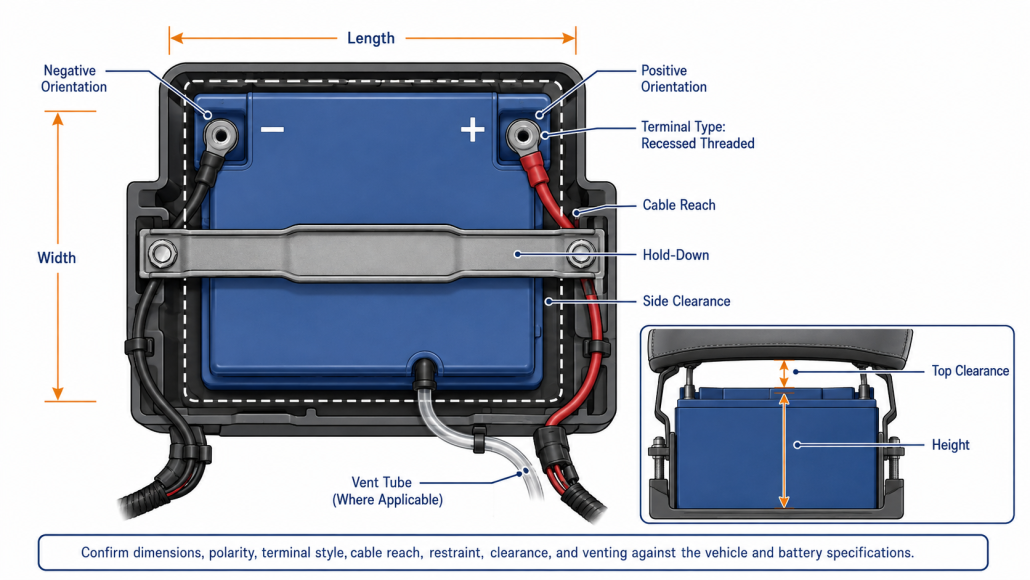
Do not choose by chemistry, CCA, or weight alone. Confirm physical fit, terminals, starting output, actual energy, charging voltage, charger mode, temperature limits, BMS behavior, warranty, and support. Fit first. Electrical requirements second. Chemistry third.
|
Compare LEOCH motorcycle battery options Riders and service professionals can compare verified motorcycle starter-battery specifications and approved fitments. Dealers, distributors, OEM teams, and private-label partners can request cross-reference data, technical documentation, and supply support. |
Compare Motorcycle Battery Specifications | Request Fitment or Wholesale Support