48 Volt Golf Cart Battery: Features, Range, and the Lithium Upgrade Guide
The 48-volt golf cart has become the benchmark for modern golf courses, resorts, gated communities, campuses, and utility fleets. Compared with older 36V systems, it delivers stronger acceleration, improved hill-climbing ability, and longer driving range while maintaining excellent energy efficiency.
At the same time, battery technology has evolved rapidly. Traditional lead-acid battery banks are increasingly being replaced by lightweight Lithium Iron Phosphate (LiFePO₄) batteries that offer longer service life, faster charging, and virtually maintenance-free operation.
Whether you’re managing an entire fleet or upgrading your personal golf cart, understanding how a 48V golf cart battery works—and what benefits lithium technology provides—can help you maximize performance while lowering long-term operating costs.
The Quick Answer
The 48 volt golf cart battery has become the industry standard because it provides an excellent balance of torque, efficiency, and driving range. Traditional 48V systems typically use six heavy lead-acid batteries wired in series, while a modern 48V 100Ah Lithium Iron Phosphate (LiFePO₄) battery can replace the entire battery bank with a single drop-in module. The result is significantly lower weight, faster charging, reduced maintenance, and up to 35 miles of driving range under typical operating conditions.
How Many Batteries Are in a 48V Golf Cart?
One of the most common questions buyers ask is:
How many batteries are in a 48V golf cart?
The answer depends entirely on the battery technology being used.
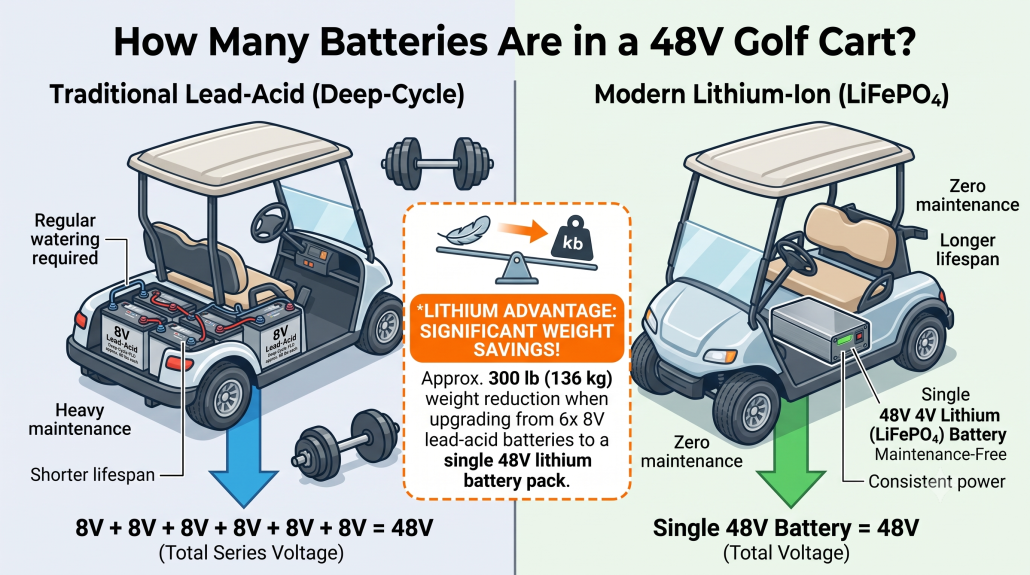
Traditional Lead-Acid Configuration
Conventional 48V golf cart batteries achieve the required system voltage by wiring multiple batteries together in series.
The two most common configurations are:
- Six 8-volt batteries(6 × 8V = 48V)
- Four 12-volt batteries(4 × 12V = 48V)
Because every battery contributes to the overall system voltage, the entire bank performs only as well as its weakest battery. As the batteries age at different rates, balancing and maintenance become increasingly important.
These battery banks are also extremely heavy, often adding 300–400 pounds (136–181 kg) to the vehicle.
Modern Lithium Configuration
A lithium upgrade dramatically simplifies the electrical system.
Instead of connecting multiple lead-acid batteries, a single 48V lithium battery module provides the entire system voltage in one compact unit.
Higher-capacity applications may use two or more modules connected in parallel to increase amp-hour capacity while maintaining the same 48V operating voltage.
Compared with traditional lead-acid batteries, a lithium system offers several important advantages:
- Reduces vehicle weight by approximately 300 pounds
- Eliminates battery balancing between multiple lead-acid units
- Simplifies installation
- Requires virtually no maintenance
- Improves acceleration and energy efficiency
For fleet operators, this weight reduction can also decrease tire wear and reduce overall energy consumption.
Range & Speed: What to Expect from a 48V Cart
When evaluating a 48V golf cart, two performance questions usually come first:
- How fast does a 48 volt golf cart go?
- How far can it travel on a single charge?
The answers depend on controller settings, terrain, passenger weight, tire size, and battery capacity.
How Fast Does a 48 Volt Golf Cart Go?
Most factory-configured 48V golf carts are electronically governed to approximately 12–15 mph (19–24 km/h) to comply with golf course safety requirements.
However, many neighborhood electric vehicles (NEVs) and customized carts feature upgraded controllers and motors.
With properly matched components, a 48V system can comfortably achieve 25 mph (40 km/h) or more, making it suitable for private communities, resorts, and light utility applications where regulations permit.
How Far Can It Go?
Driving range is determined primarily by battery capacity and average power consumption.
A typical golf cart cruising on relatively level terrain draws approximately 50–60 amps during normal operation.
Using a 48V 100Ah lithium battery, the available energy is:
48V × 100Ah = 4,800Wh (4.8kWh)
Under typical operating conditions, this energy capacity translates to approximately:
- 30–35 miles (48–56 km)of driving range
- Approximately two to three rounds of 18-hole golf
- A full day of operation for many commercial fleets
Actual range varies depending on:
- Terrain
- Passenger load
- Tire size
- Driving style
- Ambient temperature
- Vehicle modifications
Because lithium batteries maintain more stable voltage during discharge, performance remains consistent throughout the driving cycle rather than gradually declining as with lead-acid batteries.
36V vs. 48V vs. 72V: The Efficiency Matrix
Choosing the right system voltage depends on the intended application.
| System Voltage | Best Application | Electrical Efficiency | Average Top Speed (Stock) |
| 36V System | Older, flat-terrain carts | Low (High amperage causes heat) | 12 – 14 mph |
| 48V System | Modern fleets, lifted community carts | High (Optimized torque and lower current) | 15 – 19 mph |
| 72V System | Heavy-duty utility, extreme off-road | Very High (Requires specialized controllers) | 25+ mph |
For most recreational and commercial users, the 48V platform offers the best balance between performance, efficiency, acquisition cost, and component availability.
Upgrading a 36V Cart to 48V: The Technical Checklist
Many owners of older golf carts consider converting from 36V to 48V to improve performance.
While the upgrade is certainly possible, simply replacing the batteries is not sufficient.
Several electrical components must also be compatible with the higher operating voltage.
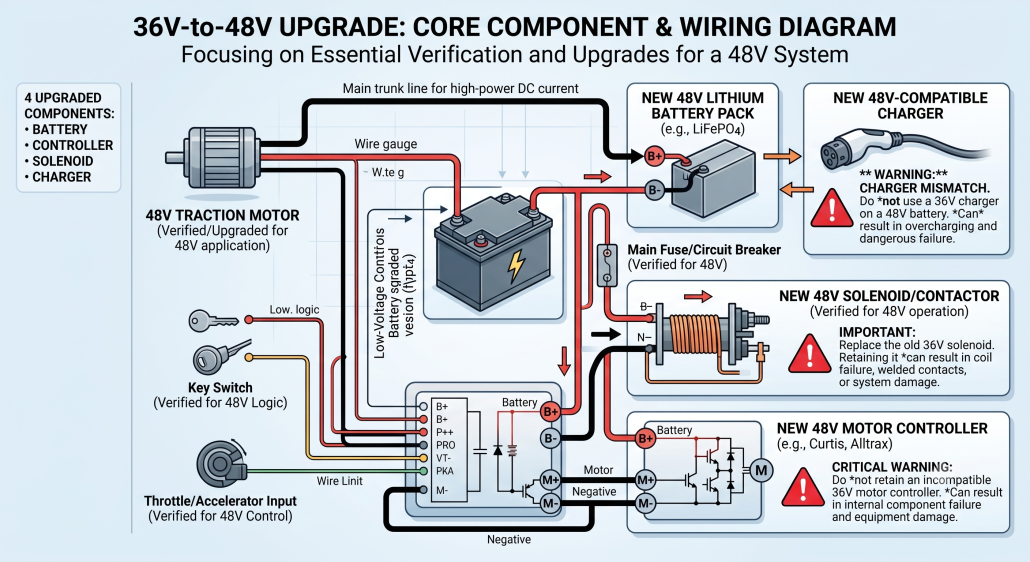
1. Replace the Motor Controller
The motor controller regulates how power is delivered to the electric motor.
A controller designed for 36V cannot safely operate on 48V and should always be replaced with a properly rated 48V controller.
2. Upgrade the Solenoid (Contactor)
The solenoid functions as the high-current switch connecting the battery to the motor.
Using a 36V solenoid with a 48V battery system can cause the contacts to overheat and potentially weld shut, leading to serious electrical failures.
Installing a properly rated 48V solenoid is essential for safe operation.
3. Replace the Battery Charger
A 36V charger cannot charge a 48V battery bank.
Attempting to use the wrong charger may leave the batteries undercharged or trigger battery protection systems.
Whether using lead-acid or lithium, always select a charger specifically designed for the battery chemistry and system voltage.
4. Verify Motor Compatibility
Many golf cart motors can tolerate both 36V and 48V operation, but this is not universally true.
Before performing a voltage conversion, verify the motor’s specifications to ensure it can safely operate at the higher voltage without overheating or reducing service life.
Why Fleet Operators Are Switching to Lithium
For commercial golf courses, resorts, universities, airports, and industrial facilities, battery selection is increasingly driven by total cost of ownership (TCO) rather than purchase price alone.
Compared with lead-acid batteries, lithium technology provides:
- Faster charging between shifts
- Zero watering or routine maintenance
- Consistent power throughout discharge
- Lower vehicle weight
- Longer replacement intervals
- Reduced fleet downtime
These operational advantages often offset the higher initial purchase cost over the battery’s lifetime.
Commercial Fleet Resource
If you’re a golf course superintendent, resort manager, fleet operator, or custom golf cart builder planning a large-scale 48V golf cart battery upgrade, selecting the right lithium system involves more than comparing battery capacity alone.
Explore our comprehensive guide, The Ultimate Guide to Lithium Golf Cart Batteries, to evaluate manufacturing quality, Battery Management System (BMS) design, total cost of ownership (TCO), global certifications, and drop-in BCI battery sizing for commercial fleets.
Frequently Asked Questions
How long do 48 volt golf cart batteries last?
Battery lifespan depends largely on the battery chemistry.
Traditional lead-acid batteries typically provide 3–5 years of service or approximately 500 charge-discharge cycles, assuming proper maintenance.
A premium LiFePO₄ lithium battery can operate for 10 years or more, with many systems rated for 3,500–6,000+ cycles, depending on operating conditions and depth of discharge.
The longer lifespan significantly reduces replacement frequency and lowers lifetime operating costs.
Can you put a 48V lithium battery in any golf cart?
In most cases, yes.
A 48V lithium battery is designed as a direct replacement for an existing 48V lead-acid battery bank.
However, before installation, you should confirm that the golf cart’s:
- Motor
- Motor controller
- Solenoid (contactor)
- Battery charger
are all compatible with a 48V electrical system.
If those components are correctly rated, the lithium battery can typically be installed as a drop-in replacement while providing immediate improvements in weight, performance, charging speed, and maintenance requirements.
Upgrade Your Golf Cart for Better Performance and Lower Operating Costs
The 48V golf cart battery has become the preferred power solution for modern golf carts because it delivers an ideal combination of efficiency, torque, and driving range. Whether used on golf courses, in gated communities, or across commercial fleets, the 48V platform offers strong performance without the complexity or cost of higher-voltage systems.
By upgrading from traditional lead-acid batteries to Lithium Iron Phosphate (LiFePO₄) technology, owners gain more than just lighter weight. They benefit from faster charging, significantly longer service life, consistent power delivery, and greatly reduced maintenance—advantages that translate into lower lifetime operating costs and improved vehicle reliability.
If you’re planning a battery replacement, a fleet modernization project, or a 36V-to-48V conversion, choosing the right lithium battery system is a smart investment in both performance and long-term value.
Ready to upgrade your golf cart fleet? Contact our battery specialists to discuss drop-in lithium replacements, fleet conversion strategies, and customized 48V battery solutions for your specific application.