
Lithium vs Lead-Acid Golf Cart Batteries: Which One Is Right for You?
Introduction: The Evolution Under the Seat
Golf carts are no longer limited to the golf course.
Across the United States, golf carts have evolved into Neighborhood Electric Vehicles (NEVs), resort transportation vehicles, hunting buggies, campus mobility solutions, and industrial utility carts. Many modern carts now carry multiple passengers, operate on hilly terrain, and travel significantly longer distances than they did just a decade ago.
As usage demands increase, battery technology has become one of the most important factors influencing performance, reliability, and operating costs.
Unfortunately, many buyers focus exclusively on upfront purchase price when comparing batteries.
The smarter approach is to evaluate the complete performance profile—including lifespan, maintenance requirements, power delivery, charging speed, and long-term Total Cost of Ownership (TCO).
The real question isn’t simply “Which battery costs less today?” but rather:
Which battery technology best supports your daily operational requirements over the next decade?
Lithium vs. Lead-Acid Golf Cart Batteries: The Core Differences
Before comparing performance, it’s important to understand the two technologies.
Traditional Lead-Acid Batteries
Most golf carts still operate using either:
- Flooded Lead-Acid (FLA) batteries
- Absorbent Glass Mat (AGM) batteries
These systems store energy through a chemical reaction between lead plates and sulfuric acid.
Advantages include:
- Lower initial purchase price
- Broad availability
- Familiar maintenance procedures
However, they also bring significant drawbacks:
- Heavy weight
- Routine maintenance requirements
- Voltage drop during discharge
- Limited cycle life
- Reduced performance in demanding applications
Lithium Iron Phosphate (LiFePO₄) Batteries
Modern lithium golf cart batteries typically use Lithium Iron Phosphate (LiFePO₄ or LFP) chemistry.
Unlike the lithium-ion chemistries commonly found in smartphones and consumer electronics, LiFePO₄ utilizes an inherently stable olivine crystal structure.
This crystal structure forms exceptionally strong covalent bonds that prevent oxygen release during operation.
As a result, LiFePO₄ batteries offer:
- Outstanding thermal stability
- Exceptional safety performance
- Long cycle life
- High power density
- Consistent voltage output
This makes LiFePO₄ the preferred chemistry for commercial golf carts, fleet vehicles, utility carts, and Neighborhood Electric Vehicles.
Power Delivery: Why Lead-Acid Suffers from Voltage Sag
One of the biggest differences between lithium and lead-acid batteries becomes apparent when the cart is under load.
What Is Voltage Sag?
As a lead-acid battery discharges, its voltage gradually decreases.
The result is familiar to many golf cart owners:
- Slower acceleration
- Reduced hill-climbing performance
- Lower top speed
- Diminished torque
The cart simply feels weaker as the battery drains.
Understanding Peukert’s Law
Peukert’s Law explains why lead-acid batteries lose usable capacity when subjected to higher current demands.
Situations that increase discharge rates include:
- Carrying multiple passengers
- Climbing hills
- Pulling cargo
- Running oversized tires
- Frequent stop-and-go driving
Under these conditions, lead-acid batteries experience accelerated voltage drop and capacity loss.
The harder you work them, the less energy they effectively deliver.
The Lithium Advantage: Flat Voltage Performance
Lithium Iron Phosphate batteries behave differently.
A high-quality lithium monoblock maintains a nearly flat voltage curve throughout most of the discharge cycle.
This means:
- Consistent acceleration
- Stable top speed
- Reliable hill-climbing power
- Maximum torque delivery
Whether the battery is at 100% charge or 15% charge, the cart performs almost identically.
For lifted carts, hunting buggies, and commercial fleets, this performance consistency is a major advantage.
The Lifespan Equation: Cycles vs. Real-World Climates
Battery lifespan is often the deciding factor when calculating long-term value.
Typical Cycle Life Comparison
| Battery Type | Typical Cycle Life |
| Flooded Lead-Acid | 500–800 Cycles |
| AGM | 700–1,000 Cycles |
| Lithium Iron Phosphate (LiFePO₄) | 3,000–5,000+ Cycles |
The Usable Capacity Secret: When evaluating lifecycles, remember that a lead-acid battery should never be discharged past 50% Depth of Discharge (DOD) without causing permanent damage. Because LiFePO₄ safely allows for 100% DOD, a single 100Ah lithium battery delivers the exact same daily usable run-time as a massive 200Ah lead-acid battery bank, making the long-term ROI even more dramatic.
On paper, lithium already delivers multiple times the lifespan of lead-acid.
However, real-world climate conditions make the gap even larger.
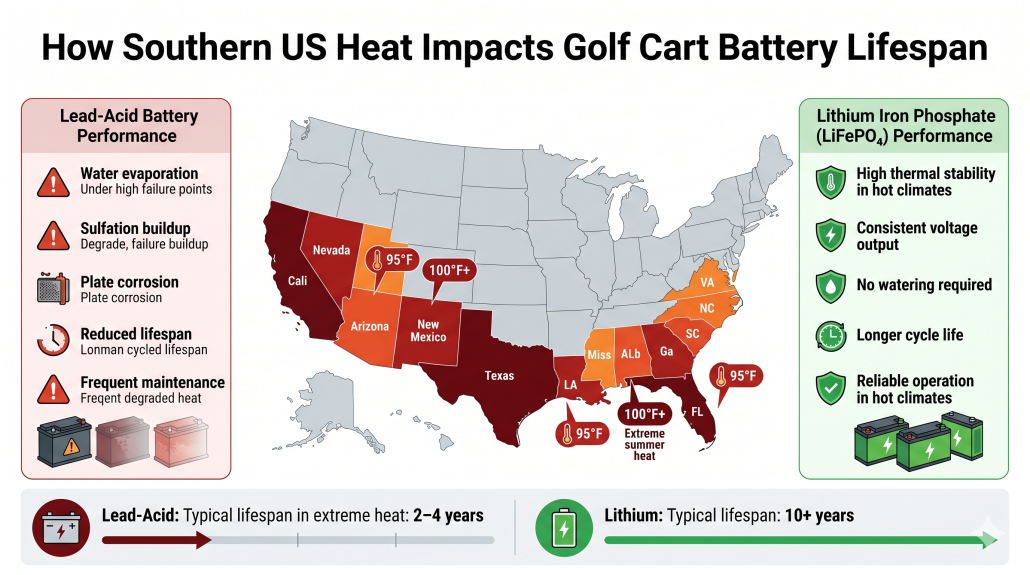
Why Southern US Climates Accelerate Battery Failure
Many golf carts operate in:
- Florida
- Texas
- Arizona
- Georgia
- South Carolina
- Southern California
High ambient temperatures accelerate lead-acid battery degradation through:
- Water evaporation
- Plate corrosion
- Sulfation buildup
- Increased self-discharge
As a result, many lead-acid batteries never reach their advertised 3–5 year lifespan.
In contrast, lithium batteries demonstrate significantly better thermal resilience and maintain performance in hot environments where lead-acid systems struggle.
For operators in warm climates, lithium is often not just an upgrade—it becomes a reliability requirement.
Do Lithium Golf Cart Batteries Require Routine Maintenance?
Lithium golf cart batteries are 100% maintenance-free and do not require any manual upkeep. Unlike flooded lead-acid systems, they completely eliminate the need for monthly distilled water top-offs, terminal corrosion cleaning, acid neutralizers, or equalization charging.
Unlike flooded lead-acid batteries, they do not require:
- Monthly distilled water top-offs
- Terminal cleaning
- Corrosion removal
- Equalization charging
- Acid level inspections
This eliminates one of the largest ownership burdens associated with traditional golf cart batteries.
How the Battery Management System (BMS) Works
Every quality lithium golf cart battery includes an integrated Battery Management System (BMS).
Think of the BMS as the battery’s onboard computer.
It automatically monitors:
- Cell voltage
- Temperature
- Charge status
- Discharge current
- Cell balancing
The BMS actively protects the battery against:
- Overcharging
- Deep discharge
- Short circuits
- Overcurrent events
- Temperature extremes
Instead of relying on manual maintenance procedures, the battery continuously manages itself.
Financial Reality: Is the Higher Initial Upfront Cost Worth It?
This is the question most buyers ask:
Are lithium golf cart batteries worth it?
The answer depends on how long you plan to own the cart.
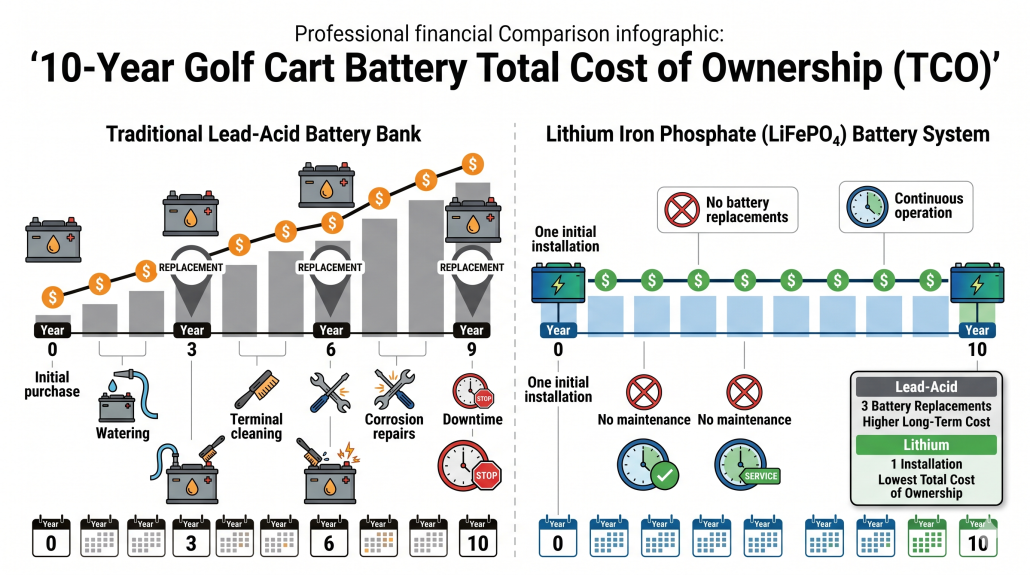
Cost Comparison Over 10 Years
| Cost Factor | Lead-Acid Battery Bank | Lithium Battery System |
| Initial Purchase Cost | Lower | Higher |
| Maintenance Costs | High | None |
| Watering Supplies | Required | None |
| Corrosion Repairs | Possible | None |
| Replacement Frequency | Every 3–5 Years | 10+ Years |
| Charging Efficiency | Lower | Higher |
| Downtime | Higher | Minimal |
| 10-Year Total Cost | Significantly Higher | Lower |
The 10-Year Ownership Reality
A typical golf cart owner will purchase:
Two to three complete lead-acid battery sets over a decade
or
One lithium battery system
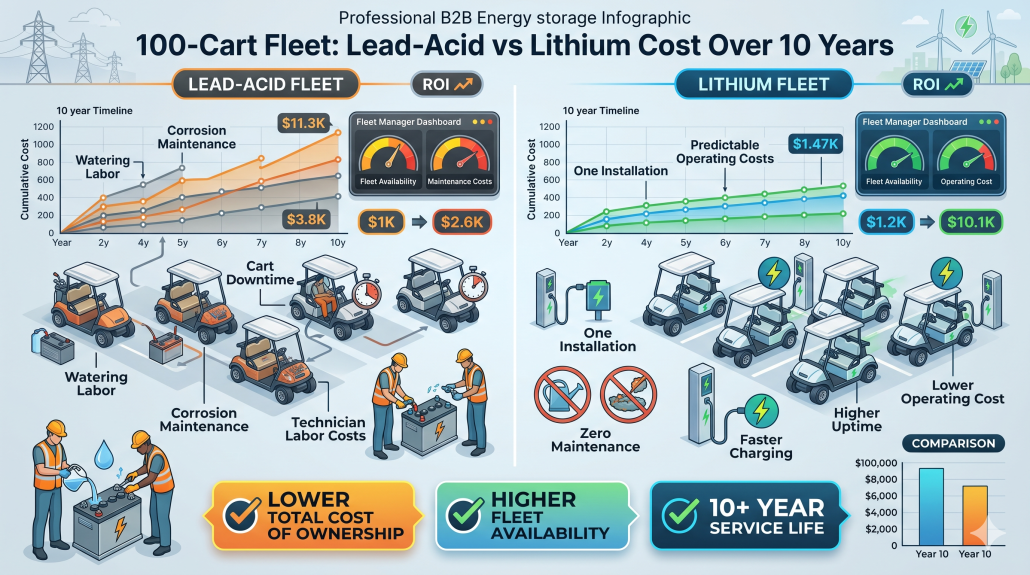
Once labor, maintenance, replacement costs, and downtime are included, lithium frequently becomes the lowest-cost solution over the life of the vehicle.
This is why commercial fleets, golf courses, resorts, and utility operators are rapidly transitioning to lithium technology.
Structuring Your Transition: Choose the Right Upgrade Path
Every golf cart platform has unique electrical requirements.
Before purchasing a lithium battery system, make sure you understand the conversion process specific to your vehicle.
Own an EZGO cart?
Read our technical safety guide:EZGO Lithium Battery Upgrade: How to Safely Convert RXV & TXT Models
Converting a Club Car platform?
Explore our installation guide:Club Car Lithium Battery Conversion Guide
Driving a Yamaha platform?
Yamaha’s unique chassis and motor setups require specific layout planning. Read our comprehensive technical walkthrough:Replacing Your Yamaha Golf Cart Battery: The Right Way to Upgrade
These resources cover battery sizing, wiring requirements, controller compatibility, and platform-specific safety considerations.
Conclusion: Which Battery Technology Is Right for You?
Lead-acid batteries still offer a lower upfront purchase price and remain suitable for occasional-use applications.
However, for owners seeking:
- Longer range
- Better hill-climbing performance
- Faster charging
- Zero maintenance
- Extended lifespan
- Lower long-term operating costs
Lithium Iron Phosphate (LiFePO₄) has become the clear industry standard.
The combination of stable voltage output, superior thermal performance, integrated BMS protection, and 10+ year lifespan makes lithium the preferred solution for both individual owners and commercial fleets.
While the initial investment is higher, the long-term financial and performance benefits continue to make lithium the smartest upgrade available for modern golf cart applications.
Whether you’re upgrading a neighborhood cruiser, a hunting buggy, or an entire fleet, evaluating the complete ownership picture—not just the purchase price—will lead to the best decision.
For a detailed guide on how to plan your lithium battery upgrade, including compatibility checks and installation tips, we recommend reading:
Replacing Golf Cart Batteries with Lithium: What You Need to Know Before Upgrading Your System
Upgrading 6V and 8V Golf Cart Batteries: Why It’s Time to Switch to Lithium