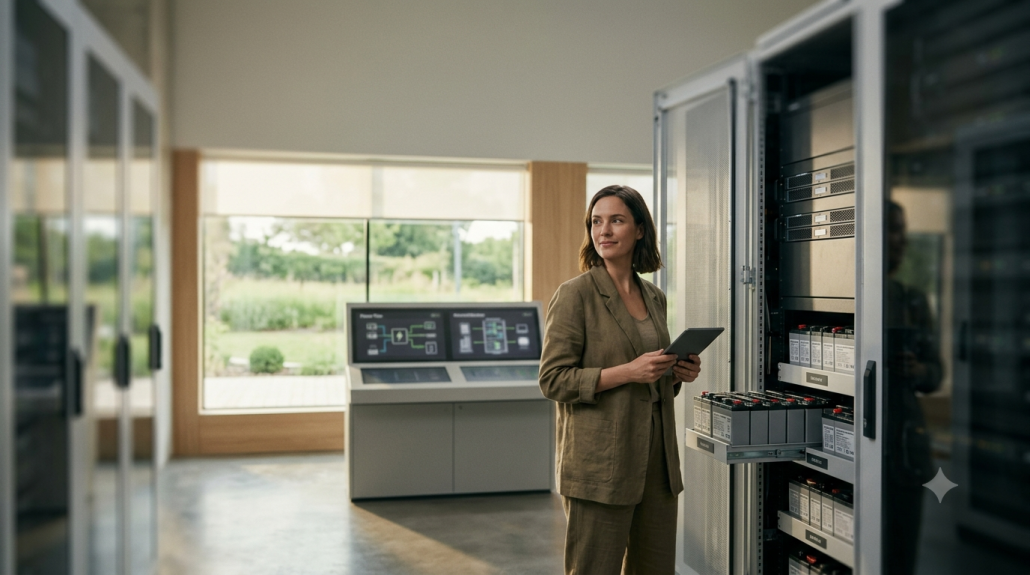
Understanding Data Center Battery Backup Systems: The Complete Engineering Guide
Modern data centers power everything from AI model training and cloud computing to financial transactions and healthcare systems. As rack densities increase and workloads become more critical, even a brief power interruption can result in costly downtime, hardware failures, and data loss.
While standby generators often receive the most attention in discussions about backup power, they are not the first system that protects a data center during an outage. Instead, the real first line of defense is the data center battery backup system, working alongside an online Uninterruptible Power Supply (UPS) to deliver instantaneous power until generators are fully operational.
Understanding how these systems work—and why battery technology has become a strategic design decision—is essential for facility managers, consulting engineers, and data center operators planning new infrastructure or upgrading existing facilities.
Quick Answer: A data center battery backup system combines an online double-conversion UPS with high-performance battery cabinets to provide uninterrupted power when utility electricity fails. The batteries immediately support critical IT equipment for approximately 5–15 minutes while standby generators start and synchronize. Modern facilities increasingly evaluate Lithium Iron Phosphate (LiFePO₄) batteries alongside traditional VRLA technologies to improve lifecycle performance, reduce maintenance, and optimize space utilization.
Why Data Centers Need Battery Backup Systems
Unlike office buildings or residential properties, data centers cannot tolerate even a momentary loss of power. A voltage sag lasting only milliseconds may cause servers to reboot unexpectedly, interrupt storage arrays, or disconnect network infrastructure.
Battery backup systems bridge the gap between utility failure and generator startup. This short period—commonly called ride-through time—is enough to keep critical loads operating continuously until an alternative power source is available.
Without battery backup, a facility would experience:
- Unexpected server shutdowns
- Potential data corruption
- Network interruptions
- Cooling system failures
- Reduced service availability
- Significant financial losses due to downtime
Rather than acting as long-duration energy storage, UPS batteries provide immediate, highly reliable power exactly when it is needed most.
How a Data Center Battery Backup System Works
Although every facility has unique design requirements, the overall power architecture follows the same principle.
During normal operation, utility power flows through the UPS, which continuously conditions incoming electricity before supplying it to IT equipment. At the same time, the UPS charger keeps the battery bank fully charged.
If utility power fails, the sequence is remarkably fast:
| Stage | System Response |
| Normal Operation | Utility grid powers the UPS and connected IT equipment while batteries remain fully charged. |
| Power Disturbance | The UPS detects voltage loss or instability immediately. |
| Battery Discharge | Battery cabinets instantly supply DC power to the UPS inverter, maintaining uninterrupted AC output to servers. |
| Generator Startup | Standby generators start and stabilize, typically within 5–15 seconds. |
| Return to Normal | The generator assumes the load, and the UPS begins recharging the batteries. |
Unlike standby UPS systems used in homes or small offices, enterprise data centers typically employ online double-conversion UPS systems, which provide zero transfer time because connected equipment is always powered through the UPS inverter.
Note: While enterprise data centers rely on online double-conversion architectures, smaller commercial facilities may utilize different topologies. For a broader look at commercial deployments, explore our complete guide to uninterruptible power supply applications in business.
Core Components of a Data Center Battery Backup System
A modern backup power system consists of multiple integrated components working together to ensure continuous operation.
Online UPS
The online UPS is the heart of the electrical protection system. It continuously converts incoming AC power into DC and then back into clean AC output, eliminating voltage fluctuations, harmonics, and power disturbances before electricity reaches sensitive IT equipment.
Battery Cabinets
Battery cabinets store the energy required during utility outages. They are designed for high-rate discharge, allowing large amounts of power to be delivered almost instantly.
Depending on project requirements, battery cabinets may utilize:
- Valve-Regulated Lead-Acid (VRLA) batteries
- Pure Lead batteries
- Lithium Iron Phosphate (LiFePO₄) batteries
LEOCH Solution: LEOCH offers both high-density Lithium UPS Cabinets and advanced Thin Plate Pure Lead UPS Battery Series. While lithium solutions provide intelligent BMS management and a massive reduction in footprint, TPPL batteries serve as the ultimate bridge technology. By utilizing highly compressed, ultra-thin pure lead plates, TPPL batteries deliver exceptional high-rate discharge, rapid recharge times, and a longer operational life compared to conventional lead-alloy AGM batteries. Together, they provide flexible, high-performance backup solutions for any critical infrastructure requirement.
Battery Management System (BMS)
For lithium battery systems, the Battery Management System continuously monitors:
- Cell voltage
- Current
- Temperature
- State of Charge (SOC)
- State of Health (SOH)
The BMS also balances individual cells and protects against overcharging, over-discharging, short circuits, and abnormal temperatures.
Automatic Transfer Switch (ATS)
The ATS coordinates the transition between utility power and standby generators. While the UPS batteries maintain continuous power, the ATS safely transfers the facility to generator operation once voltage and frequency stabilize.
Power Distribution Units (PDUs)
PDUs distribute conditioned power from the UPS to server racks, networking equipment, and other critical loads while allowing branch-level monitoring and protection.
LiFePO₄ vs. VRLA Batteries for Data Center UPS Systems
Battery chemistry plays a significant role in lifecycle cost, maintenance requirements, and facility design.
| Parameter | Lithium Iron Phosphate (LiFePO₄) | VRLA Battery |
| Design Life | 10–15 years | 3–5 years |
| Typical Cycle Life | 3,000–6,000+ cycles | 300–500 cycles |
| Weight | Up to 70% lighter | Heavy |
| Installation Footprint | 40–60% smaller | Larger footprint |
| Operating Temperature | Excellent thermal tolerance | Performance declines at elevated temperatures |
| Maintenance | Minimal | Regular inspection and periodic replacement |
| Recharge Speed | Fast | Slower |
| Total Cost of Ownership | Lower over lifecycle | Higher due to replacements |
VRLA batteries continue to serve many existing UPS installations because of their lower upfront cost and long history in the industry. However, many new data center projects and retrofit programs are evaluating LiFePO₄ technology for its longer service life, reduced maintenance requirements, improved energy density, and lower total cost of ownership over the system lifecycle.
A Note on Fire Safety and Compliance (UL 9540A & NFPA 855)
As facilities transition to lithium-based backup power, navigating fire safety codes is paramount. Modern LiFePO₄ systems must be evaluated against the UL 9540A test method, which assesses thermal runaway fire propagation. Successfully completing UL 9540A testing proves that a potential fire will not propagate between battery cabinets. Furthermore, this testing allows Authorities Having Jurisdiction (AHJs) to waive the strict 3-foot separation requirements dictated by NFPA 855, enabling data centers to safely maximize their space and energy capacity.
Why AI Data Centers Are Driving Lithium Adoption
The rapid expansion of AI computing has fundamentally changed data center power requirements.
Traditional enterprise server racks often consumed 5–15 kW per rack. Today’s GPU clusters commonly exceed 50 kW, and some high-density deployments are designed for 100 kW or more per rack.
Higher power density creates several engineering challenges:
- Increased peak power demand
- Greater thermal loads
- Reduced white-space availability
- Higher electrical infrastructure costs
Lithium battery systems address many of these challenges by providing:
- Higher power density in a smaller footprint
- Faster recharge capability
- Lower floor loading due to reduced weight
- Longer replacement intervals
- Improved compatibility with modular UPS architectures
As AI infrastructure continues to expand, lithium technologies are increasingly considered for facilities seeking long-term operational efficiency and scalability.
How Much Battery Runtime Does a Data Center Need?
A common misconception is that battery systems should power a data center for several hours during an outage.
In practice, most UPS battery systems are intentionally designed for 5–15 minutes of runtime.
This duration is sufficient because the batteries are not intended to replace generators. Their primary function is to maintain uninterrupted power during the short period required for standby generators to start, synchronize, and assume the electrical load.
Typical runtime targets include:
| Facility Type | Typical UPS Runtime |
| Enterprise Data Center | 5–10 minutes |
| Colocation Facility | 10–15 minutes |
| Hyperscale Data Center | 5–15 minutes |
| Edge Data Center | 10–30 minutes (depending on design objectives) |
Longer runtimes may be specified for remote locations or facilities where generator startup could be delayed.
Designing the Right Battery Backup System
Selecting an appropriate battery backup system involves more than simply choosing a battery chemistry. Engineers typically evaluate:
- Critical IT load (kW)
- Required backup runtime
- UPS efficiency
- Future capacity expansion
- Ambient operating temperature
- Redundancy architecture (N, N+1, or 2N)
- Available installation space
- Structural floor loading
These factors determine the optimal battery capacity, cabinet configuration, and overall backup strategy.
Maintenance Best Practices
Even the most advanced battery technology requires routine inspection to ensure reliable performance.
For VRLA systems, recommended maintenance typically includes:
- Visual inspections
- Terminal torque checks
- Internal resistance measurements
- Capacity testing
- Temperature monitoring
Lithium battery systems generally require less manual maintenance, but facility managers should still monitor:
- BMS event logs
- Communication status
- Firmware updates (where applicable)
- Cabinet condition
- Periodic capacity verification
Preventive maintenance helps identify potential issues before they affect system availability.
Emerging Trends in Data Center Battery Backup
The rapid growth of AI, cloud services, and edge computing is reshaping how backup power systems are designed. Rather than simply increasing battery capacity, modern facilities are optimizing for higher power density, operational flexibility, and long-term efficiency.
AI Infrastructure Is Driving Higher Power Density
AI clusters equipped with GPUs can consume several times more power than traditional server racks, creating larger and more concentrated electrical loads. This shift requires UPS battery systems capable of delivering high-rate discharge while maintaining stable voltage during sudden load changes. As rack densities continue to increase, operators are also prioritizing battery technologies with smaller footprints to maximize valuable white space for IT equipment.
Modular Architectures Improve Scalability
Many new data centers are moving away from oversized battery rooms designed for future expansion. Instead, modular UPS systems and battery cabinets allow operators to deploy only the capacity they currently need and expand incrementally as computing demand grows. This approach reduces upfront capital expenditure while minimizing disruption during future upgrades.
Battery Intelligence Is Becoming Standard
Modern battery systems are evolving from passive energy storage into intelligent assets. Advanced Battery Management Systems (BMS) continuously monitor cell voltage, temperature, state of charge, and overall battery health, while integrating with Data Center Infrastructure Management (DCIM) platforms. Combined with predictive analytics, operators can identify potential issues early, schedule maintenance proactively, and reduce the risk of unexpected battery failures.
Sustainability Is Reshaping Backup Power Decisions
Environmental targets are becoming a key factor in infrastructure planning. Facility operators are evaluating battery technologies not only on purchase price, but also on lifecycle performance, energy efficiency, maintenance requirements, and replacement frequency. Longer-lasting battery systems with higher round-trip efficiency can help reduce operating costs while supporting corporate sustainability and carbon reduction goals over the entire life of the data center.
Grid-Interactive UPS and Peak Shaving
Historically, UPS batteries sat idle, waiting for an emergency. Today, advanced backup systems are becoming grid-interactive. By utilizing intelligent inverters and highly cyclical lithium or TPPL batteries, data centers can participate in “peak shaving”—running the facility on battery power during times of peak utility pricing, and recharging when electricity is cheaper. This transforms the battery backup system from a sunk insurance cost into an active revenue-generating asset.
Why these trends matter
Looking ahead, data center battery backup systems will play an increasingly strategic role rather than serving solely as emergency power reserves. As AI computing, edge deployments, and digital infrastructure continue to expand, battery systems will be expected to deliver greater efficiency, deeper visibility, and seamless scalability—helping operators balance resilience, operational costs, and long-term growth.
Frequently Asked Questions
How long do data center UPS batteries last?
Traditional VRLA batteries typically have a service life of 3–5 years, while high-quality LiFePO₄ batteries can provide 10–15 years of operation, depending on environmental conditions, cycling, and maintenance practices.
What batteries are commonly used in data centers?
Most legacy installations use VRLA batteries. However, many new facilities and upgrade projects evaluate Lithium Iron Phosphate (LiFePO₄) technology for its longer service life, smaller footprint, and reduced maintenance requirements.
Why don’t data centers rely only on generators?
Generators require several seconds to start and stabilize after a utility outage. UPS battery systems provide instantaneous power during this transition, ensuring uninterrupted operation of critical IT equipment.
Can lithium batteries replace VRLA batteries in existing UPS systems?
In many cases, yes. However, compatibility depends on the UPS charging profile, electrical design, battery management requirements, certifications, and site-specific engineering considerations. A detailed assessment should be completed before replacing an existing battery system.
Final Thoughts
Reliable backup power is the foundation of every modern data center. While generators provide long-duration resilience, battery backup systems ensure the seamless transition that prevents costly downtime and protects mission-critical infrastructure.
As data centers evolve to support AI, cloud computing, and edge applications, battery technologies are evolving as well. Although VRLA batteries remain widely deployed, lithium-based solutions are increasingly being evaluated for projects that prioritize lifecycle performance, reduced maintenance, and space efficiency.
Whether designing a new facility or modernizing an existing UPS installation, understanding the role of battery backup systems is essential to building resilient, scalable, and future-ready digital infrastructure.