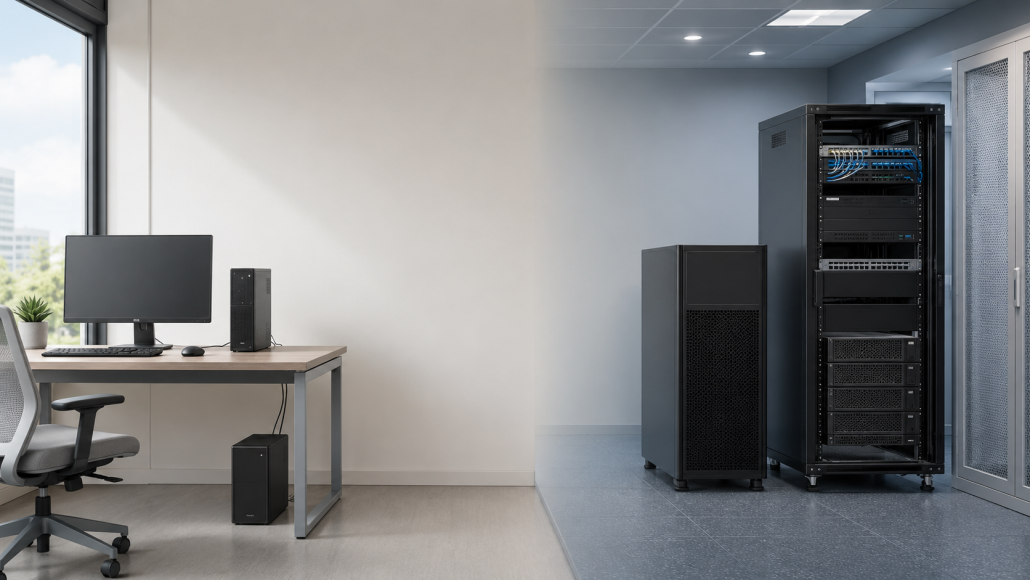
Online UPS vs. Offline UPS Explained: Which Should You Choose?
|
Quick answer Choose an offline UPS for basic electronics on generally stable utility power when low cost, high normal-mode efficiency, and short-duration backup matter most. Choose an online double-conversion UPS when the load is critical or unusually sensitive, the input power is poor, or zero transfer time is a verified requirement. For many workstations and distributed IT loads, a line-interactive UPS is the practical middle ground. |
Online UPS and offline UPS sound like terms for internet connectivity, but they describe the internal power path. An online UPS does not have to be connected to the internet, and an offline UPS does not leave equipment unpowered during normal operation. The names indicate whether the inverter continuously supplies the load or waits until backup power is needed.
That architectural choice affects transfer behavior, voltage and frequency regulation, electrical isolation, energy losses, heat, fan noise, purchase cost, and the types of loads each system can protect. It does not, by itself, determine runtime, battery chemistry, output capacity, or every feature on a product datasheet.
The right choice is therefore not simply ‘online is better.’ The right choice is the least complex, fully compatible topology that controls the actual power risk and meets the required availability.
What Do Online and Offline Mean in a UPS?
An offline UPS, also called a standby UPS, normally routes acceptable utility AC power to the connected load. A charger maintains the battery while the inverter waits. When input power fails or leaves the model’s acceptable range, a transfer device moves the load to inverter output powered by the battery. Because the load changes from one source path to another, there is a brief, nonzero transfer interval.
An online UPS generally refers to an online double-conversion design. During normal double-conversion operation, a rectifier converts incoming AC to DC, the DC bus feeds an inverter, and the inverter continuously produces AC for the load. The battery is connected to the DC side and remains charged; it does not have to discharge continuously. If input power fails, stored energy supports the same inverter path, so the output does not wait for a utility-to-inverter transfer.
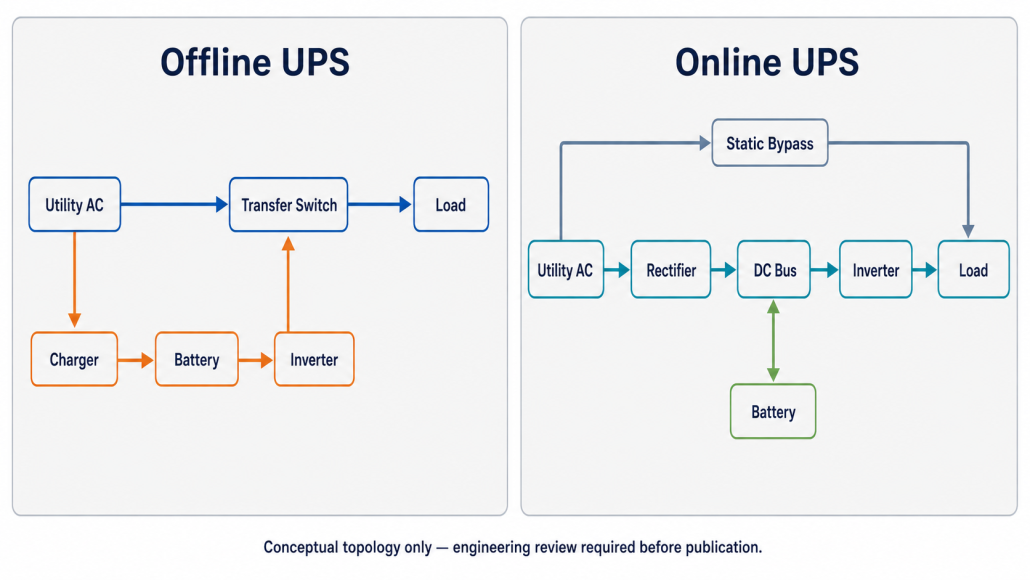
These definitions describe the normal operating mode. Online UPS systems also commonly include a static bypass for overloads or internal faults, and some offer an economy mode that sends acceptable utility power around the double-conversion path to reduce losses. Those modes change the protection and transfer behavior, so they must be considered when a project requires zero transfer time or continuous conditioning.
Online UPS vs. Offline UPS at a Glance
| Decision factor | Offline UPS | Online double-conversion UPS |
| Normal power path | Acceptable utility power normally feeds the load; inverter waits | Rectifier and inverter continuously feed the load in double-conversion mode |
| Utility failure | Transfers from utility path to battery-powered inverter | Battery supports the existing DC bus and inverter path |
| Transfer time | Brief and nonzero; exact maximum is model-specific | Zero in double-conversion mode; eco and bypass behavior is model-specific |
| Voltage and frequency | Limited conditioning; transfers when input exceeds thresholds | Tight, continuous output regulation within the UPS design limits |
| Input isolation | Load normally remains exposed to acceptable utility waveform | Load is regenerated through the inverter in double-conversion mode |
| Efficiency and heat | Usually higher efficiency and less heat in normal operation | Usually more conversion loss, heat, and cooling demand; actual values vary |
| Cost and complexity | Lower purchase cost and simpler architecture | Higher purchase and operating cost, with more power-conversion components |
| Typical fit | Routers, basic PCs, peripherals, and simple POS on stable power | Critical servers, sensitive instruments, telecom, industrial controls, and poor-power sites |
These are topology-level tendencies, not substitutes for a product datasheet. Input range, bypass design, transfer behavior, output waveform, efficiency, overload capability, battery capacity, runtime, monitoring, acoustics, and certifications can differ substantially within the same category.
How Does an Offline UPS Work?
During normal conditions, an offline UPS monitors the incoming utility supply while passing acceptable power to the load. The battery charger replenishes and maintains the battery, but the inverter is not continuously carrying the load. This direct path reduces conversion losses and usually keeps the product compact, cool, quiet, and economical.
When the input fails or crosses a transfer threshold, the control circuit commands a switch and starts or connects the inverter. The load then receives AC generated from battery DC. The transition occurs in milliseconds, but the exact maximum must come from the selected model’s specification rather than a universal topology number.
Many computer power supplies and small network devices can ride through a compatible transfer interval. A sensitive instrument, control system, or device that has already rebooted during short events may not. Offline protection is best where the utility supply is usually stable and the goal is to save work, shut equipment down safely, or keep a small load operating through a brief outage.
For a deeper explanation of the components and operating sequence, see how an offline UPS works.
How Does an Online Double-Conversion UPS Work?
In double-conversion mode, the rectifier converts incoming AC into DC. That DC supports a regulated bus connected to the battery and feeds the inverter. The inverter then creates controlled AC output for the protected load. Because the load is already on the inverter, an input outage does not require it to move from a utility-fed output path to a newly energized inverter path.
This arrangement allows the UPS to accept a wider range of input conditions without exposing the load to the same voltage and frequency variation. It can deliver regulated output through sags, overvoltage, frequency drift, waveform distortion, and other disturbances within the system’s design limits. It is therefore well suited to critical equipment and sites with poor or highly variable power.
The battery is not continuously cycled simply because the UPS is online. Under normal conditions, the rectifier supplies the DC bus and the charger maintains the battery. The battery supplies energy when the input is unavailable or outside the usable range, subject to the UPS design and operating mode.
The Static Bypass and Eco-Mode Caveat
Most online UPS systems include a static bypass so the load can be transferred to an alternate AC path during certain overloads, internal faults, maintenance events, or commanded operating states. Larger installations may also use a separate maintenance bypass that allows service work while an alternate source supports the load. The exact arrangement varies by system and must be reviewed in the one-line diagram and operating manual.
An economy or high-efficiency mode may normally use a bypass-like path and engage double conversion only when input conditions leave a defined window. That can reduce energy losses, but it also reduces the continuous regeneration that motivated the online purchase and may introduce a transfer interval. When a requirement states ‘zero transfer time,’ specify double-conversion mode and verify how the selected UPS handles eco mode, static bypass, overload, and fault conditions.
The Differences That Matter Most
1. Transfer behavior and load continuity
Offline UPS systems change the load from the utility path to the inverter path when backup is needed. Online double-conversion systems keep the load on the inverter and draw replacement energy from the battery through the DC bus when input power disappears. This is the basis for the online system’s zero-transfer claim in double-conversion mode.
Do not choose by a category-level timing estimate alone. Compare the offline model’s maximum transfer time with the protected equipment’s ride-through capability, and verify every online operating mode that may be enabled. A zero-millisecond specification in online mode does not automatically describe eco mode or bypass operation.
2. Power conditioning and frequency stability
An offline UPS typically provides surge suppression and model-specific filtering, then transfers to battery when the input crosses its permitted limits. While the input is accepted, the load normally sees the utility waveform. That is adequate for many basic electronics on a stable grid, but it does not continuously recreate the output.
An online UPS continuously synthesizes output through the inverter in double-conversion mode. This gives it tighter control of voltage and frequency and better separation from many input disturbances. The practical value rises when the site has unstable utility power, a generator with difficult voltage or frequency behavior, sensitive instrumentation, or a process where a restart is costly.
3. Efficiency, heat, and acoustics
Every conversion stage has losses. Because an offline UPS normally passes utility power rather than processing the full load through a rectifier and inverter, it is generally more efficient in normal operation and produces less heat. Small models may run without a continuously operating fan, which can matter in a quiet office or studio.
Online systems normally consume more energy and reject more heat, and many use fans. Modern designs can still achieve strong efficiency, especially near their intended load range, but the result is product- and mode-specific. Compare manufacturer efficiency curves or certified data at the expected load, not only a maximum headline figure. Include UPS losses and cooling energy when estimating lifecycle cost.
4. Purchase price, maintenance, and lifecycle cost
Offline architecture is simpler, so it usually costs less to buy and operate. For a basic desktop, router, or point-of-sale system, paying for continuous double conversion may add complexity without addressing a meaningful risk.
Online UPS systems cost more because they require continuous power electronics, thermal management, bypass functions, monitoring, and often greater service capability. For a critical server, production controller, or diagnostic instrument, however, the avoided cost of a single disruption can outweigh the premium. Evaluate total cost against the consequence of downtime, not against purchase price alone.
5. Runtime and battery behavior
Topology does not set runtime. Backup duration depends mainly on battery energy, connected watt load, conversion efficiency, battery age and condition, temperature, and the manufacturer’s runtime curve. An online UPS does not automatically run longer than an offline unit of similar rating, and a larger VA label does not guarantee more battery energy.
Determine whether the UPS only needs to bridge an orderly shutdown, support a process until a generator stabilizes, or keep the load operating for an extended outage. Use the exact model’s runtime curve at the expected load. Approved external battery cabinets can increase runtime on compatible systems, but they do not increase the inverter’s watt or VA capacity.
6. Output waveform and electrical fit
Online double-conversion UPS systems generally provide regulated sine-wave output, but the exact distortion, voltage tolerance, crest factor, overload capability, and compatibility still belong to the product specification. Offline units may provide simulated or pure sine-wave output on battery depending on the model.
Check both the UPS watt rating and VA rating, then review the load’s power factor, inrush current, harmonic profile, and manufacturer guidance. Motors, laser printers, medical devices, laboratory instruments, industrial controls, and redundant power supplies can have requirements that are poorly represented by a simple steady-state watt total.
Which UPS Should You Choose?
Choose an offline UPS for basic protection on stable power
An offline UPS is usually appropriate for a modem, router, basic desktop computer, monitor, small peripheral set, or simple point-of-sale installation when utility power is generally stable. The load must tolerate the specified transfer time and battery-mode waveform, and the objective should be economical short-duration backup or graceful shutdown.
This remains a specification decision. Confirm the watt rating, VA rating, input window, maximum transfer time, waveform, number of battery-backed outlets, runtime curve, replaceable-battery options, shutdown software, and warranty. A low price does not compensate for an incompatible output or undersized inverter.
Choose an online UPS for critical loads or difficult input power
Online double-conversion is the stronger choice when an interruption could stop a critical process, corrupt data, force a long restart, or create a safety or quality problem. Common candidates include mission-critical servers, storage and network systems, telecom equipment, industrial controls, sensitive laboratory instruments, and approved healthcare applications.
It is also appropriate when the site has severe voltage variation, unstable frequency, frequent generator operation, or a documented need for continuous output conditioning. Specify the required operating mode and bypass behavior, because an online label alone does not define every failure or maintenance state.
Consider line-interactive UPS as the middle ground
For many home offices, workstations, network closets, NAS systems, small servers, and retail environments, the real decision is not between the two extremes. A line-interactive UPS can correct many voltage sags and overvoltage events without using its battery, while retaining a simpler and usually more efficient normal power path than online double conversion.
Line-interactive still has a transfer interval and does not provide the same continuous voltage and frequency regeneration as online mode. It can nevertheless offer the best balance when offline protection is too basic but the load does not justify continuous double conversion.
For a broader framework based on load criticality and site conditions, see how to match UPS topology to the application.
How to Size and Specify the UPS
Choosing a topology narrows the architecture, but it does not complete the design. The final UPS must carry the real load, provide the required duration, fit the electrical system and environment, communicate with dependent systems, and support an approved service strategy.
- Define the consequence of interruption and the disturbances the site actually experiences. State whether zero transfer is required in normal operating mode and how bypass operation should be handled.
- Add the maximum watt demand of every battery-backed device, including realistic peaks and inrush where applicable. Keep printers, heaters, and unsuitable motor loads off small UPS outlets unless the manufacturer explicitly supports them.
- Check both the UPS watt and VA limits, output power factor, overload curve, crest factor, and any phase or redundancy requirements. Leave practical headroom for peaks, derating, and planned growth.
- Set a runtime objective and verify it on the exact manufacturer’s runtime curve at the expected load. Include the time required for shutdown, generator start and stabilization, or continued process operation.
- Confirm input voltage and frequency range, plug or hardwire arrangement, output waveform and distortion, transfer or bypass behavior, efficiency at expected load, environmental limits, acoustics, monitoring, service access, and certifications.
UPS Topology and Battery Chemistry Are Separate Decisions
Online and offline describe how the UPS manages the power path. They do not specify whether the energy-storage system uses valve-regulated lead-acid, lithium-ion, lithium iron phosphate, or another approved chemistry. Battery architecture determines stored energy, discharge capability, charging requirements, weight, thermal behavior, monitoring, service intervals, and part of the lifecycle cost.
VRLA remains common because it is established, widely supported, and economical. Purpose-designed lithium UPS systems can reduce weight and footprint, support detailed battery monitoring, and change replacement and service planning. The preferred chemistry depends on duty cycle, environment, project life, maintenance resources, regulations, and the verified UPS-battery design.
Never install a lithium battery as a drop-in replacement merely because its nominal voltage resembles the original VRLA battery. The charger, DC bus, battery-management system, fault current, protection, communications, enclosure, thermal design, firmware, and safety certifications must support the proposed battery. Use only manufacturer-approved batteries and external cabinets.
For distributors, integrators, and project teams evaluating the energy-storage side of the system, explore LEOCH UPS battery solutions or discuss the duty cycle, DC voltage, load, runtime, environment, communications, and required standards with a technical representative.
Common Questions
Is an online UPS always better than an offline UPS?
No. Online double conversion provides stronger conditioning and zero transfer time in that operating mode, but it also adds cost, losses, heat, and complexity. Offline can be the better engineering and economic fit for a basic load on stable utility power. The best system is the least complex option that meets the verified risk and compatibility requirements.
Does online UPS mean the unit needs internet access?
No. The term refers to the inverter being continuously online with the load in normal double-conversion operation. Network cards, cloud monitoring, and remote management are separate features that can be available on several UPS topologies.
Does an offline UPS leave equipment unprotected until an outage?
Not necessarily. Many offline units include surge suppression and filtering while utility power feeds the load. The limitation is that they do not continuously regenerate the output, and they must transfer to the inverter when input power leaves the permitted range. The exact protection functions are model-specific.
Does an online UPS really have zero transfer time?
In double-conversion mode, yes: the inverter already powers the load, and the battery supports the same DC bus when input power fails. Eco mode, static bypass, maintenance bypass, overload, or fault operation can use different paths, so verify those states in the exact product documentation.
Does an online UPS consume its battery continuously?
No. The rectifier normally supplies the DC bus and inverter while the charger maintains the battery. The battery supplies energy when input power is unavailable or unacceptable. Battery life still depends on temperature, charging design, calendar age, discharge history, chemistry, maintenance, and other system factors.
Which UPS is best for a server?
Online double conversion is appropriate for mission-critical servers, poor-power sites, and loads that require zero transfer time or continuous conditioning. A well-specified line-interactive UPS can protect many small servers and distributed IT systems. Offline is better reserved for basic, transfer-tolerant loads. In every case, verify capacity, waveform, runtime, monitoring, redundancy, and manufacturer compatibility.
How long will an online or offline UPS run?
There is no topology-only answer. Determine the expected watt load and use the manufacturer’s runtime curve for the exact UPS and battery configuration. Battery condition, age, temperature, and conversion efficiency affect the runtime available in service.
Final Decision
Choose offline when utility power is stable, the load is basic and transfer-tolerant, and economical short-term backup is the goal. Choose online double conversion when the load is critical, power quality is poor, frequency is unstable, generator interaction is difficult, or zero transfer time is a verified requirement in normal operation. Choose line-interactive when voltage regulation is valuable but continuous double conversion is unnecessary.
Then verify the exact product. Watt and VA capacity, input range, transfer and bypass behavior, waveform, overload limits, efficiency, acoustics, runtime curve, monitoring, environmental ratings, service model, and approved battery system determine whether the UPS will protect the load you actually have.
|
For distributors, integrators, and UPS project teams LEOCH supports battery solutions for backup-power applications. To evaluate a project, share the UPS topology and operating mode, DC bus voltage, continuous and peak load, target runtime, temperature range, communications, installation constraints, service plan, and required standards. Discuss your UPS battery requirements – https://leochlithium.us/contact-us/ |