How Long to Charge a Motorcycle Battery: A Practical Guide for All Battery Types
A motorcycle battery does more than start the engine. It supports ignition, electronics, fuel delivery, and the small but critical systems that keep a ride dependable. When the battery runs low, one of the most common questions riders ask is how long it will take to charge it back up. The answer depends on battery chemistry, charger output, and how deeply the battery has been discharged.
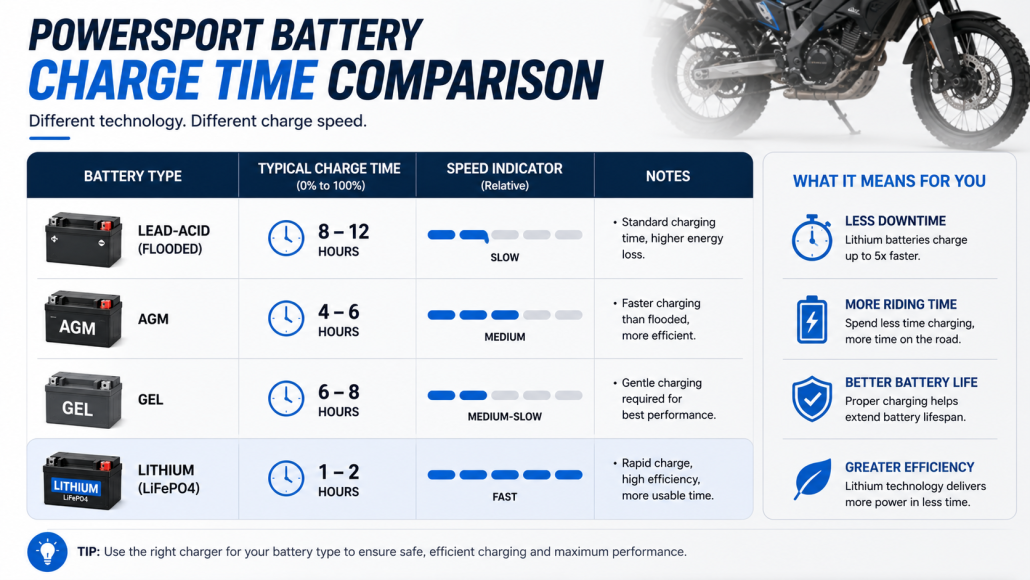
Quick Answer: A motorcycle battery typically takes 8–12 hours to charge if it is flooded lead-acid, 6–10 hours for AGM, 7–11 hours for gel, and 1–3 hours for lithium-ion or LiFePO4 when paired with the right charger. The exact time depends on the battery’s state of charge, charger amperage, and battery condition.
Charging time by battery type
| Battery Type | Typical Charging Time | Key Charging Behavior |
| Flooded Lead-Acid | 8–12 hours | Charges slowly and requires careful voltage regulation to avoid overheating or excessive gassing |
| AGM | 6–10 hours | Slightly faster than flooded lead-acid because of lower internal resistance |
| Gel | 7–11 hours | Sensitive to overvoltage and should only be charged with a gel-compatible charger |
| Lithium-Ion / LiFePO4 | 1–3 hours | Charges much faster when paired with a compatible lithium charger and BMS-enabled battery |
The source draft already reflects these ranges, and the technical takeaway is straightforward: lithium charges faster because it accepts current more efficiently, while lead-acid and gel batteries need slower, more controlled charging to avoid damage.
Why charging time matters
Charging too slowly is inconvenient, but charging incorrectly is more costly. Undercharging leaves the battery partially depleted, while overcharging creates heat, stresses the internal chemistry, and shortens battery life. For lead-acid and gel batteries, repeated overcharging can lead to electrolyte loss, plate damage, and permanent failure. For lithium batteries, the Battery Management System typically prevents unsafe charging once the cell voltage reaches its upper limit.
That is the real issue, for riders and dealers alike: charging time is not just about convenience. It affects service life, reliability, and the total cost of ownership.
What affects motorcycle battery charging time?
Charging time is not fixed. A battery that was only lightly discharged may recover in a few hours, while one that has sat flat for weeks may take longer or may not recover fully at all. Battery chemistry is the biggest variable, but charger output matters just as much. A low-amp maintainer is ideal for storage, while a properly sized smart charger will restore a battery much faster.
Battery condition also matters. If a battery charges slowly, loses voltage quickly, or becomes hot during charging, the issue may be internal wear rather than charger selection. In that case, replacement is usually the more reliable answer.
Lead-acid vs. AGM vs. gel vs. lithium
Lead-acid batteries remain common because they are inexpensive and familiar, but they are slower to recharge and more sensitive to being left discharged. AGM batteries improve on flooded lead-acid by reducing maintenance and improving vibration resistance. Gel batteries require the most charging discipline, because they are sensitive to overvoltage and need a compatible charger.
Lithium batteries, especially LiFePO4 models, are the fastest-charging option in the group. They are also lighter, hold voltage more consistently, and usually require less day-to-day maintenance. For riders who want shorter downtime and a cleaner ownership experience, that difference is significant.
If you are comparing chemistries more broadly, our related guides on Best Rated Motorcycle Batteries and The Best Lithium Motorcycle Battery: An Engineering Guide to LiFePO4 Upgrades are useful next reads. For V-twin owners, The Best Harley-Davidson Battery guide goes deeper into lithium replacement value for heavy-cranking applications.
The hidden risk of overcharging
Overcharging is one of the most common reasons batteries fail early. In flooded and AGM batteries, it can create heat, dry out electrolyte, and damage plates. In gel batteries, it can cause irreversible harm if the charger is not matched to the chemistry. The source draft correctly calls out these failure modes and recommends smart charging with automatic shutoff or trickle mode as the safest approach.
In lithium batteries, the BMS provides the protection layer by stopping charge once the safe upper limit is reached. That is one of the reasons lithium can charge faster while still staying reliable.
Is it time to upgrade to lithium?
For riders who are tired of long charging times, weak starting performance, or repeated battery maintenance, lithium is often the better long-term solution. The source draft notes that lithium motorcycle batteries can charge 3–5 times faster than lead-acid batteries and also include built-in safety features such as a BMS.
That makes lithium especially attractive for riders who want quicker turnaround between rides and less time spent managing the battery during storage. Even so, the battery still has to match the motorcycle’s charging system and physical battery bay. A battery that performs better on paper is not useful if it does not fit the machine correctly.
Best practices for charging and storage
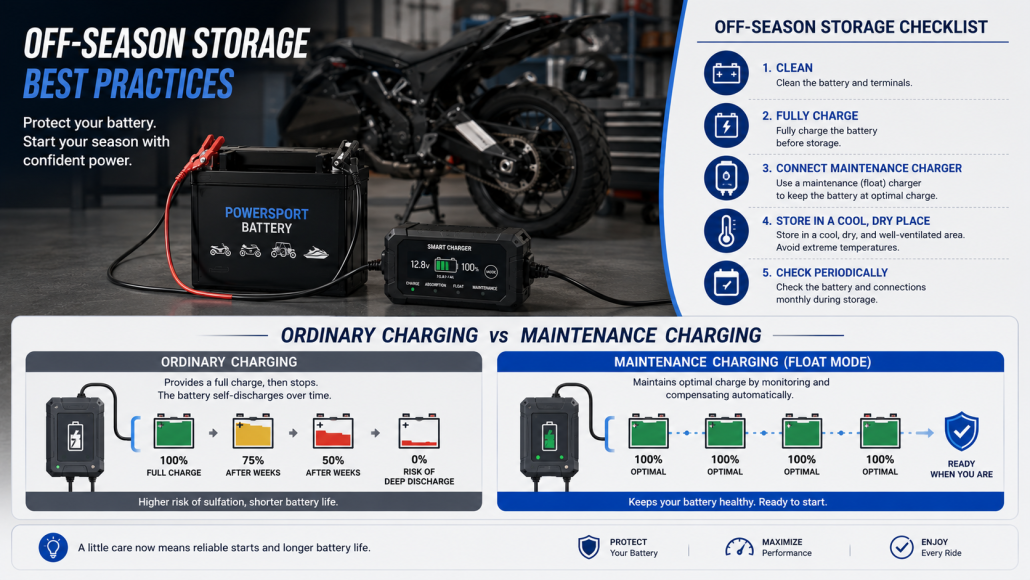
The source draft’s maintenance guidance is exactly right: follow the manufacturer’s charging instructions, avoid repeatedly jump-starting deeply discharged batteries, and keep a smart charger connected during off-season storage.
For colder climates and seasonal riders, storage discipline matters just as much as chemistry. A battery that sits idle through the off-season without maintenance will age much faster than one that is stored correctly. Disconnect the battery when the bike will sit for long periods, keep it in a cool and dry place, and use a charger that matches the battery type.
Final thoughts
How long it takes to charge a motorcycle battery depends on the battery’s chemistry, how deeply it was discharged, and whether the charger is properly matched to the system. Lead-acid and AGM batteries usually take longer and are more sensitive to storage habits, while lithium batteries recharge faster and hold voltage more consistently when paired with the right charging equipment.
For riders who want reliable starts, shorter downtime, and less maintenance, the charging question is only part of the decision. Battery chemistry, charger compatibility, and storage habits all shape long-term performance.
Check out this guide, for a deeper dive into whether a lithium upgrade makes sense for your riding style and electrical demands: When Should You Upgrade Your Motorcycle Starter Battery?