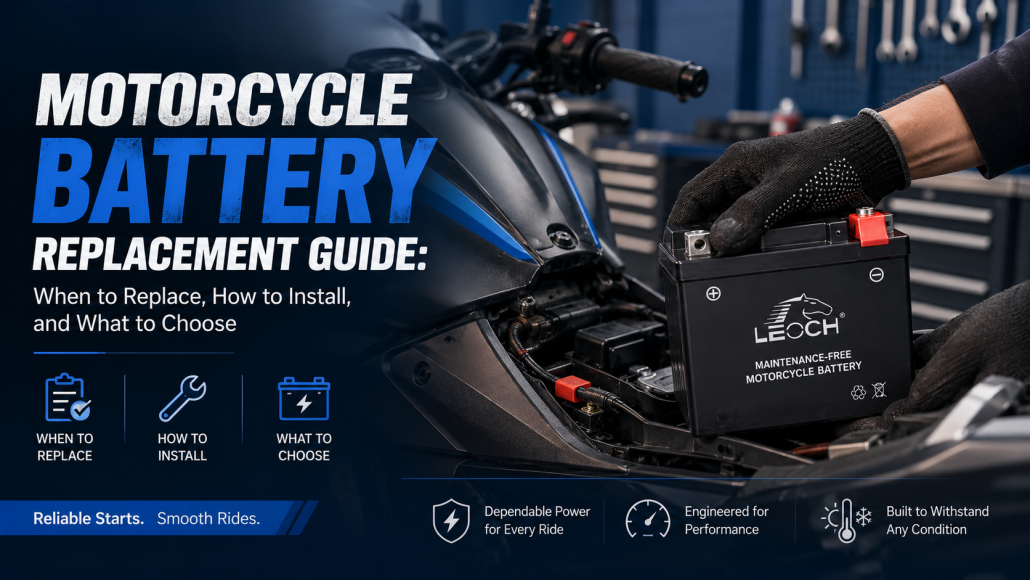
Powersports Battery Replacement Guide: When, How, and What to Choose
A dead powersports battery can leave you stranded at the worst possible time. Whether you ride daily, head out on weekend trips, or store your machine through the winter, battery health directly affects starting reliability, electrical performance, and overall ride confidence. For riders in the Americas market, this topic extends beyond motorcycles to the broader powersports category, including ATVs, UTVs, side-by-sides, and other recreational vehicles that depend on compact, high-current batteries.
The right replacement battery should match your vehicle’s voltage and physical dimensions, deliver enough cranking power for reliable starts, and fit the way you actually use the machine. That is why battery replacement is not just a maintenance task. It is a performance and reliability decision.
Quick Answer: Most powersports batteries last about 2–4 years for lead-acid and 5–8 years for lithium when properly maintained. If your machine starts slowly, the lights dim, the starter clicks, or resting voltage falls below 12.4V, replacement is usually the smarter choice than waiting for a complete failure.
How long does a powersports battery last?
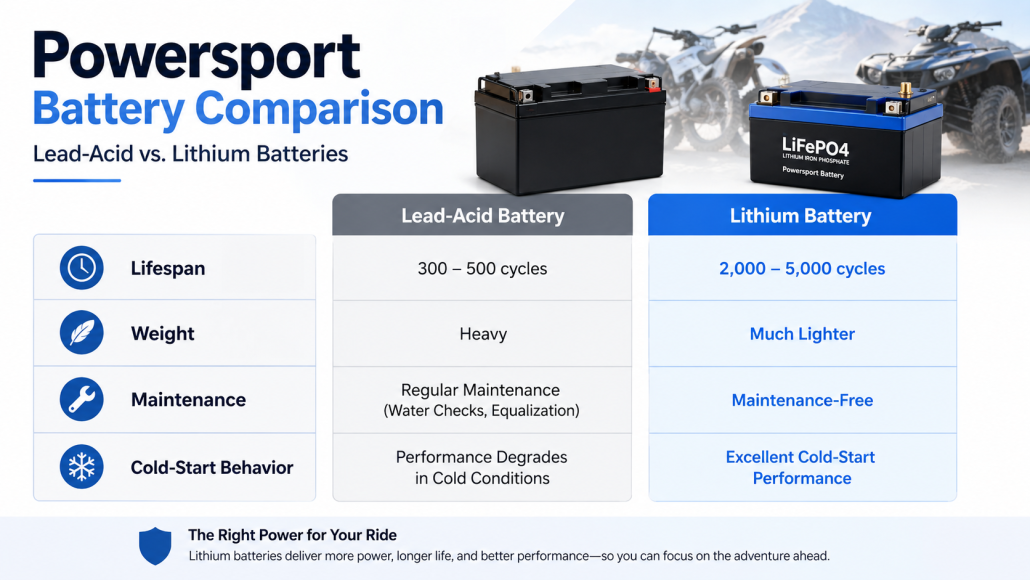
Battery life depends on chemistry, riding habits, climate, and charging discipline. In the source draft, lead-acid batteries are described as typically lasting 2–4 years, while lithium-ion powersports batteries often last 5–8 years, especially when paired with a proper Battery Management System (BMS). That difference is not just about chemistry on paper; it comes from how the battery handles repeated use, partial charging, and long storage periods.
Lead-acid batteries are generally more forgiving on upfront cost, but they age faster when left partially charged, deeply discharged, or stored for long periods without a maintainer. Lithium batteries hold voltage more consistently and are less sensitive to the kinds of cycling that shorten the life of lead-acid systems. In practical terms, that means lithium often delivers steadier performance across more seasons, while lead-acid remains a lower-cost choice for riders who prioritize purchase price over longevity.
If your machine sits idle for months without a battery tender, life expectancy can fall well below the typical range. Many premature “battery failures” are really storage failures rather than chemistry failures.
Signs your powersports battery needs to be replaced
A battery rarely fails without warning. The source draft correctly identifies the key signs: slow starting, dim or flickering lights, clicking at the starter, swelling, leaking, frequent recharging, and resting voltage below 12.4V.
The most important point is that a battery can still look acceptable at rest and fail the moment it is asked to deliver cranking current. That is why riders should not rely only on a casual voltage reading. A battery that drops too far under load is no longer doing its job, even if it appears charged on the surface.
How to replace a powersports battery safely
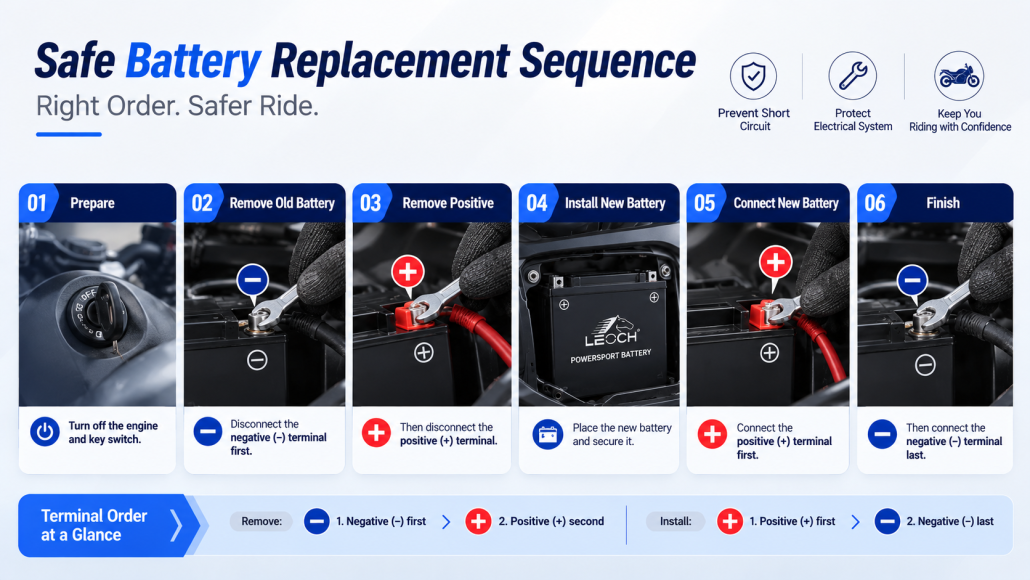
Replacing a powersports battery is usually straightforward, but the terminal order matters. The source draft’s sequence is the correct one: switch off the ignition, locate the battery, disconnect the negative terminal first, remove the old battery, install the new one, then reconnect the positive terminal first and the negative terminal last.
That order reduces the risk of accidental short circuits. Disconnecting the negative terminal first helps isolate the circuit, while reconnecting the positive terminal first during reassembly prevents the wrench from bridging the battery and frame while the system is still open. If you are removing a lead-acid battery, handle it carefully, because acid residue and corrosion can damage the tray and cable ends. Once the new battery is installed, it should sit securely in the tray, and all electronics should power up normally.
How to choose the right replacement battery
The four most important selection factors are voltage, cold cranking amps, battery dimensions, and chemistry. The source draft already frames the decision correctly: voltage is non-negotiable, CCA determines starting power, size determines fit, and chemistry determines lifespan, weight, charging behavior, and maintenance requirements.
Most powersports vehicles use 12V systems, so the replacement must match the bike or vehicle’s electrical architecture. CCA matters because it determines how much starting current the battery can deliver in cold conditions or under a high-load start. Physical dimensions matter because many powersports battery compartments have little tolerance for oversized cases. Chemistry then determines the rest of the ownership experience: how long the battery lasts, how much it weighs, whether it requires maintenance, and how stable it remains over time.
| Factor | Lead-Acid Battery | Lithium Battery |
| Lifespan | 2–4 years | 5–8 years |
| Weight | Heavier | Up to 60% lighter |
| Maintenance | May require topping up | Maintenance-free |
| Self-Discharge | Higher | Very low |
| Cold Start Performance | Less efficient in cold | Stronger performance |
| Upfront Cost | Lower | Higher, but lower long-term cost |
For riders who want the lowest initial spend, lead-acid still makes sense. For riders who want lower weight, longer service life, and more consistent performance across seasons, lithium is usually the better long-term choice.
When lithium makes sense for powersports
Lithium is especially attractive for performance riders, touring riders, and owners who have added electrical accessories such as lighting or audio systems. The source draft makes this point clearly: if you are tired of short battery life, corrosion, or acid leaks, lithium is worth serious consideration.
The reason is not just convenience. Lithium delivers more stable voltage during use, which supports more consistent starting and accessory performance. That matters in the real world, where modern powersports machines are often asked to run more electronics than they were originally designed for. Even so, lithium should still be selected carefully. It must be compatible with your vehicle’s charging system and physical battery bay. A battery that is technically better on paper is not useful if it does not fit the machine or integrate properly with the charging architecture.
Winter storage and battery care
Winter storage is where many batteries are quietly lost. The source draft’s guidance is correct and practical: disconnect the battery, store it in a cool, dry place, and use a battery tender to maintain charge during long storage.
That advice matters especially in seasonal climates, where the battery may sit unused for months. A battery stored partially discharged will age faster than one kept in a stable condition. In that sense, storage discipline can matter just as much as battery chemistry. A rider who stores the machine properly can often extend battery life significantly compared with someone who leaves it disconnected and forgotten all winter.
Battery choice by use case
The best battery depends on how the machine is used. A rider who wants the lowest upfront price and rides only occasionally may still find lead-acid practical. A rider who values lower weight, stronger consistency, and reduced maintenance will usually be better served by lithium. That decision becomes even more important for touring riders and machines with extra loads, where voltage stability can make a noticeable difference in everyday use.
Frequently asked questions
Can I replace a powersports battery myself?
Yes. Most powersports battery replacements are straightforward if you follow the correct terminal order, secure the battery properly, and confirm that the replacement matches your vehicle’s voltage and dimensions. The source draft also correctly notes that this can usually be done with simple tools and a bit of patience.
How often should I check my powersports battery?
At least once a month during riding season is a practical rule. It is also smart to test voltage before long trips or after winter storage. The source draft already recommends monthly checks and voltage testing after storage, which is exactly the right habit for seasonal riders.
Should I upgrade to lithium?
If you want lighter weight, longer service life, and lower long-term maintenance, lithium is usually the better choice. If your priority is the lowest upfront cost, lead-acid remains a reasonable option. The right answer depends on how often you ride, where you store the machine, and whether you value long-term savings over initial purchase price.
Related reads
For readers who want to go deeper, the source draft already points to three useful related articles: Best Rated Motorcycle Batteries: Comparing Lead-Acid, AGM, and Lithium Technologies, The Best Lithium Motorcycle Battery: An Engineering Guide to LiFePO4 Upgrades, and The Best Harley-Davidson Battery: Why V-Twin Riders Are Upgrading to Lithium. Those links fit well as supporting content in a powersports battery hub.
Final thoughts
A failing powersports battery does not always give a dramatic warning. Sometimes it simply loses the ability to deliver current when you need it most. Replacing it proactively helps avoid stranded starts, weak electrical performance, and unnecessary downtime. Whether you choose lead-acid or lithium, the correct answer depends on voltage, fitment, cranking power, and how the machine is actually used. For American powersports riders, that makes battery replacement a practical engineering decision, not just a maintenance task.