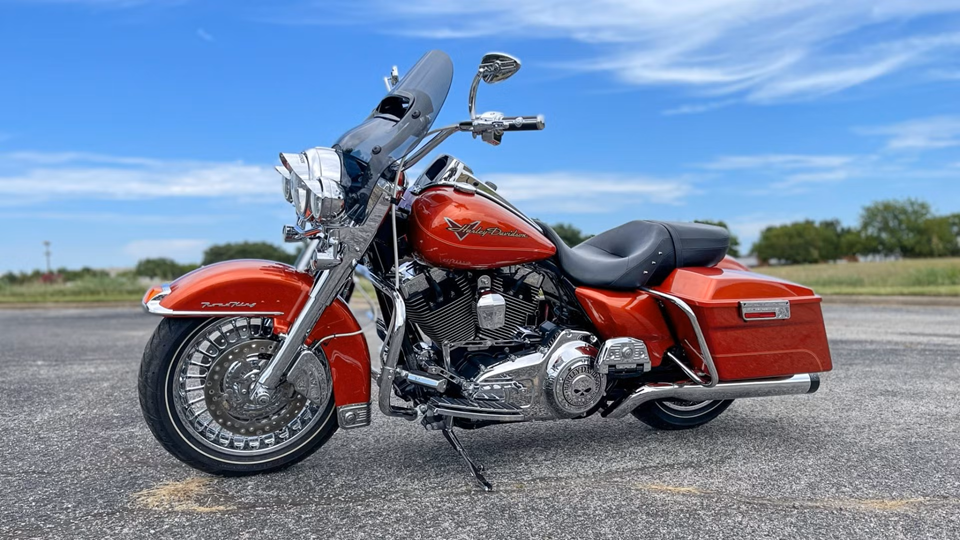
The Best Harley-Davidson Battery: Why V-Twin Riders Are Upgrading to Lithium
For many Harley-Davidson owners, there’s a familiar sound that’s guaranteed to ruin the start of a ride.
Click.
Instead of the deep rumble of a V-Twin engine coming to life, the starter struggles, the lights dim, and the battery simply doesn’t have enough power to overcome the engine’s compression.
While many riders assume their battery has simply reached the end of its life, the real issue is often more fundamental: modern Harley-Davidson motorcycles demand far more from a battery than traditional lead-acid technology was designed to deliver.
Today’s Touring, Softail, Road Glide, Street Glide, and Sportster models feature larger displacement engines, higher compression ratios, more onboard electronics, and security systems that continuously draw power—even when parked.
As a result, more riders are replacing conventional AGM batteries with Lithium Iron Phosphate (LiFePO₄) batteries that provide dramatically higher cranking power, lower weight, and significantly longer service life.
The Quick Answer
The best battery for a Harley-Davidson in 2026 is a Lithium Iron Phosphate (LiFePO₄) battery. Large-displacement V-Twin engines require exceptional starting current, and a quality lithium battery can deliver 800+ Cold Cranking Amps (CCA) almost instantly. Compared with traditional AGM batteries, lithium batteries reduce voltage sag during startup, remove over 10 pounds of weight from the motorcycle, resist extreme engine vibration, and typically last two to three times longer.
Why Do Harley-Davidson Motorcycles Destroy Standard Batteries?
Unlike many motorcycles, Harley-Davidson models place unusually high demands on their starting batteries.
It’s not because the batteries are poorly built—it’s because the motorcycles themselves are exceptionally demanding.
Large V-Twin Engines Need Massive Starting Current
Harley-Davidson’s Milwaukee-Eight and Twin Cam engines feature large-displacement cylinders with relatively high compression.
Turning these engines over requires a tremendous burst of current within a fraction of a second.
If the battery voltage drops too quickly during cranking, several problems occur simultaneously:
- The starter motor slows down.
- Ignition voltage decreases.
- Electronic control modules receive unstable power.
- Engine starting becomes inconsistent.
This is why high Cold Cranking Amps (CCA) matter so much when choosing the best battery for Harley-Davidson motorcycles.
Lithium batteries excel because they deliver maximum current almost immediately instead of gradually losing voltage under heavy loads.
The Famous “Harley Shake”
Every Harley rider appreciates the unmistakable character of a V-Twin engine.
Unfortunately, batteries don’t.
The significant vibration generated by large-displacement engines can gradually damage traditional lead-acid batteries.
Inside an AGM battery, lead plates remain susceptible to long-term mechanical fatigue despite being supported by fiberglass separators. Continuous vibration can eventually contribute to:
- Internal plate wear
- Reduced electrical contact
- Capacity loss
- Premature battery failure
A Harley lithium battery, by contrast, uses a solid-state cell structure with no heavy lead plates to flex or crack. This makes lithium chemistry exceptionally resistant to the continuous vibration experienced during thousands of miles of riding.
Security Systems Never Truly Sleep
Modern Harley-Davidson motorcycles incorporate the H-D Smart Security System, electronic control modules, clocks, and memory functions that continue drawing small amounts of electricity while parked.
Although the parasitic draw is relatively small, it accumulates over weeks or months.
For riders who store their motorcycles during winter—or simply don’t ride every week—battery self-discharge becomes increasingly important.
Lithium batteries typically lose less than 1.5% of their charge per month, helping maintain sufficient starting power after extended storage.
AGM vs. Lithium: The Harley Battery Performance Matrix
When considering a Harley battery replacement, comparing specifications side by side quickly highlights why lithium has become the preferred upgrade for many riders.
| Performance Metric | Premium Lithium (LiFePO4) | Factory AGM (Absorbed Glass Mat) |
| Average Physical Weight | ~3 – 5 lbs | ~15 – 18 lbs |
| V-Twin Cranking Power (CCA) | Up to 800+ CCA (Instant delivery) | 300 – 400 CCA (Prone to voltage sag) |
| Vibration Resistance | Extreme (Solid-state dry cell) | High (Fiberglass matting) |
| Off-Season Self-Discharge | < 1.5% per month (Ideal for winter storage) | ~3% per month |
| Service Lifespan | 8 – 10 Years | 3 – 5 Years |
The most noticeable difference is often weight.
Removing 10–13 pounds from a Harley-Davidson isn’t simply about reducing total mass—it lowers weight positioned relatively high on the motorcycle, which can make low-speed maneuvering and parking lot handling feel noticeably easier.
Equally important is the increased cranking performance. Lithium batteries maintain higher voltage during engine startup, reducing starter strain and improving ignition reliability, especially on large Touring models equipped with additional electrical accessories.
Fitment & Installation: Upgrading Your Sportster, Softail, or Touring Rig
Installing a Harley lithium battery is generally straightforward, but there are several important considerations to ensure reliable operation.
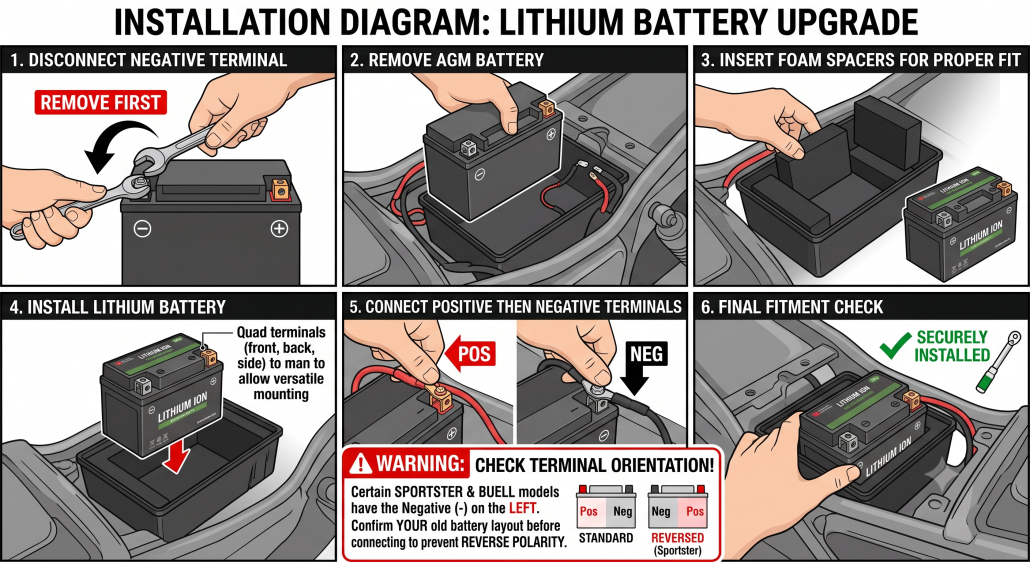
Begin by switching off the motorcycle completely and removing the seat to access the battery compartment.
Disconnect the negative (-) terminal first, followed by the positive (+) terminal. After removing the original battery, clean the cable terminals before installing the new unit.
Next, position the lithium battery securely inside the battery box and connect the positive (+) cable first, followed by the negative (-) cable. Once all terminals are tightened to the manufacturer’s recommended torque, reinstall the seat and verify that the motorcycle starts normally.
Pay Attention to Battery Size
One characteristic of lithium technology is its significantly higher energy density.
Because lithium cells store more energy in a smaller package, many lithium batteries have a smaller physical footprint than the original AGM battery.
To prevent movement inside the battery compartment, always use the supplied high-density foam spacers or battery shims to create a snug, vibration-resistant fit.
A loose battery can place unnecessary stress on cables and terminals, especially on motorcycles that experience continuous engine vibration.
Sportster Reverse-Polarity Warning
Some Harley-Davidson Sportster models use battery terminal orientations that differ from other Harley platforms.
Before connecting the cables, always verify:
- Positive terminal location
- Negative terminal location
- Cable routing
- Battery model compatibility
Never assume terminal positions are identical to your previous battery.
Accidentally reversing polarity can immediately damage the motorcycle’s electrical system, including the ECU, charging system, and battery management electronics.
Choosing the Best Battery for Your Harley-Davidson
Not every lithium battery is engineered for the demands of a large V-Twin motorcycle.
When evaluating a replacement, look beyond amp-hour ratings and consider the characteristics that most directly affect real-world performance:
- High Cold Cranking Amps (CCA) for reliable starts.
- Integrated Battery Management System (BMS) with protection against overcharging, over-discharging, short circuits, and excessive temperatures.
- Robust vibration resistance designed specifically for V-Twin motorcycles.
- Low self-discharge for seasonal storage.
- Lightweight construction without sacrificing durability.
- A model designed to fit your Harley’s battery compartment securely.
A quality lithium battery is not simply a replacement—it is a performance upgrade that improves starting reliability, reduces maintenance, and extends service life.
Frequently Asked Questions: Harley Battery Upgrades
Will my Harley’s stock charging system work with a lithium battery?
Yes.
Most modern Harley-Davidson motorcycles from the Twin Cam and Milwaukee-Eight generations regulate charging voltage between 14.0V and 14.6V, which falls within the optimal operating range for quality lithium batteries equipped with an integrated Battery Management System (BMS).
Always confirm compatibility with the battery manufacturer’s specifications, particularly if your motorcycle has been modified with aftermarket charging components.
Can I use a standard battery tender on my Harley lithium battery?
No.
Lithium batteries should only be charged using a lithium-compatible smart charger.
Traditional lead-acid battery chargers often include a desulfation mode, which periodically applies high-voltage pulses intended to break down sulfate crystals inside lead-acid batteries.
These voltage spikes are not suitable for lithium batteries and can permanently damage the battery’s internal Battery Management System (BMS), reducing performance or causing battery failure.
If you store your motorcycle for extended periods, invest in a charger specifically designed for LiFePO₄ motorcycle batteries.
Ride Further with Confidence
The battery hidden beneath your seat plays a far greater role than simply starting your motorcycle.
For Harley-Davidson owners, it must withstand high-compression engine starts, continuous vibration, long periods of storage, and the electrical demands of modern electronics—all while delivering consistent performance year after year.
That’s why more riders are choosing Lithium Iron Phosphate (LiFePO₄) technology for their Harley battery replacement. With higher cranking power, lighter weight, superior vibration resistance, and a significantly longer lifespan than traditional AGM batteries, lithium has become the preferred choice for riders who value reliability on every ride.
Whether you’re upgrading a Sportster, Softail, Road Glide, Street Glide, or Touring model, selecting a premium lithium battery can reduce maintenance, improve starting performance, and provide greater confidence every time you press the starter.
Ready to upgrade your Harley-Davidson? Explore our premium lithium motorcycle batteries or contact our technical team for help selecting the ideal battery for your specific Harley model and riding style.