EZGO Lithium Battery Upgrade: How to Safely Convert RXV & TXT Models
Introduction: The Modern Multi-Passenger Cart
Golf carts have evolved far beyond the fairway.
Across the United States, EZGO vehicles serve as neighborhood electric vehicles (NEVs), resort shuttles, campground transportation, industrial utility carts, hunting buggies, and facility maintenance vehicles. Many operate daily under heavier loads, longer driving distances, and more demanding terrain than their original designs anticipated.
As a result, many owners are discovering that aging lead-acid battery systems are becoming the weakest link in overall cart performance.
However, upgrading to lithium isn’t simply a matter of replacing old batteries with new ones.
A successful EZGO lithium battery upgrade requires understanding the specific electrical architecture of your cart. The requirements for an EZGO TXT are different from those of an EZGO RXV, and overlooking those differences can impact both performance and safety.
Before purchasing a battery system, it’s critical to understand which platform you’re working with.
EZGO RXV vs. TXT: Knowing Your Platform Before You Upgrade
Although both models are popular throughout the US golf cart market, the TXT and RXV platforms operate differently.
Understanding these differences is the first step toward a successful lithium conversion.
The EZGO TXT Platform
The EZGO TXT remains one of the most common golf carts ever produced.
Most TXT models utilize a traditional DC motor system paired with either a series controller or shunt-based controller architecture.
Advantages of the TXT platform include:
- Simple electrical design
- Proven reliability
- Straightforward maintenance
- Excellent compatibility with lithium upgrades
Because the system is relatively forgiving of voltage fluctuations, most TXT models are ideal candidates for a direct 48V lithium monoblock conversion.
For many owners, installation can be completed with minimal modifications beyond charger replacement.
The EZGO RXV Platform
The RXV represents a more advanced design.
Instead of a conventional DC motor, the RXV utilizes a high-efficiency AC drive system that improves energy efficiency and overall performance.
The RXV also incorporates an electronic parking brake system that automatically engages under certain operating conditions.
This brake system is where lithium battery selection becomes critically important.
The Crucial RXV Safety Warning
Not all lithium batteries are engineered for high-performance golf cart applications.
Some lower-cost lithium batteries contain Battery Management Systems (BMS) that cannot supply sufficient peak discharge current when the cart experiences sudden acceleration demands.
Examples include:
- Climbing steep hills
- Accelerating from a stop
- Carrying multiple passengers
- Pulling utility loads
- Operating oversized tires
While a standard DC cart can pull a steady 75A, a modified EZGO RXV accelerating up an incline can experience transient current spikes exceeding 200A. If your lithium battery’s BMS cannot support a continuous output of 100A–150A and a short-duration peak current of 250A–300A, the system will instantly trip into safety shutdown, locking the mechanical brakes mid-transit.
When the battery’s BMS detects excessive current demand, it may temporarily shut down to protect the cells.
On an RXV, this creates a serious issue.
If power is suddenly interrupted, the automatic electronic parking brake can deploy while the vehicle is moving.
This can result in:
- Sudden vehicle deceleration
- Loss of control
- Potential drivetrain damage
- Significant safety risks
For RXV owners, selecting an enterprise-grade lithium battery with sufficient continuous discharge and peak discharge capacity is not optional—it is a mandatory safety requirement.
Always verify that the battery’s BMS specifications are compatible with RXV current demands before installation.
Reclaiming Performance: The 48V Lithium Advantage
A properly engineered lithium conversion delivers far more than longer battery life.
It fundamentally changes how the cart drives.
Extended Service Life
Traditional lead-acid batteries typically require replacement every 3 to 5 years.
High-quality Lithium Iron Phosphate (LiFePO₄) systems often provide:
- 10+ years of service life
- 3,500+ charge cycles
- Consistent performance throughout their lifespan
For fleet operators and frequent users, this dramatically lowers total ownership costs.
Faster Charging
Lithium batteries charge significantly faster than lead-acid systems.
Benefits include:
- Reduced downtime
- Faster turnaround between uses
- Improved fleet utilization
- Opportunity charging during breaks
Many users can recover meaningful range during short charging sessions.
Zero Maintenance
Traditional lead-acid ownership includes:
- Watering batteries
- Cleaning corrosion
- Inspecting terminals
- Managing acid exposure
Lithium eliminates these maintenance tasks entirely.
Simply charge and drive.
Reclaiming 300 Pounds of Dead Weight
A typical 48V lead-acid battery bank weighs approximately 350–400 pounds.
Many 48V lithium systems weigh less than 100 pounds.
Removing over 300 pounds from a cart immediately improves:
- Acceleration
- Hill climbing
- Braking responsiveness
- Tire longevity
- Suspension performance
- Energy efficiency
It’s essentially equivalent to permanently removing two adult passengers from the vehicle.
The Technical Sizing Matrix for EZGO Carts
Selecting the proper battery capacity depends on how the vehicle is actually used.
Keep in mind that terrain, tire size, payload, speed, and driving habits all influence actual range.
| EZGO Application Profile | Recommended System Voltage | Ideal Amp-Hour (Ah) Capacity | Expected Range on a Full Charge |
| Standard 2-Seater (Flat Golf Course Use) | 36V or 48V | 50Ah – 60Ah | 15 – 20 Miles |
| 4-Seater NEV (Neighborhood Cruising) | 48V | 100Ah – 105Ah | 30 – 35 Miles |
| Lifted Cargo / Off-Road Hunting Buggy | 48V or 72V | 150Ah+ | 45+ Miles (High-Torque) |
Converting an Older 36V EZGO to 48V Lithium
Many owners of older EZGO Marathon and early TXT models ask whether upgrading from 36V to 48V is possible.
The answer is generally yes—but verification is essential.
A 48V lithium conversion can provide:
- Higher top speeds
- Improved torque
- Better hill-climbing performance
- Increased efficiency
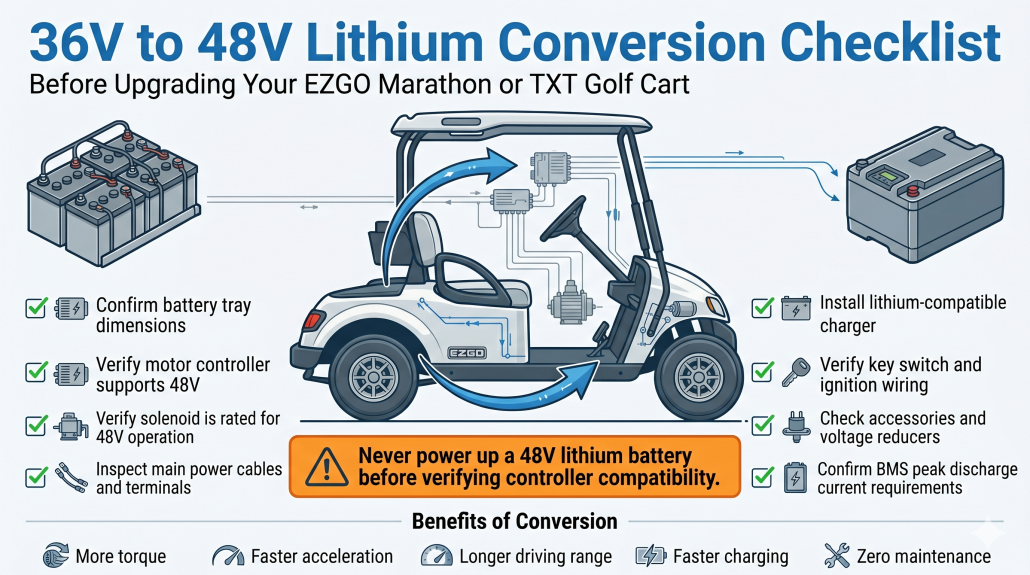
However, before installing a 48V battery, verify the following components:
Conversion Checklist
✓ Motor controller rated for 48V operation
✓ Solenoid compatible with 48V systems
✓ Appropriate charger for lithium chemistry
✓ Proper gauge wiring and connections
✓ Battery tray dimensions suitable for installation
✓ Existing accessories compatible with higher voltage
Failure to verify component compatibility can damage electrical systems and void manufacturer warranties.
Choosing a Monoblock vs. Multiple Battery System
Some lithium conversion kits utilize multiple 12V batteries wired in series.
While functional, this approach introduces:
- Additional wiring
- More connection points
- Increased troubleshooting complexity
- Greater installation time
A single 48V lithium monoblock provides a cleaner solution.
Advantages include:
- Simplified installation
- Fewer failure points
- Centralized Battery Management System
- Improved cell balancing
- Easier maintenance and diagnostics
For most EZGO conversions, a drop-in monoblock design offers the most professional installation outcome.
Fleet & Residential Planning Note
Upgrading your specific brand of cart is only one part of the equation. For a complete breakdown of battery lifespan, charging practices, range calculations, ROI analysis, and lithium technology comparisons, explore our master resource:
Future-Proofing Your EZGO Ride
A lead-acid replacement may restore basic functionality, but it does little to improve the vehicle itself.
A properly engineered lithium conversion transforms the cart into a more capable, more reliable, and more efficient vehicle.
Benefits include:
- Faster charging
- Longer lifespan
- Greater range
- Reduced vehicle weight
- Improved acceleration
- Better hill-climbing performance
- Zero battery maintenance
Most importantly, selecting a lithium battery designed specifically for your EZGO platform ensures safe, reliable operation for years to come.
Whether you’re managing a commercial fleet, operating a resort shuttle service, or upgrading a personal neighborhood vehicle, lithium technology has become the new benchmark for golf cart performance.
Ready to Upgrade?
Explore LEOCH’s complete lineup of lithium golf cart battery systems engineered for EZGO, Club Car, and Yamaha platforms.
For fleet operators, dealers, distributors, and commercial users, contact our US-based battery specialists to discuss wholesale programs, fleet conversion packages, and custom lithium upgrade solutions.
Frequently Asked Questions: EZGO Lithium Upgrades
Can I use my factory EZGO charger for a lithium battery?
You cannot use a factory lead-acid charger for a lithium golf cart battery upgrade. Lead-acid chargers utilize a multi-stage charging profile designed to intentionally boil and desulfate lead plates. Applying this profile to a Lithium Iron Phosphate (LiFePO₄) battery can permanently damage the cells and fail to safely trigger the Battery Management System (BMS) cell-balancing sequence. Always use a dedicated smart charger designed for lithium chemistry.
How fast does an EZGO lithium battery charge?
An enterprise-grade lithium golf cart battery charges approximately 3x to 5x faster than a traditional lead-acid bank. While standard lead-acid batteries require 8 to 12 hours for a full saturation charge, a high-capacity LEOCH lithium monoblock can achieve a 100% state of charge in 2 to 3 hours.
Where is the best place to perform an EZGO lithium conversion?
While many DIY owners handle conversions at home, professional installation is highly recommended for newer AC systems or whenever you are bypassing factory components like an On-Board Computer (OBC). For fleet operations, partnering with an authorized distributor ensures correct software integration with local maintenance support.