12V Lithium Battery: The Complete Engineering Guide (2026)
Introduction
The 12V lithium battery has become one of the world’s most widely adopted rechargeable battery formats. From RVs and marine vessels to home solar systems, backup power, mobility equipment, robotics, and industrial applications, its combination of lightweight construction, long cycle life, and maintenance-free operation has made it the preferred replacement for traditional lead-acid batteries.
As battery technology has matured, Lithium Iron Phosphate (LiFePO₄) has emerged as the dominant chemistry for 12V energy storage. Compared with conventional flooded or AGM batteries, LiFePO₄ delivers higher usable capacity, faster charging, significantly longer service life, and enhanced thermal stability.
For engineers, system integrators, fleet managers, and end users alike, selecting the right 12V lithium battery requires more than comparing amp-hour ratings. Battery chemistry, Battery Management System (BMS), continuous discharge capability, operating temperature, charging profile, and communication interfaces all influence long-term performance and safety.
Quick Answer: What Is a 12V Lithium Battery?
A 12V lithium battery is a deep-cycle rechargeable energy storage system constructed from four Lithium Iron Phosphate (LiFePO₄) cells connected in series (4S configuration), yielding a nominal voltage of 12.8V. Designed as a high-performance replacement for traditional lead-acid batteries, a 12V LiFePO₄ battery provides 3,000 to 6,000+ charge cycles, 100% usable Depth of Discharge (DoD), ~98% round-trip efficiency, and an integrated Battery Management System (BMS) for safety.
At a Glance: 12V Lithium vs Lead-Acid
| Parameter | 12V LiFePO₄ Battery | AGM / Flooded Lead-Acid |
| Nominal Voltage | 12.8V | 12V |
| Recommended Depth of Discharge | 80–100% | ~50% |
| Cycle Life | 3,000–6,000+ | 300–800 |
| Round-Trip Efficiency | 95–98% | 75–85% |
| Maintenance | None | Regular (Flooded) |
| Charge Time | 2–4 hours | 8–12 hours |
| Weight | About 50–70% lighter | Heavy |
| Self-discharge | Very low | Higher |
| Typical Service Life | 10–15 years | 3–5 years |
Understanding 12V Lithium Battery Technology
Although commonly referred to as a “12V battery,” a LiFePO₄ battery actually operates over a wider voltage range.
A typical voltage profile includes:
| Battery State | Voltage |
| Fully Charged | 14.4–14.6V |
| Nominal | 12.8V |
| Resting | 13.2–13.4V |
| Recommended Recharge | ~12.0V |
| BMS Cutoff | Typically 10–10.8V |
Unlike lead-acid batteries, lithium maintains a relatively flat discharge curve. This means equipment continues receiving stable voltage throughout most of the discharge cycle, resulting in consistent motor performance, inverter output, and electronic operation.
Why LiFePO₄ Has Become the Industry Standard
Not all lithium batteries use the same chemistry. While Lithium Nickel Manganese Cobalt (NMC) remains common in electric vehicles and consumer electronics due to its high energy density, LiFePO₄ has become the preferred chemistry for stationary and deep-cycle applications because it prioritizes safety, longevity, and reliability.
Thermal Stability
LiFePO₄ chemistry offers excellent resistance to thermal runaway, making it well suited for residential, marine, and industrial environments where long-term operational safety is essential.
Long Cycle Life
Most quality LiFePO₄ batteries deliver 3,000 to over 6,000 full charge cycles, depending on operating conditions and depth of discharge. For many users, this translates to more than a decade of service.
Deep Cycling
Unlike lead-acid batteries that should generally not be discharged below 50%, LiFePO₄ batteries can routinely operate at 80–100% depth of discharge without significantly shortening battery life.
High Efficiency
With round-trip efficiencies approaching 95–98%, more stored energy is available for practical use, reducing overall energy losses in solar, backup, and mobile power systems.
The Role of the Battery Management System (BMS)
One of the most important components inside a modern 12V lithium battery is the integrated Battery Management System (BMS).
Rather than simply storing energy, the BMS continuously monitors battery health and ensures safe operation by protecting against:
- Overcharging
- Over-discharging
- Overcurrent
- Short circuits
- Cell imbalance
- High and low temperatures
Many advanced batteries also include additional capabilities such as Bluetooth monitoring, CAN bus or RS485 communication, remote diagnostics, and firmware updates, enabling real-time battery management for both residential and commercial installations.
How to Choose the Right 12V Lithium Battery
Selecting a battery involves more than matching voltage. The following specifications have the greatest impact on system performance.
Capacity (Ah)
Amp-hours determine how much energy the battery stores.
Common capacities include:
| Capacity | Typical Applications |
| 50Ah | Portable power, small boats, mobility devices |
| 100Ah | RVs, marine, solar storage, camping |
| 200Ah | Larger off-grid systems, commercial equipment |
| 300Ah+ | Industrial energy storage and extended backup |
As a simple estimate:
Runtime (hours) = Battery Capacity (Wh) ÷ Load Power (W)
For example, a 12V 100Ah battery stores approximately:
12.8 × 100 = 1,280 Wh
A 100W appliance could theoretically operate for around 12 hours, before accounting for inverter losses and system efficiency.
Continuous Discharge Current
Not all batteries can deliver the same amount of power.
While one battery may provide 100A continuously, another may support 200A or higher for demanding applications such as:
- Electric trolling motors
- RV air conditioners (via inverter)
- Mobility equipment
- Industrial automation
- Emergency backup systems
Matching discharge capability to the application’s peak power requirements is just as important as selecting the correct capacity.
Expansion Capability
Many modern LiFePO₄ batteries support series and parallel connections.
Typical configurations include:
- 12V → 24V
- 12V → 36V
- 12V → 48V
- Parallel expansion for greater capacity
This modular approach enables users to begin with a single battery and expand energy storage as power demands grow.
The 100Ah Standard: BCI Group 31 Drop-In Replacement
The 12V 100Ah lithium battery is the most widely specified capacity across RV, marine, and solar installations. Storing approximately 1,280 Wh of usable energy, a single 100Ah LiFePO₄ module delivers double the usable power of a standard 100Ah AGM battery while weighing 60% less.
- Standard BCI Dimensions: Most 12V 100Ah lithium batteries are engineered to fit standard BCI Group 31 or Group 24 battery boxes, enabling direct mechanical drop-in replacement.
- Zero Peukert Loss: Unlike lead-acid batteries, which lose usable capacity under heavy current draws (Peukert’s Law), a 100Ah LiFePO₄ battery delivers its full rated capacity whether powering a low-draw LED circuit or a high-draw 1,000W inverter.
Common Applications for 12V Lithium Batteries
One reason the 12V platform remains so popular is its compatibility with countless electrical systems already designed around 12-volt architectures.
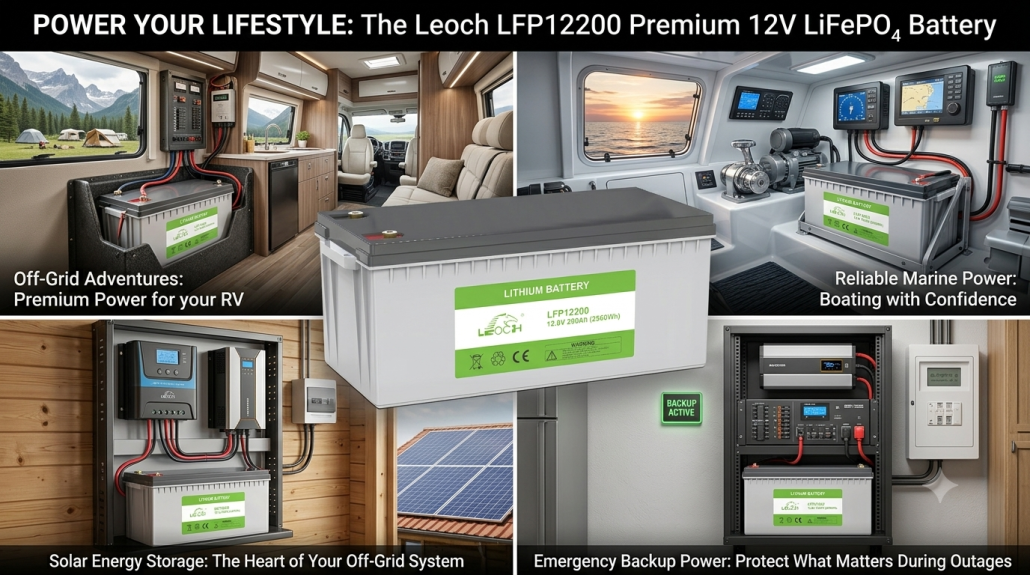
RV and Motorhome House Batteries
Lithium batteries provide stable off-grid power while significantly reducing vehicle weight. They also support rapid charging from solar panels, shore power, and DC-DC chargers.
Related Reading: The Best Lithium Batteries for RVs: 2026 Engineering & Upgrade Guide
Marine House Batteries
Marine environments demand corrosion-resistant, maintenance-free batteries capable of deep cycling and long periods between charging. LiFePO₄ batteries offer excellent vibration resistance and reliable performance for navigation electronics, trolling motors, and onboard appliances.
Related Reading: The Complete Guide to RV House Batteries: Upgrading to Lithium Monoblocks
Residential Solar Energy Storage
A 12V lithium battery can store excess solar generation for later use, improving self-consumption and providing backup power for essential household loads during outages. While larger residential systems often use 48V architectures, 12V batteries remain common in cabins, tiny homes, and small off-grid installations.
Related Reading: Solar Batteries for Home: An Engineering Guide to Residential Storage
Backup Power and UPS
Small UPS systems, security equipment, telecom devices, emergency lighting, and network infrastructure increasingly use 12V LiFePO₄ batteries as replacements for sealed lead-acid batteries due to their longer lifespan and lower maintenance requirements.
Related Reading: The Complete Guide to Uninterruptible Power Supply Applications in Business
Industrial and Mobility Equipment
12V lithium batteries also power:
- Automated Guided Vehicles (AGVs)
- Medical equipment
- Cleaning machines
- Robotics
- Wheelchairs and mobility scooters
- Portable instrumentation
- Remote monitoring systems
12V Lithium Battery Charger Requirements & Profiles
Charging a 12V LiFePO₄ battery requires a dedicated multi-stage 12V lithium battery charger programmed with a Constant Current / Constant Voltage (CC/CV) charging profile.
- Voltage Thresholds: A proper lithium charger targets a bulk/absorption voltage between 14.2V and 14.6V (3.55V-3.65V per cell) and floats between 13.5V and 13.8V.
- Avoid Desulfation Modes: Traditional lead-acid chargers often include automatic desulfation or high-voltage equalization modes (> 15.0V). Connecting a lithium battery to an equalization charge will trigger the BMS high-voltage protection cutoff and disconnect the charger.
- Alternator Charging (DC-to-DC): When charging from an engine alternator, always install a DC-to-DC charger. Because lithium batteries feature exceptionally low internal resistance, they will draw maximum current from the alternator, risking alternator overheating without a current-limiting DC-DC regulator.
Total Cost of Ownership: Why Lithium Costs Less Over Time
Although a 12V LiFePO₄ battery typically costs more upfront than a comparable lead-acid battery, its longer service life and reduced maintenance often result in a lower total cost of ownership (TCO).
| Cost Factor | Lead-Acid | LiFePO₄ |
| Initial Cost | Lower | Higher |
| Replacement Frequency | Every 3–5 years | 10–15 years |
| Watering & Maintenance | Required (Flooded) | None |
| Energy Efficiency | Lower | Higher |
| Lifetime Cost | Higher | Lower |
For commercial fleets, telecom operators, and industrial users, the reduction in downtime, labor, and replacement frequency often justifies the investment within several years.
Frequently Asked Questions
Is a 12V lithium battery better than a lead-acid battery?
For most deep-cycle applications, yes. A LiFePO₄ battery offers a longer lifespan, higher usable capacity, faster charging, lighter weight, and virtually no maintenance compared with traditional lead-acid batteries.
Can I replace a 12V lead-acid battery with a 12V lithium battery?
In many applications, yes. However, you should verify charger compatibility, charging voltage, and whether the existing system requires updates such as a lithium-compatible charger or DC-DC charger.
How long does a 12V lithium battery last?
Most high-quality LiFePO₄ batteries provide between 3,000 and 6,000+ charge cycles, equivalent to approximately 10–15 years of typical use under recommended operating conditions.
Can a 12V lithium battery be connected in series or parallel?
Many modern batteries are designed to support series and parallel configurations, allowing users to build 24V, 36V, or 48V systems or increase overall capacity. Always follow the manufacturer’s specifications for the maximum number of batteries that can be connected.
Can a 12V lithium battery be used in cold weather?
Yes, but charging requires special attention. Most LiFePO₄ batteries can discharge at sub-zero temperatures, while charging below 0°C (32°F) should only be performed if the battery includes low-temperature charging protection or an integrated heating function.
Conclusion
The 12V lithium battery has become the benchmark for reliable deep-cycle energy storage across residential, commercial, recreational, and industrial applications. Thanks to LiFePO₄ chemistry, integrated Battery Management Systems, and modular expansion capabilities, today’s batteries deliver significantly longer service life, higher efficiency, and lower lifetime operating costs than traditional lead-acid alternatives.
Whether you’re upgrading an RV, powering a marine vessel, building an off-grid solar system, or replacing backup batteries in mission-critical equipment, selecting the right battery requires evaluating far more than voltage alone. Capacity, discharge performance, charging compatibility, environmental conditions, and BMS functionality all play a crucial role in long-term reliability.
Investing in a well-engineered 12V LiFePO₄ battery not only improves daily performance but also reduces maintenance, minimizes downtime, and provides a scalable energy platform that can adapt as your power needs evolve.