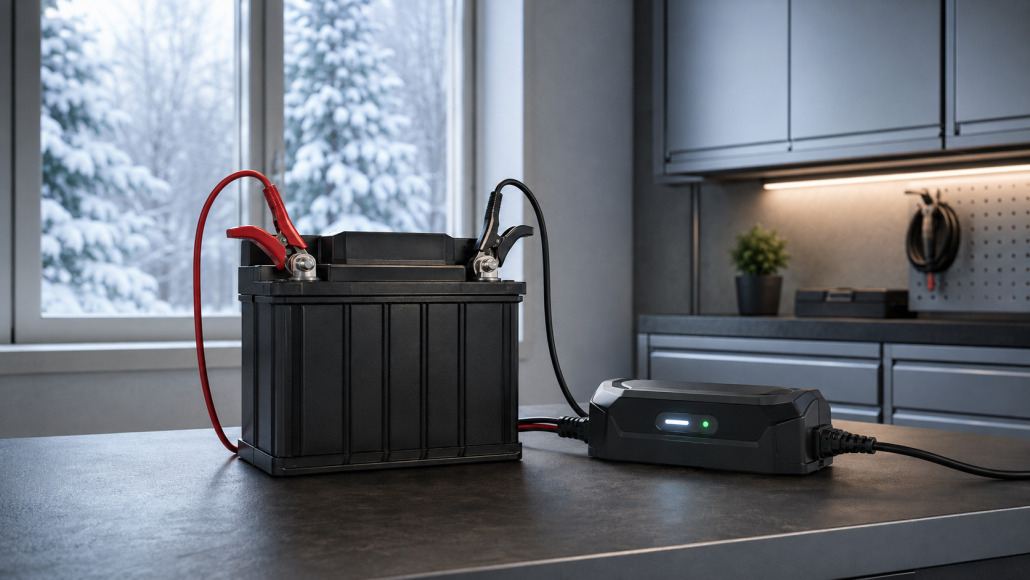
How to Store a Motorcycle Battery During Winter
Quick answer
To store a motorcycle battery during winter, inspect it, identify its chemistry, charge it with a compatible smart charger, and eliminate parasitic drain. Store it in a cool, dry, well-ventilated place. Lead-acid batteries may use an approved maintainer; LiFePO4 batteries require model-specific storage and cold-charging instructions.
A motorcycle can look perfectly preserved after winter and still refuse to start because the battery spent months slowly losing charge. The cold is only part of the story. Clocks, alarms, trackers, ECUs, and USB accessories can keep drawing current with the ignition off, while every battery also self-discharges over time.
For a lead-acid battery, remaining at a low state of charge encourages sulfation, which reduces the active plate area and can become difficult to reverse. A discharged lead-acid battery is also far more vulnerable to freezing because its electrolyte contains proportionally more water. Yuasa’s powersports technical manual gives a useful illustration: a fully charged lead-acid battery may resist freezing below -75°F (-59°C), while a fully discharged one may freeze around 27°F (-3°C). Exact limits vary by battery, but the maintenance lesson is consistent: do not store lead-acid in a discharged state.
Lithium iron phosphate (LiFePO4) starter batteries avoid sulfation and usually self-discharge more slowly, but they are not care-free. Parasitic drain can still take them below a safe state of charge, charger requirements vary, and low-temperature charging rules are product-specific.
Why Motorcycle Batteries Fail During Winter Storage
The common springtime failure is usually a combination of time and low state of charge rather than cold alone. Heat generally accelerates self-discharge, while cold temporarily reduces available capacity and cranking output. A battery in a cold garage may therefore hold charge relatively well when disconnected, yet still appear weak when asked to crank a cold engine.
The more serious risk is leaving the battery connected to an unseen electrical load. Even a small continuous draw can remove a meaningful share of a compact powersports battery’s capacity over several weeks. If the battery is already aging, partly discharged, dirty across the case, or connected to an alarm or tracker, the storage window becomes shorter.
This is why winter battery care begins with chemistry and load management, not with a universal instruction to plug in any charger and leave it running.
Should You Remove a Motorcycle Battery for Winter?
You do not always need to remove the battery. It can remain installed when the motorcycle is stored in a dry, secure location, the battery is easy to inspect, and a manufacturer-approved maintainer can be connected safely. Leaving it installed may also be necessary when the security system must stay armed.
Removal or at least disconnection is the safer choice when there is no suitable outlet, the bike has unknown parasitic draw, the storage area is damp or exposed to severe temperature swings, or the battery manufacturer specifies indoor storage. If you leave the battery installed without a maintainer, disconnecting the negative cable usually interrupts the motorcycle’s normal standby loads. Be aware that this may disable the alarm and reset the clock, radio, or learned settings.
Safety first
Do not charge, reuse, or casually store a battery that is swollen, cracked, leaking, unusually hot, frozen, or physically damaged. Isolate it from ignition sources and follow the battery manufacturer or a qualified dealer’s handling and recycling instructions.
Winter Storage by Battery Type
The correct storage method depends on the label on the battery, not on the motorcycle alone. If the chemistry is unclear, identify it before choosing a charger. Flooded lead-acid batteries normally have serviceable caps and a vent; AGM and gel are valve-regulated lead-acid designs; LiFePO4 batteries should be marked LiFePO4, LFP, or lithium iron phosphate.
| Battery type | Before storage | During storage | Main risks |
| Flooded lead-acid | Charge fully with an approved lead-acid charger; check electrolyte only as the manual directs; keep upright and ventilated | Automatic lead-acid maintainer or periodic inspection/charging per manufacturer | Low state of charge, acid exposure, vent blockage, freezing when discharged |
| AGM | Charge fully with an AGM-compatible profile; do not open a sealed battery | Automatic constant-monitoring AGM maintainer, or periodic voltage checks | Constant-current trickle charging, overvoltage, prolonged discharge |
| Gel | Use a gel-approved charge profile and the manufacturer’s storage limits | Gel-compatible smart maintainer only if approved | Assuming AGM and gel voltage limits are identical; excessive charge voltage |
| LiFePO4 | Disconnect loads; follow the exact maker’s storage state-of-charge, interval, and temperature instructions | Lithium-compatible charger only when required; continuous connection only if approved | Lead-acid desulfation/equalization modes, forced recovery, and unapproved cold charging |
The table deliberately avoids one universal storage voltage. Open-circuit voltage depends on chemistry, design, temperature, recent charging, and the manufacturer’s state-of-charge chart. A lead-acid voltage that suggests full charge does not mean the same thing for LiFePO4, whose voltage curve is flatter and whose BMS may disconnect at low state of charge.
How to Store a Motorcycle Battery During Winter: 7 Steps
- Identify the battery and read its limits. Confirm whether it is flooded lead-acid, AGM, gel, or LiFePO4. Read both the motorcycle owner’s manual and the battery instructions for charging voltage, storage temperature, state of charge, and maintenance interval. When the two documents differ, stop and resolve the compatibility question with the battery supplier or a qualified technician.
- Inspect before connecting a charger. Turn off the ignition and look for swelling, cracks, leakage, loose posts, damaged cables, or heavy corrosion. A damaged or frozen battery should not be charged. For conventional batteries, wear eye and hand protection and keep flames, sparks, cigarettes, and metal tools away from the charging area.
- Charge with the correct smart charger. Bring the battery to the storage condition specified by its manufacturer. Use a charger that explicitly supports the chemistry and the battery’s capacity. Charge in a dry, ventilated location. Do not use a generic recovery, equalization, repair, or desulfation mode on LiFePO4 unless the battery manufacturer specifically permits it.
- Disconnect in the safe order. With the ignition off and the charger disconnected from AC, remove the negative (-) cable first, then the positive (+) cable. This order reduces the chance of creating a short circuit through the motorcycle frame. If the battery is awkward to remove or part of a tightly packaged electrical system, follow the model-specific service manual.
- Clean and protect the connection points. Wipe the case and terminals clean and dry. For external corrosion on lead-acid terminals, use the method approved by the battery or motorcycle manufacturer and prevent cleaning solution from entering the cells. Protect exposed terminals from accidental contact with tools or other conductive objects.
- Choose a stable storage location. Store the battery upright when its design requires it, on a stable surface in a cool, dry, well-ventilated area away from direct sunlight, heaters, flames, moisture, children, and pets. Modern plastic-cased batteries can be stored on concrete; cleanliness, stability, temperature, and moisture matter more than the floor material.
- Monitor according to chemistry. If an approved automatic maintainer is used, inspect the connections and charger periodically rather than assuming the setup is fail-safe. Without continuous maintenance, check the battery at the interval in its manual and recharge before it falls below the manufacturer’s limit. The first check should be early enough to reveal unexpected parasitic drain.
Battery Maintainer vs. Trickle Charger
The terms are often used interchangeably in search, but the equipment is not necessarily the same. A modern battery maintainer monitors voltage, changes charging stages, and reduces or pauses output when the battery reaches the intended state. A basic trickle charger may continue supplying a small fixed current whether the battery needs it or not.
That distinction matters during months of storage. Harley-Davidson’s AGM service guidance recommends an automatic constant-monitoring charger and warns that constant-current chargers, including some trickle chargers, can overcharge and dry out sealed AGM batteries. For lithium, the charger must also match the specific LiFePO4 product and avoid unapproved lead-acid recovery modes.
A charger that lists several chemistries is not automatically safe in every setting. Select the correct mode before connection, confirm that automatic recovery or desulfation cannot activate in lithium mode, and follow the maximum voltage and current stated by the battery maker.
How to Store an AGM Motorcycle Battery
AGM is sealed and maintenance-free in the sense that it does not require water top-ups, but it still requires charge management. Fully charge it with an AGM-compatible charger before storage, then either connect an approved automatic maintainer or check it at the interval specified by the manufacturer. Yuasa, for example, advises checking AGM powersports batteries about every three months during storage, while conventional batteries require more frequent checks. Your battery’s manual should control the final schedule.
Do not pry open a sealed AGM battery. Avoid a constant-current trickle charger and do not assume that any automotive charger is appropriate for a small motorcycle battery. Excessive charge current or voltage can cause heating, gas venting, dry-out, and premature failure.
How to Store a LiFePO4 Motorcycle Battery
For LiFePO4, begin by eliminating parasitic draw. Many starter-battery manufacturers recommend disconnecting the battery for seasonal storage, then checking it periodically rather than leaving it on a charger indefinitely. Others support a dedicated lithium maintenance mode. Follow the instructions for the exact model because storage state of charge, voltage thresholds, BMS behavior, and maintenance intervals differ.
Low-temperature charging also requires model-specific judgment. Some LiFePO4 manufacturers prohibit charging below 32°F (0°C); others permit limited cold charging because of cell design, BMS controls, or reduced charge current. Do not apply a universal internet rule. If the manual does not explicitly allow charging at the battery’s current temperature, let the battery warm into its approved charging range before connecting the charger.
Never force charge into a deeply discharged lithium battery or bypass a BMS protection state unless the manufacturer provides a documented recovery procedure. A near-zero voltage reading can indicate BMS disconnection, severe over-discharge, or damage, and those conditions should not be treated as ordinary maintenance.
Can You Leave a Battery Maintainer Connected All Winter?
Yes, but only when the maintainer is approved for the exact battery chemistry and designed for unattended long-term maintenance. The battery, wiring, outlet, and charger must remain dry, undamaged, and adequately ventilated. If the motorcycle’s security system remains armed, use the charger type and connection method specified by the motorcycle manufacturer.
Continuous connection is not a universal requirement. A disconnected lithium starter battery with low self-discharge may need only periodic checks, while a lead-acid battery or a bike with an alarm may benefit from constant monitoring. The right answer comes from the battery manual and the actual parasitic load, not from chemistry alone.
Do Not Rely on Brief Winter Start-Ups
Starting the motorcycle for a few minutes in the garage is not a substitute for proper storage charging. The starter removes a large burst of energy, and many motorcycle charging systems produce limited output at idle. The engine may be shut down before the battery has recovered what the start consumed. Short operation can also create other storage concerns that are outside the battery system.
If you ride during winter, make it a genuine ride only when conditions are safe and the owner’s manual permits it. Otherwise, manage the battery with a compatible charger and a defined inspection schedule.
How to Reinstall and Test the Battery in Spring
Before installation, inspect the case and terminals again. If the battery has been stored in a very cold location, allow it to reach the charging and testing temperature specified by the manufacturer. Measure open-circuit voltage only after any recent charge has rested for the recommended period, then compare the reading with the correct chemistry-specific chart.
Install the battery securely and reconnect the positive (+) cable first, followed by the negative (-) cable. Restore terminal covers and the hold-down, then confirm that cables cannot rub, loosen, or contact the frame incorrectly. If the starter turns slowly, the lights collapse during cranking, or the battery will not hold charge, test it under load rather than repeatedly jump-starting it.
For the full diagnostic sequence, see Motorcycle Battery Check: How to Test, Diagnose, and Decide When It’s Time for Replacement.
After the motorcycle starts, verify the charging system against the motorcycle and battery specifications. A healthy battery cannot compensate for a regulator, stator, wiring, or accessory problem that undercharges or overcharges it.
Frequently Asked Questions
How often should I charge a motorcycle battery during winter storage?
Use the interval in the battery manual. As one manufacturer example, Yuasa recommends monthly checks for conventional batteries and about every three months for AGM during storage. Temperature, battery age, state of charge, and parasitic load can require earlier inspection.
Does disconnecting the negative terminal stop battery drain?
It normally stops the motorcycle’s connected standby loads, but the battery will still self-discharge internally. Disconnecting may also disable alarms and reset electronic settings.
Can a motorcycle battery freeze?
A discharged lead-acid battery can freeze at a much higher temperature than a fully charged one, which can crack the case and damage the plates. LiFePO4 does not have the same water-based electrolyte freezing mechanism, but it still has manufacturer-defined storage and charging temperature limits.
Can I store a motorcycle battery on a concrete floor?
Yes. Modern battery cases are made from plastics that do not discharge through concrete. Use a stable, clean, dry location and protect the terminals from short circuits.
Should a lithium motorcycle battery be stored at 100% charge?
There is no universal answer for every LiFePO4 starter battery. Follow the maker’s specified storage state of charge or voltage window; do not import guidance from phones, e-bikes, or unrelated battery packs.
Is a battery tender the same as a maintainer?
Battery Tender is also a brand name, while battery tender is often used casually for a maintainer. What matters is the function: an automatic maintainer should monitor the battery and adjust or stop output instead of supplying uncontrolled constant current.
Can I use a car charger on a motorcycle battery?
Only when the charger explicitly supports the battery chemistry and its permitted current and voltage. A high-output automotive charger or an automatic desulfation mode can be unsuitable for a small AGM or LiFePO4 powersports battery.
A Reliable Spring Start Begins Before Storage
Winter storage is not simply a choice between removing the battery and plugging in a tender. The reliable method is to identify the chemistry, eliminate uncontrolled drain, use the correct charger, respect the temperature limits, and inspect on a schedule that matches the battery and motorcycle.
For flooded and AGM batteries, preventing prolonged low state of charge protects against sulfation and freezing damage. For LiFePO4, the priorities are preventing parasitic over-discharge, using an approved lithium charge profile, and following the exact product’s cold-charging rules. Those differences matter more than any universal storage shortcut.
Prepare it correctly now, and the first warm day of spring can begin with a clean start instead of a battery replacement.
Explore LEOCH powersports battery solutions
LEOCH supports motorcycle and powersports applications across lead-acid and lithium technologies. Riders can compare application requirements, while dealers, distributors, OEMs, and private-label partners can contact the LEOCH team for product coverage and supply support.