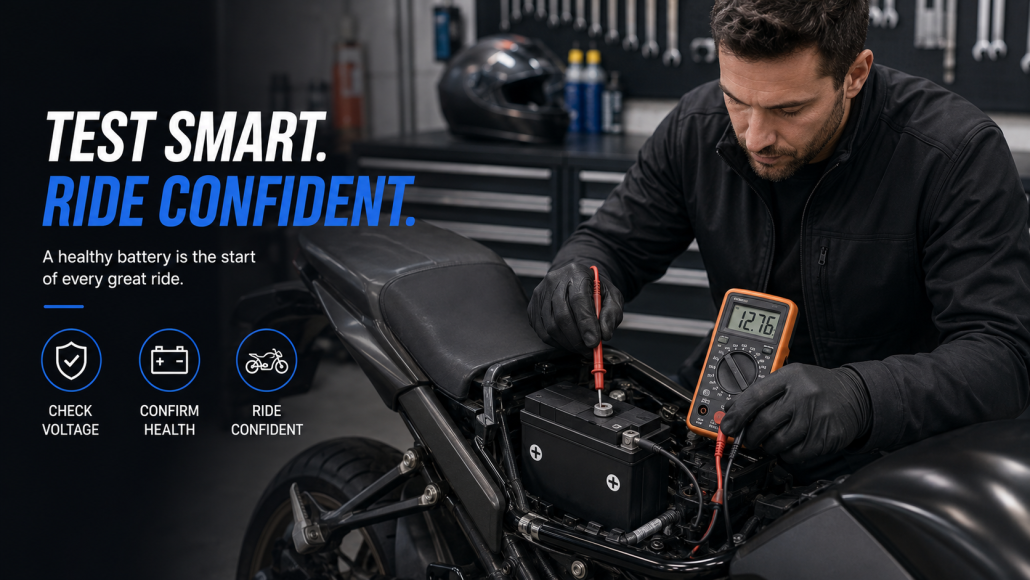
Motorcycle Battery Check: How to Test, Diagnose, and Decide When It’s Time for Replacement
A motorcycle battery does more than start the engine. It supports ignition, lights, indicators, GPS units, and other electronics that affect both safety and ride quality. When the battery begins to weaken, the warning signs are often subtle at first: slower starts, dimmer lights, or a starter that sounds different than usual. A quick motorcycle battery check can tell you whether the battery still has useful life left, whether it simply needs charging, or whether replacement is the smarter choice. The source draft already covers this core idea well, including the importance of regular checks and the battery’s role in powering critical electrical systems.
Quick Answer: A healthy 12V motorcycle battery should generally read around 12.6V or higher at rest. If the battery struggles to start the bike, shows visible damage, or drops below 12.0V after charging, it is often nearing replacement time. The most reliable check combines a visual inspection, a voltage test, and a load test rather than relying on a single reading.
Why a motorcycle battery check matters
A battery check is not just a maintenance habit. It is a practical way to catch performance problems before they become roadside failures. The source draft correctly explains that skipping battery checks can lead to sudden failure during a ride, shorter battery life, and unnecessary stress on the charging system.
That matters because battery failure is rarely convenient. In many cases, the battery begins to degrade slowly before it stops working completely. By the time the starter becomes sluggish or the dashboard electronics begin to dim, the battery is already telling you something useful.
Signs your motorcycle battery may be failing
A weak battery usually leaves clues before it quits. Slow or difficult starts, dim headlights, flickering dashboard lights, and visible swelling, leakage, or terminal corrosion are all signs that the battery deserves a closer look. The source draft captures these warning signs well, and they should stay near the top of the article because they match how riders search when they are already worried something is wrong.
The important technical point is that a battery can sometimes look acceptable on the surface and still fail under real starting load. That is why the next step is not just checking appearance, but checking voltage and performance under demand.
For riders who want a long-term, maintenance-free option, upgrading to a motorcycle lithium battery can simplify your routine checks and improve reliability.
How to perform a motorcycle battery check
A proper battery check should move from simple observation to electrical testing.
First, inspect the battery visually. Look for swelling, cracks, leaks, or corrosion around the terminals. Check that the cables are secure and that no residue or buildup is interfering with the connection. The source draft already includes this as the first step, and it is the right place to start because some issues are visible before any measurement is taken.
Next, test resting voltage with a multimeter. Set the meter to DC volts, connect the probes to the battery terminals, and confirm the reading after the battery has had time to rest. The source draft correctly identifies 12.6V as a healthy reading for a fully charged 12V motorcycle battery.
Finally, perform a load check if possible. A battery that reads well at rest but collapses under starter demand is no longer trustworthy for real riding conditions. That is why load behavior matters as much as resting voltage.
Motorcycle battery voltage guide
| Resting Voltage | What It Usually Means |
| 12.6V or higher | Fully charged, healthy battery |
| 12.4V–12.5V | Slightly discharged, still usable |
| 12.0V–12.3V | Weak, should be recharged soon |
| Below 12.0V | Likely failing, replacement may be needed |
The source draft uses these ranges correctly and notes that they apply mainly to lead-acid batteries, while lithium batteries typically hold voltage more consistently until near the end of their cycle life.
Lead-acid vs. AGM vs. lithium
Not all motorcycle batteries behave the same way during testing. Lead-acid batteries are the most maintenance-sensitive and are more prone to self-discharge, acid stratification, and terminal corrosion. AGM batteries improve the experience by reducing maintenance and improving vibration resistance, but they still benefit from routine voltage checks. Lithium batteries are lighter, more stable in voltage, and require far less day-to-day maintenance, which is why many riders eventually consider them as a long-term replacement option. The source draft already makes this distinction clearly and accurately.
| Battery Type | Typical Check Behavior | Maintenance Profile | Voltage Stability |
| Lead-Acid | Needs frequent checks | Higher maintenance | Less consistent |
| AGM | Needs periodic checks | Moderate maintenance | Better than flooded |
| Lithium | Holds voltage more steadily | Minimal maintenance | Very stable until near depletion |
For riders who want a simpler routine and longer service life, the lithium path is worth serious consideration. The source draft’s conclusion is aligned with that, especially where it notes that lithium can simplify checks and improve reliability.
When it is time to replace the battery
A battery should be replaced when it consistently falls below 12.0V after charging, fails a load test, or has simply reached the end of its expected life. The source draft gives a useful guide here: lead-acid batteries commonly last 3–5 years, while lithium batteries often last longer.
From a practical standpoint, the decision should not be based on age alone. If the battery is still starting reliably, holds voltage well, and passes load testing, replacement can wait. If it is weak under load or charging poorly despite maintenance, replacement is the more reliable choice.
Battery care that extends service life
Routine checks are only part of the equation. Storage habits matter too. The source draft correctly recommends regular inspection, keeping the battery charged, and considering a lithium upgrade if maintenance becomes a recurring problem.
For riders who store their bike seasonally, a battery tender can help preserve charge state during long idle periods. That matters because many battery failures are really storage failures. A battery that spends months partially discharged will age faster than one that is maintained properly.
LEOCH battery expertise
Battery choice depends on application, riding habits, and long-term cost expectations. As a North American lithium battery manufacturer, LEOCH develops both lithium and lead-acid battery solutions, including LiFePO₄ batteries for energy storage, motive power, and backup applications, as well as advanced AGM, pure lead, and other lead-acid technologies for UPS, telecom, and industrial systems. For a broader breakdown of battery chemistries, see our guide, The Complete Guide to Battery Classification: Understanding All Types of Lithium Batteries and Beyond. By combining multiple battery chemistries with application-focused engineering, LEOCH helps customers select the right balance of reliability, performance, safety, and lifecycle value.
Frequently asked questions
Can I do a motorcycle battery check myself?
Yes. A visual inspection and a multimeter reading are enough to identify many common battery issues. A load test provides even better insight if the equipment is available. The source draft already supports this diagnostic approach.
How often should I check my motorcycle battery?
A monthly check during riding season is a practical rule, and it is smart to test the battery before long trips and after winter storage.
Should I replace or recharge?
If the battery is only slightly discharged, recharge it. If voltage remains below 12.0V after charging or the battery fails a load test, replacement is usually the better call.
When replacement becomes unavoidable, refer to a detailed step-by-step resource like this guide on motorcycle battery replacement.
And if you’re tired of frequent checks and maintenance, consider making the switch to a motorcycle lithium battery. With longer lifespan, stable performance, and zero need for watering or corrosion management, it’s a smarter investment for riders who value reliability.