
Lithium Battery Conversion for Golf Carts: 7 Checks Before Upgrading
|
Quick answer Yes, many 36V and 48V lead-acid golf carts can be converted to a purpose-built LiFePO4 system. A reliable conversion matches the battery’s approved voltage window, continuous and peak current, regenerative-charge limits, charger, physical mounting, accessories, and operating temperature to the exact cart. Treat it as a system upgrade, not a battery-only swap. |
If you are researching a lithium battery conversion for golf cart use, start with compatibility rather than advertised range or cycle life. LiFePO4 can reduce routine maintenance and weight while delivering consistent power in an approved system, but those benefits are not automatic.
The battery, battery management system (BMS), charger, controller, wiring, accessories, mounting, and environment must work together. Use these checks before ordering.
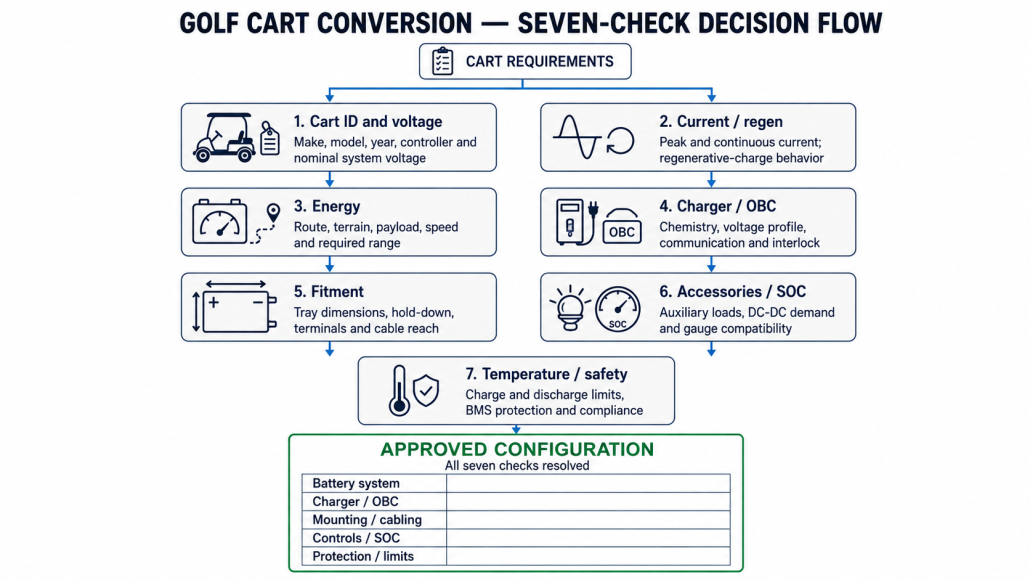
Check 1: Identify the Cart and Its Electrical System
Record the make, model, year, serial number, original battery arrangement, controller, motor, and modifications. Battery count is a useful cross-check – six 6V batteries indicate 36V; six 8V or four 12V batteries indicate 48V – but the vehicle label, manual, and controller specifications control.
Match more than the marketing label. The replacement pack’s working and full-charge voltage must stay within the approved limits of the controller, contactor or solenoid, charger, and other electronics. Changing a cart from 36V to 48V is a vehicle-system conversion and may require additional components; it is not the same as replacing a 36V lead-acid bank with an approved 36V lithium system.
Check 2: Match Continuous, Peak, and Regenerative Current
Amp-hours describe capacity, not whether the cart can climb without a BMS cutoff. Compare controller demand with the pack’s continuous rating and peak current at the stated duration. Include passengers, cargo, grades, oversized tires, lift kits, and controller upgrades.
If the cart uses regenerative braking, also confirm the battery’s allowable charge or regen current and its behavior near full state of charge. A pack that cannot accept the returned energy may trip protection. Ask what happens to drive and braking behavior if the BMS opens while the vehicle is moving.
Check 3: Size Energy for Real Use – Not Ah Alone
Start with nominal energy: volts x amp-hours / 1,000 = kilowatt-hours. Usable drive energy depends on pack limits, BMS reserve, temperature, efficiency, and aging. Terrain, speed, payload, tires, stops, accessories, and driving style also change range, so universal mileage claims are not credible.
For a current product example, LEOCH lists the GP48-105 at 48V, 105Ah, and 5.04kWh. Its published data sheet also lists 105A maximum continuous discharge and 300A for 1.5 seconds. Those values must be checked against the cart’s demand; the 105Ah label alone does not prove compatibility or range.
Check 4: Replace or Verify the Charger and Charge Controls
Use only a charger approved for the exact pack. Confirm voltage, current, profile, temperature behavior, connector, receptacle, and required BMS communication. Do not assume a legacy charger, automatic mode, or lithium label proves compatibility.
Some carts use onboard charging controls, including certain Club Car systems with an onboard computer (OBC). A bypass or revised charge path may be required, but wiring varies by model and year. Follow the battery and vehicle manufacturer’s approved procedure or use a qualified technician; a generic splice instruction does not belong in a universal guide.
Check 5: Measure Fitment, Mounting, and Cables
Measure tray length, width, height, seat clearance, terminal reach, cable routing, and hold-downs. Repair acid damage. A lighter pack still needs rigid restraint against vibration, braking, and turns, and the changed mass should not create a handling issue.
Inspect cable gauge, insulation, lugs, polarity, disconnects, and overcurrent protection. Tighten terminals only to the published torque. Do not series- or parallel-connect packs unless the manufacturer approves the exact models, quantity, wiring, protection, and BMS behavior.
Check 6: Plan for 12V Accessories and State of Charge
Power 12V accessories through a properly sized DC-DC converter from the traction pack. Do not tap part of a multi-battery string; unequal loading can create imbalance and unreliable operation.
A lead-acid voltage gauge may not report lithium state of charge accurately because LiFePO4 voltage remains relatively flat through much of its discharge. Use the battery’s approved display, shunt, app, or compatible CAN/RS-485 interface. Confirm that communications, key-switch logic, alarms, and contactor control work with the cart.
Check 7: Verify Temperature, Safety, and Local Requirements
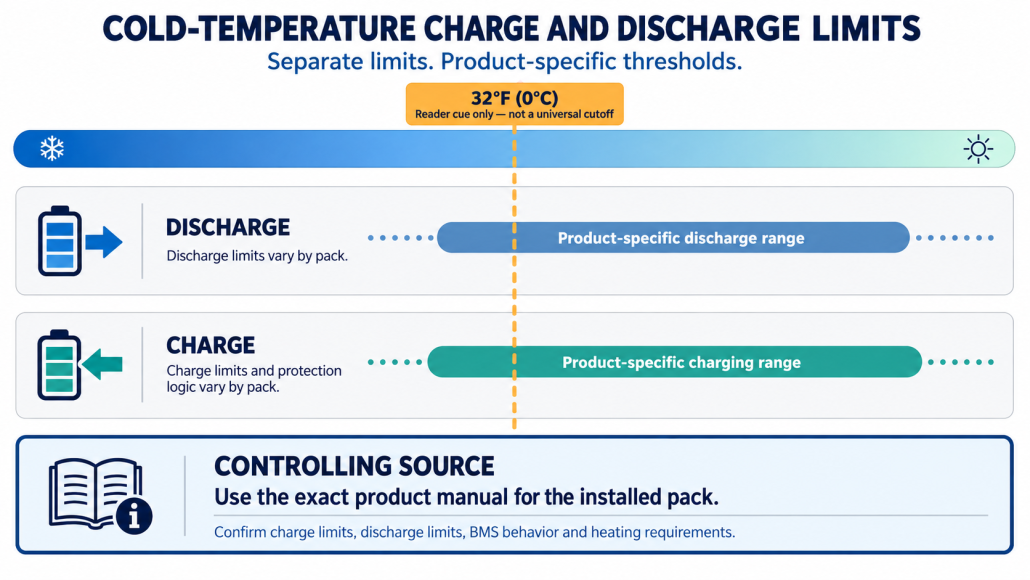
Charging restrictions matter in cold climates. Many LiFePO4 systems limit charging near or below 32°F unless approved low-temperature protection or heating is active; the exact product manual is the controlling source. Also check the enclosure rating, storage limits, water exposure, ventilation needs, charging location, and emergency instructions.
Ask for certification evidence for the exact model when required by an authority, fleet policy, insurer, or procurement specification. UL 2271 covers battery systems for light electric vehicle applications, but certification does not establish range or guarantee compatibility with every cart. UN 38.3 addresses transport testing, not installation approval. If the cart is used on public roads, verify federal low-speed-vehicle context plus state and local equipment, registration, and insurance rules; a battery swap does not make a cart street legal.
Lead-Acid vs. LiFePO4 After Conversion
| Decision factor | Lead-acid bank | LiFePO4 conversion |
| Routine care | Flooded types need watering and corrosion control | No watering; still inspect cables, mounting, charger, alarms, and condition |
| Vehicle mass | A multi-battery bank is generally heavier | Often substantially lighter; confirm handling, restraint, and actual product weight |
| Power delivery | Voltage typically sags more as load and discharge increase | Can hold voltage more consistently if the BMS and current ratings are adequate |
| Charging | Uses the approved lead-acid profile and ventilation practices | Requires the exact approved lithium charger/profile and temperature controls |
| State of charge | Voltage can be a familiar, though imperfect, indicator | Use an approved display, shunt, or BMS data rather than a legacy voltage-only gauge |
| Upfront cost | Usually lower | Usually higher; compare a documented lifecycle and downtime model, not a universal payback claim |
| Best fit | Lower-use carts, tight budgets, or stock systems | High-use carts and fleets that can justify the complete system |
Actual performance and service life depend on the selected products, duty, temperature, charging, storage, maintenance, and installation. Compare current data sheets and warranty terms under the same assumptions.
Is a Golf Cart Lithium Conversion Worth It?
It is often compelling for daily-use carts, hilly routes, multi-passenger vehicles, fleets with high watering labor, or operators who value faster turnaround and lower routine maintenance. It may be less compelling for a lightly used stock cart with a serviceable lead-acid bank, a tight budget, uncertain controller compatibility, or no qualified support nearby.
For a financial decision, compare the full installed cost, charger and accessories, expected duty, maintenance labor, downtime, replacement assumptions, warranty, and residual vehicle life. Use the current golf cart lithium conversion cost and ROI guide as a separate supporting resource rather than placing unstable price ranges in this evergreen article.
What to Send Before Requesting a Battery Recommendation
Provide the cart make, model, year, voltage, controller, regenerative braking, payload, terrain, tires, accessories, daily distance, tray dimensions, climate, charger, fleet quantity, and location. A supplier can then screen voltage, current, energy, fitment, charging, temperature, and documentation.
Frequently Asked Questions
Can any golf cart be converted to lithium?
No. Many common 36V and 48V carts can be converted, but approval depends on model, year, controller, current demand, regenerative braking, charger, fitment, wiring, and available support. Confirm the complete configuration before purchase.
Can I reuse my lead-acid golf cart charger?
Only if the lithium battery manufacturer explicitly approves that exact charger and settings for the pack. Otherwise, replace it with the specified lithium charger and required receptacle or control changes.
Do I need a new motor or controller?
Not always when system voltage remains the same and the existing equipment operates inside the battery’s approved limits. A voltage change, high-output controller, AC-drive conversion, regenerative system, or other modification can require additional engineering and components.
How much lithium capacity does my cart need?
Start with daily energy and peak-current demand, not a generic Ah recommendation. Define terrain, distance, payload, speed, tires, accessories, temperature, reserve, and charging opportunities, then compare those needs with the exact pack’s usable energy and discharge data.
Upgrade the System, Not Just the Battery
A successful lead-acid-to-lithium golf cart conversion aligns the vehicle, battery, BMS, charger, controller, wiring, mounting, accessories, environment, and service plan. Complete those checks first, and lithium can deliver a lighter, lower-maintenance, more consistent power system without trading convenience for hidden compatibility problems.
Explore LEOCH golf cart lithium battery systems or ask a LEOCH battery specialist to review your application. Include the cart and operating details above so the conversation begins with a compatible configuration rather than a voltage label alone.