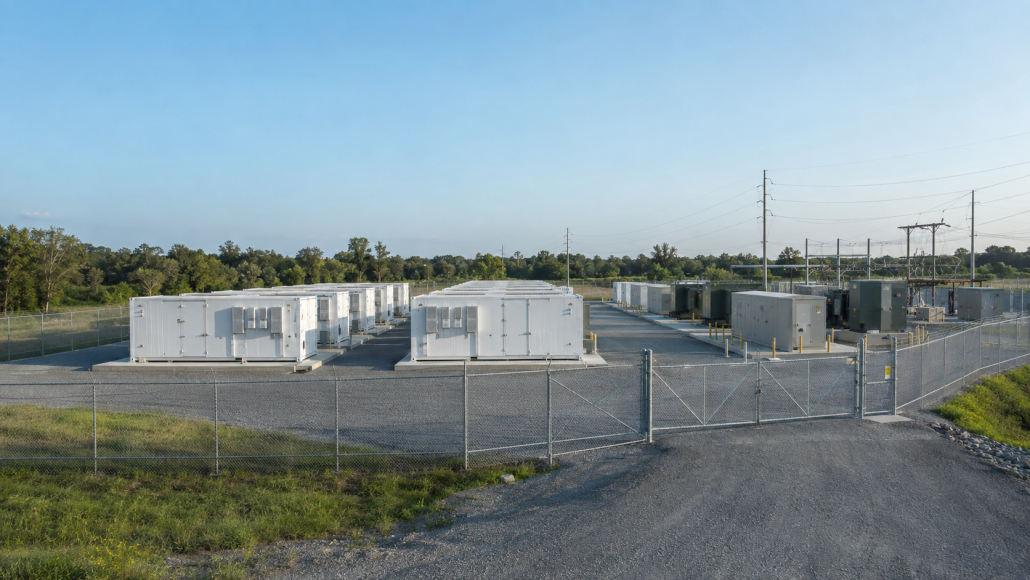
Grid-Scale Energy Storage: From Project Definition to Commercial Operation
|
Quick answer Grid-scale energy storage is a front-of-the-meter asset that absorbs electricity and returns it through power-conversion equipment under utility or market control. A successful project begins with a defined grid service and duty profile, then aligns MW, MWh, site, interconnection, safety evidence, controls, commissioning, and lifecycle obligations. Selecting a battery container before resolving those inputs can produce a technically workable system that is still difficult to permit, interconnect, finance, or operate. |
Grid energy storage is often discussed as a technology choice. Developers experience it as a chain of commercial and engineering decisions. The battery matters, but the point of interconnection, plant controls, fire strategy, acceptance tests, warranty boundary, and long-term service plan can determine whether the asset reaches commercial operation and performs as contracted.
What Is Grid-Scale Energy Storage?
Grid-scale energy storage usually refers to a utility-scale system connected to a transmission or distribution network rather than a customer’s internal electrical system. Battery energy storage systems (BESS) are common because they combine controllable power, flexible siting, and modular equipment. Other storage technologies may be better for certain durations or locations, but this guide focuses on lithium-ion BESS development.
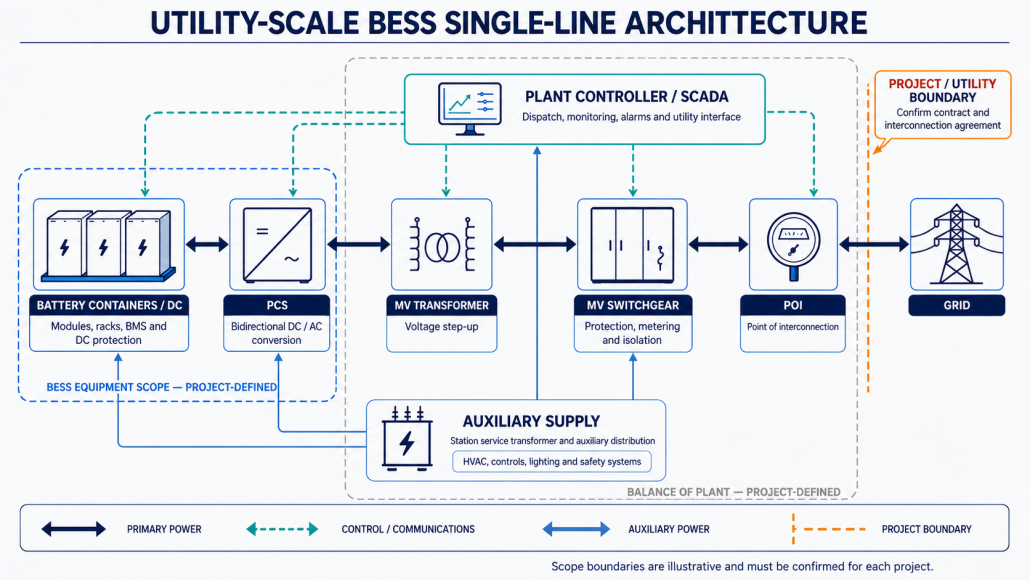
A complete plant includes more than battery cells: battery racks and BMS, power conversion systems (PCS), plant controls or EMS, SCADA and communications, thermal management, fire-risk controls, auxiliary power, transformers, switchgear, protection, metering, civil works, and the point of interconnection (POI). For deeper component detail, see utility-scale BESS architecture.
Start With the Service and Duty Profile
Define the primary service before selecting equipment. Energy shifting may require sustained discharge and daily cycling. Frequency or voltage support may emphasize response, control accuracy, and operating reserve. Capacity, congestion relief, renewable co-location, or resilience each changes the required duration, state-of-charge policy, telemetry, interconnection studies, and contract tests.
A project may pursue more than one value stream, but the services must be operationally and contractually compatible. Two commitments can compete for the same MW, stored energy, state of charge, or availability. The revenue model should therefore include dispatch conflicts, market eligibility, efficiency, auxiliary consumption, degradation, augmentation, outages, and penalties—not assume that every service can be stacked at the same time.
Translate the Duty Into MW, MWh, and Deliverable Performance
MW is the rate at which the plant can charge or discharge. MWh is stored energy. Dividing nameplate MWh by MW gives a nominal duration: a 100 MW/400 MWh system has a four-hour ratio at rated power. It does not, by itself, guarantee 400 MWh at the POI throughout the project life.
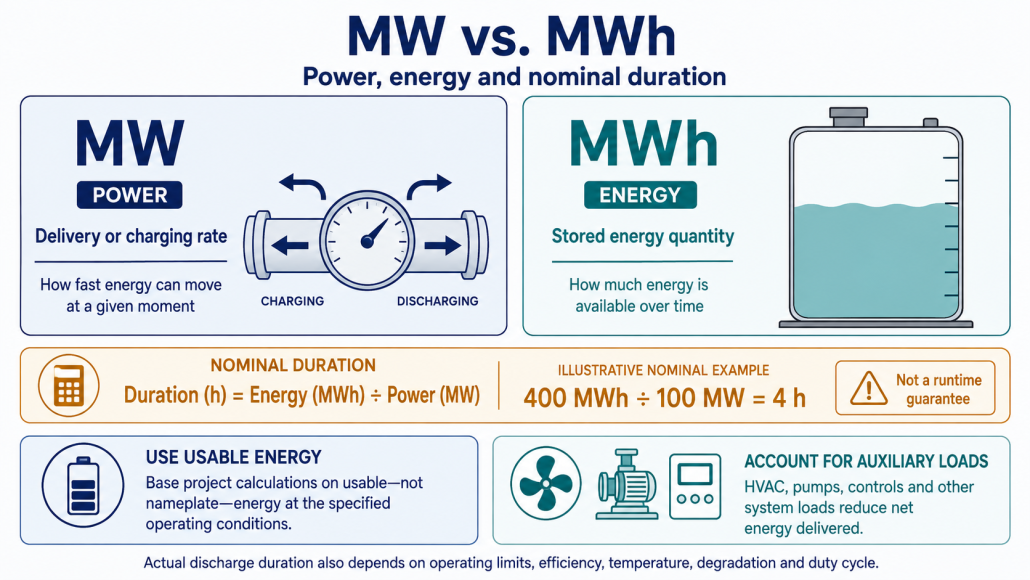
Procurement documents should define the measurement point and test conditions for usable energy, continuous and overload power, response, round-trip efficiency, auxiliary loads, availability, power factor, harmonics, noise, temperature and altitude derating, state-of-charge window, degradation, and end-of-life capacity. If a contract requires guaranteed delivery in year 10, the initial design may need an energy margin or a planned augmentation strategy.
The Grid-Scale BESS Development Path
| Stage | Developer decisions and deliverables |
| 1. Project definition | Primary service, dispatch duty, commercial structure, MW/MWh, availability, schedule, and acceptance basis |
| 2. Site and POI | Land control, access, geotechnical and flood conditions, setbacks, noise, auxiliary power, route to substation, and POI voltage |
| 3. Interconnection | Queue rules, models, cluster and affected-system studies, network upgrades, protection, telemetry, ride-through, and operating limits |
| 4. Design and procurement | Approved integrated configuration, interfaces, listings/test evidence, guarantees, warranty, spares, service, cybersecurity, and change control |
| 5. Permitting and construction | Zoning, electrical and fire review, emergency planning, civil works, quality records, installation, and stakeholder coordination |
| 6. Commissioning | Pre-energization checks, functional tests, capacity and power tests, controls, communications, protections, alarms, and punch-list closure |
| 7. Operations and end of life | Monitoring, preventive maintenance, software governance, warranty reporting, augmentation, incident response, decommissioning, and recycling |
These workstreams overlap. Site control and POI strategy influence the interconnection request; safety testing and emergency planning influence layout; the duty profile affects thermal design and warranty; and commissioning requirements should be written before the supply contract is signed.
Architecture Decisions That Affect Deployment
Integrated containers or enclosures can reduce field assembly, but they do not eliminate site engineering. Verify the boundaries among the battery supplier, system integrator, PCS supplier, EPC, plant controller, network operator, and owner. The interface matrix should assign signals, time synchronization, setpoints, alarms, trip logic, firmware, cybersecurity, testing, and long-term support.
Thermal design should use the site’s ambient range, solar load, humidity, dust, salt, elevation, duty cycle, and auxiliary-power constraints. Fire strategy should connect cell and system evidence to layout, separation, detection, ventilation or deflagration controls where applicable, emergency response, water and runoff planning, and local responder access. A favorable chemistry does not replace those layers.
U.S. Safety and Grid Requirements
Requirements vary by jurisdiction and connection level. Common U.S. references include UL 1973 for stationary batteries, UL 9540 for the complete energy storage system, and UL 1741 for applicable power-conversion equipment. UL 9540A is a test method for evaluating thermal-runaway fire propagation; the report and test level should match the proposed configuration and installation. NFPA 855, NEC Article 706, the adopted fire and building codes, and authority-having-jurisdiction conditions can shape layout and permits.
IEEE 1547 applies to distributed energy resources connected to distribution systems. IEEE 2800 addresses inverter-based resources connected to transmission and subtransmission systems. FERC Order 2023 and 2023-A reformed transmission interconnection procedures, including cluster studies, readiness, site control, modeling, and co-location provisions, but the approved transmission-provider tariff and current ISO/RTO or utility process control the project. NERC registration and reliability obligations may apply depending on the facility and its functions; they are not automatic labels for every battery plant.
Engage the utility or transmission provider, ISO/RTO where relevant, authority having jurisdiction, fire officials, land-use agencies, insurer, owner’s engineer, and emergency responders early. Product evidence supports approval; it does not replace site-specific studies or adopted code requirements.
Procurement and Bankability: Specify the Test, Not the Adjective
Terms such as high efficiency, long life, fast response, scalable, and bankable are not acceptance criteria. State the exact configuration, point of measurement, operating conditions, test method, tolerance, exclusions, data retention, and remedy. Align supply, EPC, interconnection, offtake, operations, and warranty definitions so one contract does not promise performance another contract excludes.
Review warranty years and throughput, retained capacity, operating envelope, availability calculation, planned maintenance, auxiliary consumption, augmentation rights, software licensing, remote access, cybersecurity, spare parts, service response, change management, insurance documentation, and decommissioning responsibilities. DOE’s BESS procurement checklist and technical-specification template are useful starting references, but project documents still require qualified engineering and legal review.
Frequently Asked Questions
What is the difference between grid-scale and utility-scale battery storage?
The terms are often used interchangeably for large front-of-the-meter systems. ‘Grid-scale’ emphasizes the asset’s grid role, while ‘utility-scale’ emphasizes project size or market segment. Connection level, owner, and service should be stated because neither term defines a universal MW threshold.
Does every grid battery provide black start?
No. Black start requires a suitable PCS and control strategy, an auxiliary-power plan, protection and studies, tested procedures, and authorization from the relevant grid operator. A battery’s fast response alone does not establish black-start capability.
Does a UL 9540A report mean the system is UL certified?
No. UL 9540A is a test method that produces evidence about thermal-runaway and fire-propagation behavior. UL 9540 evaluates the complete energy storage system. Confirm the exact model, configuration, certification or listing record, report scope, and installation conditions.
Can a grid-scale BESS be expanded later?
Sometimes, if the original project reserves land, POI capability, transformer and PCS capacity, communications, permits, safety basis, and compatible equipment. Battery age, firmware, warranty, study results, and market limits can restrict later additions, so planned expansion should be designed from the start.
Build the Project Around Verifiable Requirements
Grid-scale energy storage succeeds when the commercial objective, electrical design, controls, safety case, interconnection, contracts, and operating plan describe the same asset. Before requesting a configuration, assemble the project location, POI voltage, target MW/MWh and duration, duty profile, site conditions, interconnection status, schedule, and applicable U.S. approval requirements. Then compare utility battery energy storage systems against verifiable project outcomes or request a grid-storage application review.