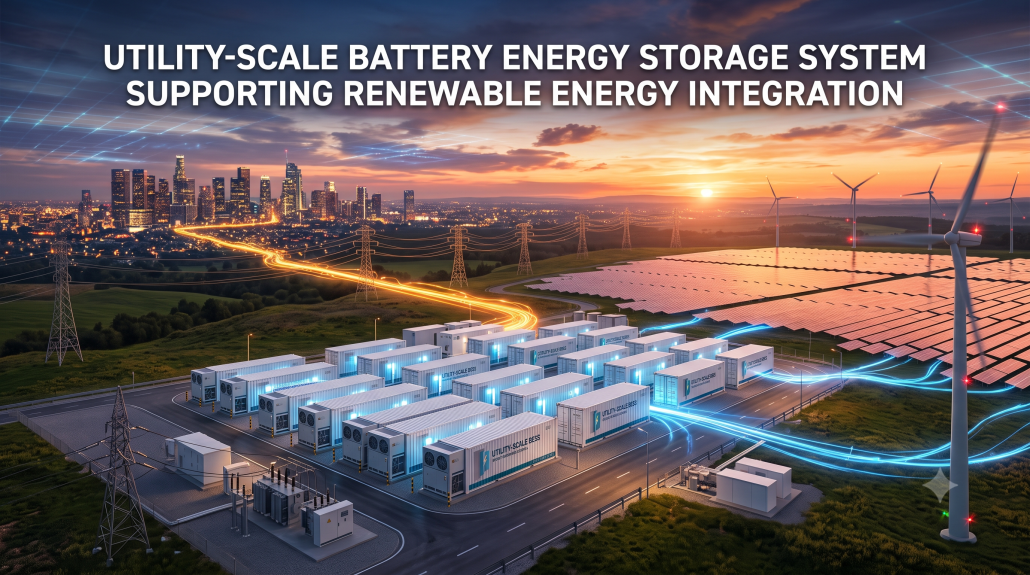
What Is a Battery Energy Storage System (BESS)? A Guide to Utility-Scale Architecture
As renewable energy adoption accelerates worldwide, power grids face a growing challenge: electricity generation no longer always matches electricity demand.
Solar farms produce maximum output during midday, while electricity consumption often peaks in the evening. Wind generation can fluctuate significantly within minutes. Without sufficient flexibility, grid operators must either curtail renewable generation or rely on expensive peaking plants to maintain system stability.
This is where a battery energy storage system (BESS) becomes a critical part of modern power infrastructure.
Rather than functioning like a conventional backup battery, a utility-scale battery energy storage system acts as a flexible grid asset capable of storing large amounts of electricity and releasing it precisely when and where the grid needs support. Many utilities now describe grid-scale storage as a form of virtual transmission infrastructure, improving grid resilience without building entirely new transmission lines.
From renewable integration and frequency regulation to energy arbitrage and emergency reserve power, modern BESS installations are becoming one of the most valuable assets in the global energy transition.
What Is a Battery Energy Storage System (BESS)?
The Quick Answer: A battery energy storage system (BESS) is a large-scale electrical energy storage solution that stores electricity inside high-capacity battery cells and releases it back to the power grid through bi-directional power conversion equipment whenever required. Unlike consumer batteries, a grid-scale BESS operates in the megawatt (MW) range, continuously communicating with grid operators to charge, discharge, and provide grid services in milliseconds.
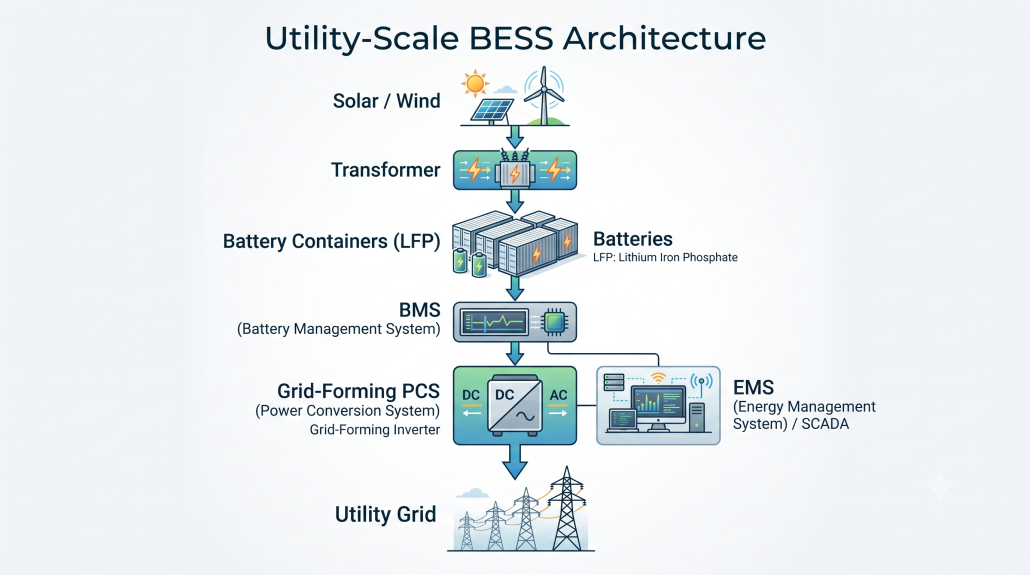
A complete BESS typically consists of:
- Battery modules
- Battery Management System (BMS)
- Power Conversion System (PCS)
- Energy Management System (EMS)
- Thermal management system
- Fire protection system
- Monitoring and SCADA communication
Together, these systems enable utilities, renewable developers, and industrial operators to balance supply and demand while improving grid reliability.
The 4 Structural Components of Grid-Scale BESS Architecture
The architecture of a utility scale battery energy storage system combines electrochemical storage, intelligent controls, and advanced power electronics into a fully integrated platform.
| System Component | Technical Function in a Utility-Scale Architecture |
| Battery Modules (LFP) | The chemical storage medium. Lithium Iron Phosphate (LiFePO4) is the industry standard due to its superior thermal stability, 6,000+ cycle lifespan, and high energy density. |
| Battery Management System (BMS) | The safety controller. Monitors individual cell voltages and manages the active liquid-cooling thermal management systems required for high-density containerized units. |
| Power Conversion System (PCS) | Advanced bi-directional inverters. Modern utility systems utilize Grid-Forming Inverters, which actively set voltage and frequency to stabilize the grid, rather than just following it. |
| Energy Management System (EMS) | The software brain. Analyzes SCADA data, grid congestion, and wholesale electricity tariffs to autonomously execute complex charge/discharge dispatch logic. |
Battery Modules: Why LFP Has Become the Utility Benchmark
While several lithium-ion chemistries exist, Lithium Iron Phosphate (LiFePO₄ or LFP) has become the preferred chemistry for most utility-scale projects.
Compared with nickel manganese cobalt (NMC) batteries, LFP offers:
- Longer operational lifespan
- Superior thermal stability
- Lower risk of thermal runaway
- No dependence on cobalt
- Lower total cost of ownership over long project lifecycles
For energy storage systems expected to operate for 15–20 years, lifecycle performance often outweighs slightly higher energy density.
Battery Management System (BMS)
The BMS serves as the safety guardian of every battery rack.
It continuously monitors:
- Cell voltage
- Cell temperature
- Current
- State of Charge (SOC)
- State of Health (SOH)
By balancing cells and detecting abnormal conditions early, the BMS maximizes battery lifespan while helping prevent overcharging, over-discharging, and overheating.
Power Conversion System (PCS)
The PCS converts DC electricity stored in batteries into grid-compatible AC power.
Today’s most advanced PCS platforms integrate grid-forming inverters, sometimes called Virtual Synchronous Machines (VSMs).
Unlike conventional grid-following inverters that depend on an existing stable grid, grid-forming inverters can establish voltage and frequency references independently, supporting weak grids and improving renewable integration.
As renewable penetration increases worldwide, grid-forming inverter technology is becoming one of the defining innovations in next-generation grid scale BESS deployments.
Energy Management System (EMS)
The EMS functions as the operational brain of the entire system.
It continuously evaluates:
- Electricity prices
- Renewable generation forecasts
- Grid demand
- Battery state
- Dispatch schedules
- Grid operator instructions
The EMS integrates with SCADA systems, utility control centers, and market operators to maximize both technical performance and financial returns.
Revenue Stacking: How a Utility-Scale BESS Stabilizes the Grid
Unlike traditional infrastructure that performs a single function, utility-scale storage generates value by delivering multiple services simultaneously—a strategy known as revenue stacking.
BESS Energy Arbitrage
One of the most common revenue streams is BESS energy arbitrage.
The system charges when electricity prices are low—often during periods of high solar generation—and discharges when wholesale prices rise during evening demand peaks.
This process:
- Reduces peak electricity costs
- Improves renewable utilization
- Generates market revenue through time-shifting energy
BESS Frequency Regulation & Ancillary Services
Grid frequency must remain extremely close to its nominal value (50 Hz or 60 Hz).
Unexpected generator outages or rapid demand changes can disturb this balance.
A modern BESS responds within milliseconds by automatically absorbing or injecting power, making BESS frequency regulation one of the fastest and most valuable ancillary services available.
Typical ancillary services include:
- Primary frequency response
- Secondary frequency regulation
- Spinning reserve replacement
- Voltage support
- Black start capability (project dependent)
Renewable Curtailment Mitigation
Transmission congestion often forces grid operators to curtail renewable generation even when wind or solar resources are available.
Instead of wasting clean electricity, a utility-scale BESS stores excess renewable energy and releases it later when transmission capacity becomes available or electricity demand increases.
This improves renewable project economics while reducing overall system emissions.
Engineering Constraints: Thermal Management and UL 9540A Safety
As energy density continues to increase, thermal management and fire safety have become central design considerations.
Why Modern Systems Use Liquid Cooling
Early battery containers relied primarily on HVAC systems.
Today’s high-capacity installations increasingly adopt liquid cooling because it offers:
- More uniform temperature distribution
- Higher energy density
- Reduced parasitic energy consumption
- Improved battery lifespan
- Better performance under high ambient temperatures
Maintaining consistent cell temperatures significantly reduces battery degradation while supporting long-term reliability.
To learn more, read BESS Cooling Systems: Why Thermal Management Shapes the Future of Energy Storage.
UL 9540 and UL 9540A
For utility-scale projects, certification extends beyond battery performance.
Two of the industry’s most important safety standards are:
UL 9540
Evaluates the complete energy storage system, including batteries, inverters, controls, and integrated safety systems.
UL 9540A
Focuses on large-scale fire propagation testing to evaluate thermal runaway behavior and fire containment under real-world conditions.
These certifications are frequently required by:
- Utilities
- EPC contractors
- Insurance providers
- Civil engineers
- Project financiers
- Local permitting authorities
Meeting these standards improves project bankability while reducing deployment risk.
Grid Engineering Reference
If you are an EPC contractor, utility planner, or substation developer designing a multi-megawatt energy storage project, explore the deployment specifications, module architecture, telemetry capabilities, and system configurations of our LEOCH Utility-Scale Battery Energy Storage System to evaluate project compatibility and engineering requirements.To explore commercial and industrial deployment strategies, see How Industrial Battery Energy Storage Solutions Enable Peak Shaving, Backup Power and Grid Services.
Frequently Asked Questions: Grid-Scale BESS Performance
What is the difference between a standard UPS and a utility BESS?
Although both systems use batteries, they serve very different purposes.
A UPS is designed to provide immediate backup power for seconds or minutes during electrical interruptions, protecting sensitive equipment until generators start or power is restored.
A utility-scale BESS, on the other hand, operates as an active grid asset. It can continuously charge and discharge over periods ranging from two to eight hours—or longer—participating in electricity markets, supporting renewable integration, regulating grid frequency, and improving transmission efficiency.
Why has LFP chemistry replaced NMC in grid-scale energy storage?
LFP batteries have become the dominant choice because they offer an excellent balance of safety, longevity, and economics.
Compared with NMC chemistry, LFP provides:
- Higher thermal stability
- Longer cycle life
- Lower degradation
- Improved resistance to thermal runaway
- Elimination of cobalt from the supply chain
- Lower lifetime operating costs
For utility assets expected to operate reliably for decades, these advantages often outweigh the slightly higher energy density offered by NMC batteries.
The Future of Bankable Grid Storage
Battery energy storage systems are rapidly evolving from supplementary equipment into core transmission infrastructure.
However, selecting the right utility-scale BESS involves much more than comparing battery capacity. Developers and utilities must evaluate battery chemistry, thermal management, inverter technology, EMS intelligence, safety certifications, cybersecurity, lifecycle costs, and long-term manufacturer bankability.
As renewable penetration continues to grow, grid operators increasingly depend on intelligent, safe, and highly reliable energy storage platforms capable of delivering multiple value streams throughout their operational lifetime.
Whether your project focuses on renewable integration, transmission support, peak shaving, or ancillary services, choosing a proven utility-scale energy storage solution is essential for maximizing long-term project performance and return on investment.
Need technical guidance for your next energy storage project? Contact our application engineering team to discuss project sizing, total cost of ownership (TCO), grid compliance requirements, and customized utility-scale BESS solutions tailored to your regional market.