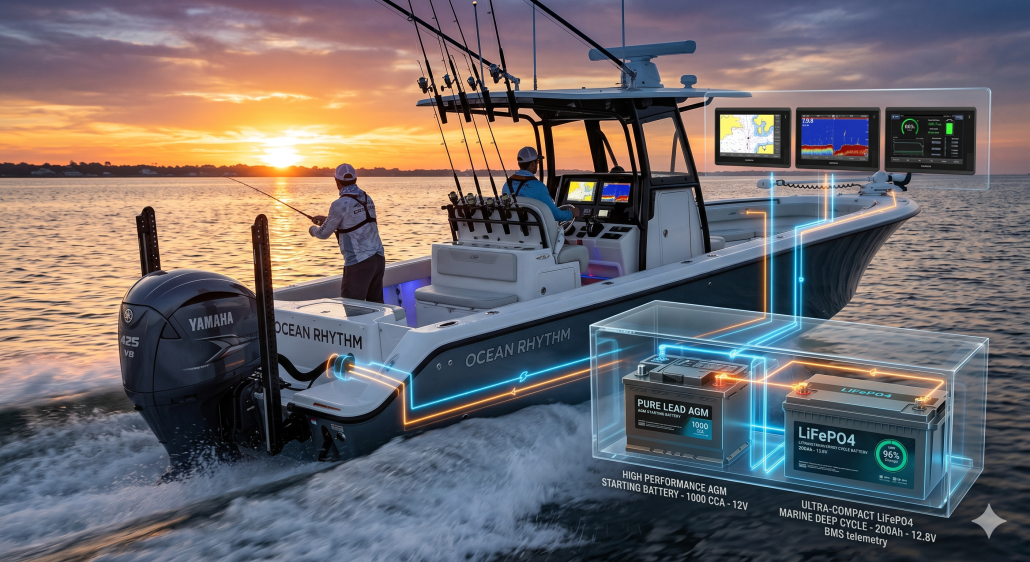
The Ultimate Marine Boat Battery Guide: Pure Lead Starting vs. Lithium House Banks
Stop Treating All Boat Batteries the Same
A modern boat is no longer just an engine and a fuel tank.
Today’s vessels are essentially floating power grids packed with sophisticated electronics, navigation systems, fish finders, radar arrays, trolling motors, live wells, lighting systems, and communication equipment.
Yet many boat owners still make one fundamental mistake:
They assume every battery on the boat should perform the same job.
You wouldn’t ask a sprinter to run a marathon.
Likewise, you shouldn’t expect a battery optimized for explosive engine starting to power electronics all day long.
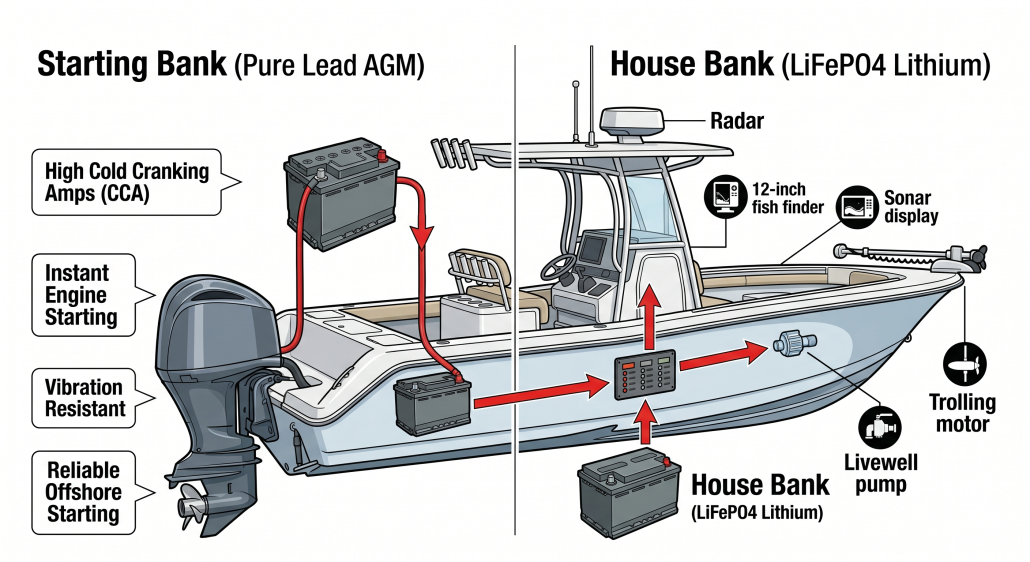
The reality is that every vessel operates with two distinct power demands:
The Starting Bank
Responsible for:
- Cranking the engine
- Starting large outboards
- Handling high-current ignition loads
The House Bank
Responsible for:
- Sonar electronics
- GPS systems
- Radar
- Live wells
- Lighting
- Trolling motors
- Auxiliary loads
Because these power profiles are completely different, professional marine installers increasingly recommend a mixed-chemistry solution.
The most reliable marine power architecture today combines:
Pure Lead AGM batteries for starting power and Lithium Iron Phosphate (LiFePO₄) batteries for house energy storage.
This approach delivers maximum reliability, longer runtime, and the lowest long-term operating costs.
Why Pure Lead AGM Beats Standard Marine Batteries for Starting Power
Starting an engine requires a completely different battery design than powering electronics.
When a captain turns the key, the battery must deliver an enormous burst of current instantly.
This is where Pure Lead AGM technology excels.
Understanding Pure Lead Technology
Traditional marine batteries use thick lead-alloy plates.
Pure Lead AGM batteries utilize plates manufactured from approximately 99% pure lead.
Because pure lead is stronger and more conductive, engineers can make the plates dramatically thinner.
The result?
More plates fit inside the battery case.
More plates create greater surface area.
Greater surface area generates significantly more starting power.
The Cold Cranking Amp (CCA) Advantage
Cold Cranking Amps (CCA) remain one of the most important performance metrics for marine starting batteries.
Pure Lead AGM batteries deliver exceptionally high CCA ratings because of their dense plate architecture.
For large offshore vessels and high-horsepower outboards, this translates into:
- Faster engine starts
- Reliable ignition after long storage periods
- Better performance in cold weather
- Improved voltage stability during cranking
Some premium Pure Lead AGM batteries can produce cranking pulses approaching 2,700 amps for demanding marine applications.
For captains running twin or triple outboard setups, this reserve power can be critical.
Built for Marine Abuse
Marine environments are exceptionally hard on batteries.
They must withstand:
- Constant vibration
- Hull impacts
- Rough water conditions
- Salt exposure
- High humidity
Pure Lead AGM batteries are fully sealed and highly vibration resistant.
Unlike flooded batteries, they are:
- Spill-proof
- Maintenance-free
- Corrosion resistant
- Resistant to wave-induced shock loads
The Ultimate Dual-Purpose Marine Battery
Another advantage of Pure Lead AGM technology is its ability to handle moderate deep cycling.
Many premium Pure Lead batteries can deliver approximately:
- 400 deep discharge cycles at 80% Depth of Discharge (DOD)
This makes them ideal for boat owners who need both:
- Exceptional engine starting
- Occasional auxiliary power support
Compared to inexpensive flooded batteries, the difference in durability is substantial.
The House Bank: Why LiFePO₄ Dominates Deep-Cycle Marine Energy
While starting batteries excel at short bursts of power, house banks require a completely different performance profile.
The goal is sustained energy delivery over long periods.
Modern vessels place enormous demands on their house batteries.
Common loads include:
- Multi-function displays
- 12-inch sonar screens
- LiveScope systems
- Radar
- Live wells
- Refrigeration
- Inverters
- 24V and 36V trolling motors
This is where Lithium Iron Phosphate (LiFePO₄) technology has become the clear industry leader.
The Usable Capacity Advantage
One of the biggest misconceptions in marine battery selection involves capacity.
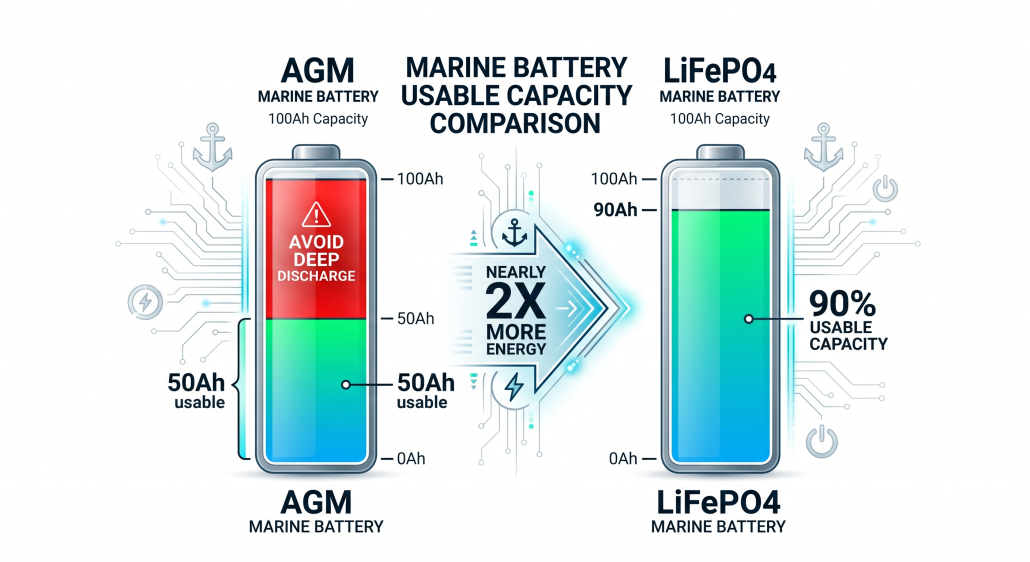
A 100Ah AGM battery does not provide 100Ah of practical energy.
To avoid permanent damage, most AGM batteries should only be discharged to approximately:
50% Depth of Discharge (DOD)
Meaning only about:
50Ah is truly usable.
By contrast, LiFePO₄ batteries can safely operate at:
- 80% DOD
- 90% DOD
- Even 100% DOD in some applications
This effectively doubles usable runtime compared to similarly rated AGM batteries.
The Flat Voltage Curve
Marine electronics demand stable voltage.
Traditional batteries gradually lose voltage as they discharge.
This can cause:
- Dim displays
- Electronics resets
- Reduced trolling motor performance
- Lower sonar clarity
Lithium batteries behave differently.
Their voltage remains remarkably stable throughout most of the discharge cycle.
Even at 15% state of charge, electronics continue operating normally.
This is known as the flat voltage curve and is one of lithium’s biggest advantages on the water.
The Weight Reduction Benefit
Weight matters on every vessel.
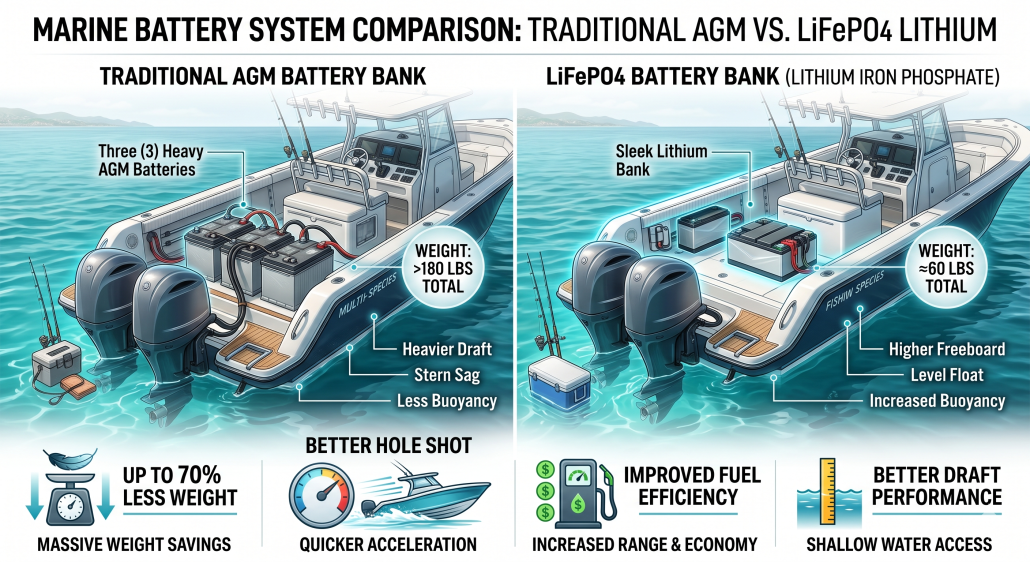
A typical lead-acid battery bank can add hundreds of pounds to the stern.
LiFePO₄ batteries can be up to:
70% lighter
than equivalent lead-acid systems.
Removing 100+ pounds from the boat can improve:
- Hole-shot acceleration
- Fuel efficiency
- Draft characteristics
- Overall handling
For tournament anglers and performance-focused boat owners, this is a significant upgrade.
The Technician’s Secret: Wiring a Mixed-Chemistry Marine System
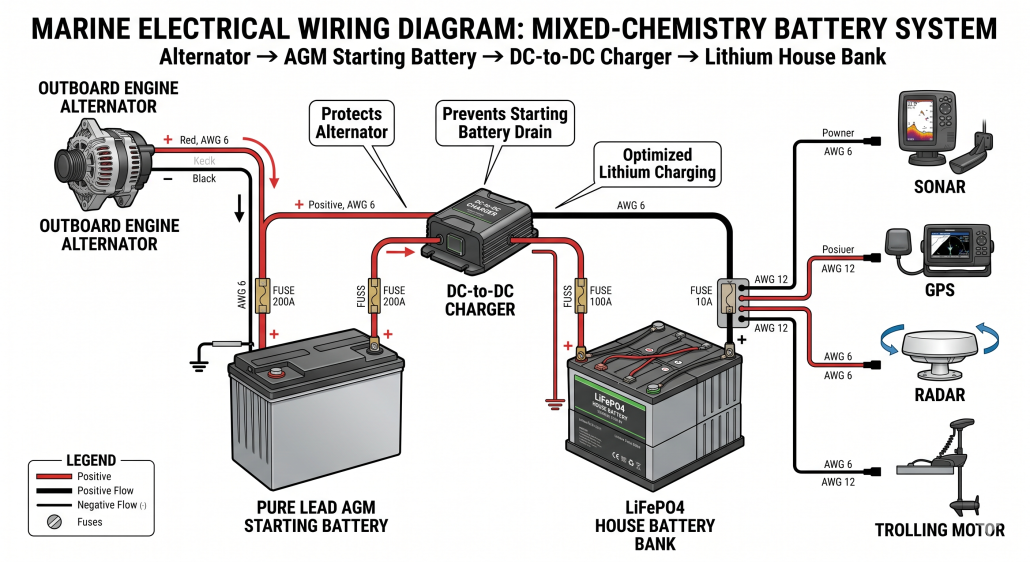
This is where many DIY installations go wrong.
Simply installing lithium batteries alongside lead-acid batteries without proper charging architecture can create serious problems.
The Alternator Problem
Many outboard alternators—even on modern Yamaha, Mercury, and Suzuki engines—were originally designed with stators optimized for lead-acid batteries, not the massive current draw of lithium.
Lithium batteries have extremely low internal resistance.
When connected directly, they can attempt to draw excessive charging current.
Potential consequences include:
- Overheated alternators
- Premature alternator failure
- Charging instability
- Reduced component lifespan
This is one of the most common mistakes made during marine lithium conversions.
The Professional Solution: DC-to-DC Chargers
Marine technicians solve this issue using a DC-to-DC charger.
The charging sequence works as follows:
- The engine alternator charges the Pure Lead AGM starting battery.
- The starting battery remains fully protected.
- The DC-to-DC charger regulates current flow.
- The lithium house bank receives the correct charging profile.
This architecture creates a safe and reliable mixed-chemistry system.
Why Installers Prefer This Configuration
A properly designed DC-to-DC charging system provides several benefits:
- Protects the alternator
- Preserves engine starting capability
- Prevents accidental battery depletion
- Optimizes lithium charging performance
- Extends overall battery lifespan
This is why professional marine installers increasingly recommend mixed-chemistry battery banks for serious recreational and commercial vessels.
Total Cost of Ownership (TCO): Evaluating Your Investment
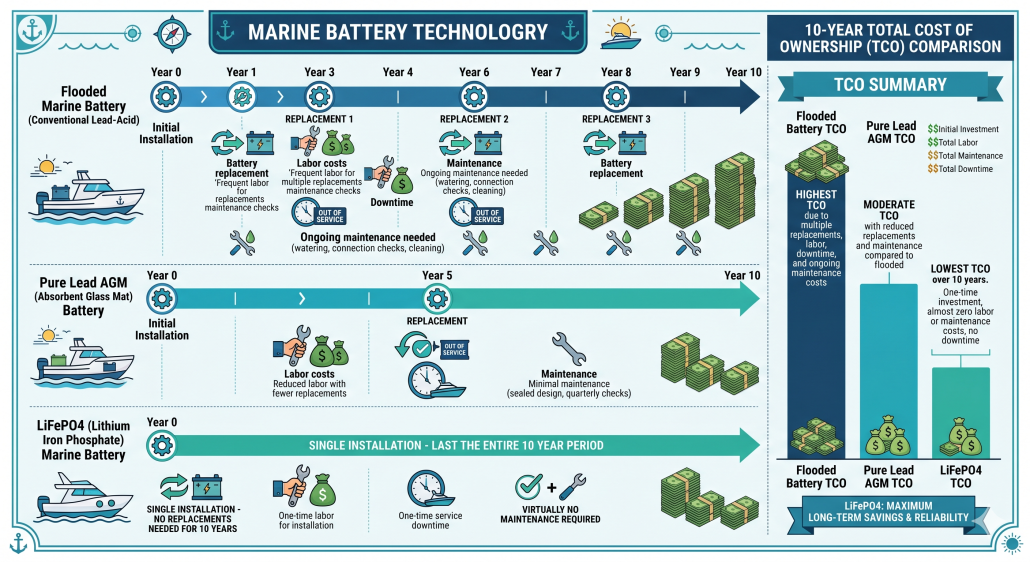
Choosing the cheapest battery rarely results in the lowest ownership cost.
The true comparison should focus on Total Cost of Ownership (TCO).
| Battery Technology | Upfront Cost | Usable Capacity (DOD) | Lifespan (Cycles) | Maintenance | Best For |
| Standard Flooded | $ (Lowest) | 50% | 200 – 300 | High (Watering) | Budget setups |
| Pure Lead AGM | $$ (Moderate) | 80% | 400+ | Zero | Engine Starting (High CCA) |
| LiFePO4 Lithium | $$$ (Premium) | 90 – 100% | 3,000 – 5,000+ | Zero | House Bank (Electronics) |
Although lithium carries the highest upfront cost, its extended lifespan and superior efficiency often make it the least expensive option over the life of the vessel.
Whether you are replacing a standard Group 24 or Group 27 starting battery, or upgrading a massive Group 31 or 8D house bank, LEOCH provides exact drop-in replacements for standard US marine battery trays.
Conclusion: Build a Professional-Grade Marine Power Grid
The best boat battery isn’t a single battery.
It’s the right battery for the right job.
Pure Lead AGM technology remains one of the best solutions available for engine starting thanks to its exceptional cranking power, vibration resistance, and reliability.
LiFePO₄ dominates deep-cycle applications by providing longer runtime, greater usable capacity, stable voltage delivery, and significant weight reduction.
Together, they create a professional-grade marine power architecture trusted by technicians, installers, and serious boat owners across the industry.
Don’t risk being stranded offshore because of the wrong battery chemistry.
Build a marine electrical system designed around how your vessel actually uses power.
Ready to Upgrade Your Marine Battery System?
Explore LEOCH’s complete portfolio of marine starting batteries, lithium house banks, and integrated marine energy solutions.
For boat builders, dealers, distributors, and fleet operators, contact our engineering team to discuss wholesale mixed-chemistry packages, custom battery configurations, and marine power system design support.