BESS vs. UPS: Do You Need Both for Commercial Backup?
Introduction
In modern commercial and industrial (C&I) facilities, power outages are no longer the only concern. Rising utility prices, tightening ISO demand response programs, and increasingly volatile US grid conditions are forcing businesses to rethink how they manage both emergency backup power and daily electricity consumption.
This has created growing interest in two major technologies: Battery Energy Storage Systems (BESS) and Uninterruptible Power Supplies (UPS). While both systems use lithium-ion batteries to store energy, they are designed for fundamentally different purposes.
That distinction often creates confusion for facility operators, procurement managers, and infrastructure planners evaluating commercial battery backup strategies.
A UPS acts as your facility’s immediate shield against power disturbances and outages. A BESS acts as a strategic energy management system that optimizes electricity usage, supports renewable integration, and reduces operating costs.
For modern facilities seeking true resilience, these technologies are not competing solutions — they are complementary components within a complete data center power architecture.
Understanding the Core Differences: BESS vs. UPS
Although both systems rely on stored battery power, the difference between BESS and UPS lies in how they respond to power events, how long they operate, and what problems they are designed to solve.
Side-by-Side Comparison: BESS vs UPS
| Feature | UPS System | BESS System |
| Primary Purpose | Immediate power protection | Energy management & long-duration backup |
| Transfer Time | Near-zero milliseconds | Typically seconds or longer |
| Critical Function | Prevent equipment shutdowns | Reduce electricity costs & manage energy |
| Typical Runtime | Minutes | Hours |
| Power Conditioning | Yes | Limited |
| Supports Peak Shaving | No | Yes |
| Deep Cycling Capability | Limited | Designed for deep cycling |
| Ideal Applications | Servers, PLCs, medical systems | HVAC, manufacturing, solar integration |
| Grid Interaction | Minimal | Direct grid interaction |
| Backup Duration Goal | Short-term bridge power | Long-duration facility support |
The Role of the UPS (Power Quality & The Immediate Bridge)
An online double-conversion UPS is engineered to provide instantaneous protection against power anomalies. Its primary functions include:
- Continuously conditioning incoming utility power (zero-transfer topology)
- Eliminating voltage sags, surges, and frequency variations
- Providing seamless backup power during outages
- Protecting highly sensitive electronic equipment
The defining characteristic of a UPS is its near-zero millisecond transfer time.
When grid power fails, the UPS immediately supplies power to connected equipment without interruption. This seamless “ride-through” capability is essential for protecting:
- Data center servers
- PLCs (Programmable Logic Controllers)
- Networking infrastructure
- Emergency systems
- Critical medical equipment
Without a UPS, even a brief grid disturbance lasting milliseconds can cause sensitive systems to reboot, crash, or lose data.
The UPS essentially bridges the gap between utility failure and backup generator startup.
The Role of the BESS (Energy Management & Peak Shaving)
A Battery Energy Storage System (BESS) serves a very different purpose.
Rather than focusing on millisecond-level power continuity, a BESS is designed for:
- Deep cycling
- Long-duration energy discharge
- Grid interaction
- Renewable energy integration
- Operational cost optimization
Unlike a UPS, BESS transfer time is slower — often measured in seconds rather than milliseconds.
This delay is acceptable for facility-level energy management applications but would be unacceptable for critical IT infrastructure.
The primary goal of a BESS is to improve operational efficiency through:
- Peak shaving
- Energy arbitrage
- Time-of-Use (TOU) optimization
- Solar energy storage
- Long-duration backup power
Modern Battery Energy Storage Systems can dramatically reduce electricity costs by discharging stored energy during expensive peak utility pricing periods.
This makes BESS technology a major financial tool in modern commercial energy strategies.
Can a Commercial BESS Replace a UPS System?
The short answer is:
No.
Even highly advanced commercial BESS platforms cannot replace a UPS for critical IT and mission-critical infrastructure loads.
The reason comes down to transfer time.
A UPS responds essentially instantaneously when utility power fluctuates or disappears. A BESS inverter typically requires several seconds to detect the outage, synchronize, and assume the load.
For sensitive infrastructure, those few seconds are catastrophic.
If a data center relies solely on a BESS without a UPS:
- Servers will reboot
- Networking equipment may fail
- PLCs can lose operational continuity
- Critical applications may crash
- Data corruption risks increase
Even momentary grid disturbances — sometimes called “grid blinks” — can disrupt operations before the BESS takes over.
This is why UPS systems remain mandatory for critical loads that require seamless continuity.
A BESS enhances facility-level resilience, but it cannot deliver the immediate ride-through capability required for mission-critical electronics.
The Ultimate Architecture: Why Modern Facilities Need Both
The most resilient commercial power architecture combines both technologies into a unified strategy.
Together, UPS systems and BESS platforms create a complete commercial microgrid environment capable of delivering both operational continuity and energy optimization.
The Synergy Between UPS and BESS
Governed by an overarching site Energy Management System (EMS) or microgrid controller, these two platforms divide the facility’s power responsibilities without conflicting:
The UPS Handles Hyper-Critical Loads
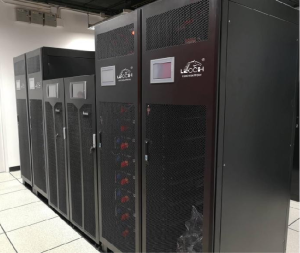
The UPS protects equipment that cannot tolerate even milliseconds of interruption, including:
- Servers
- Emergency lighting
- Network switches
- Fire and life safety systems
- Medical devices
- Industrial control systems
The UPS provides immediate short-duration support during outages and power anomalies.
The BESS Handles Bulk Facility Loads
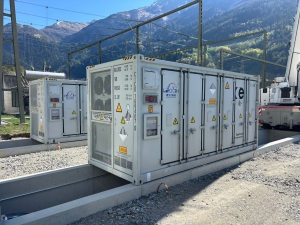
The BESS supports:
- HVAC systems
- General building loads
- Manufacturing operations
- EV charging infrastructure
- Renewable energy integration
- Long-duration backup power
Because BESS systems are optimized for deeper discharge cycles and longer runtimes, they are ideal for supporting broader facility operations during extended outages.
The Financial Benefit
One of the biggest advantages of deploying a BESS is operational cost reduction.
Through peak shaving and Time-of-Use optimization, facilities can:
- Reduce expensive peak demand charges
- Lower daily electricity costs
- Improve energy efficiency
- Maximize renewable energy usage
These ongoing savings help offset the operational “insurance policy” cost of maintaining the UPS infrastructure.
In other words:
- The UPS protects uptime.
- The BESS improves energy economics.
Together, they create both operational resilience and long-term financial value.
The Lithium-Ion Advantage for Integrated Power
Historically, legacy facilities often required massive rooms filled with heavy VRLA batteries dedicated solely to UPS backup power.
Modern lithium-ion technology dramatically changes that equation.
Streamlining the Facility Footprint
High-density lithium UPS systems and lithium BESS platforms allow facilities to achieve comprehensive power security while consuming far less physical space.
Compared with traditional VRLA infrastructure, lithium solutions provide:
- Higher energy density
- Reduced floor loading
- Smaller installation footprint
- Lower cooling requirements
- Longer service life
- Simplified scalability
For commercial buildings and data centers, this space savings directly translates into more usable revenue-generating real estate.
Facilities can dedicate more space to:
- Server racks
- Manufacturing operations
- Edge computing deployments
- Revenue-producing infrastructure
When evaluating your facility’s critical load requirements, proper UPS sizing remains essential to building an effective integrated power architecture. Read our guide on How to Calculate & Size a UPS for Your Data Center to better understand load planning and backup design.
Engineering Your Facility‘s Power Strategy
Relying on only one system leaves facilities exposed in different ways.
A UPS alone protects uptime but does little to optimize energy costs.
A BESS alone reduces electricity expenses but cannot provide seamless protection for sensitive infrastructure.
Modern commercial facilities increasingly require both technologies working together as part of a carefully engineered power strategy.
Successfully integrating lithium UPS systems and BESS architecture requires:
- Accurate load calculations
- Thermal management planning
- Runtime analysis
- Facility growth forecasting
- Infrastructure redundancy design
The right architecture balances operational continuity, long-duration resilience, and long-term energy efficiency.
To evaluate your facility’s commercial battery backup strategy and engineer a seamless integration of both lithium UPS and BESS solutions, contact the US engineering team for a custom power architecture design.