What Makes the Best Golf Cart Batteries? 8 Engineering Checks
|
Quick answer The best golf cart battery is the one that safely matches the cart and its duty cycle. Chemistry matters, but voltage, usable energy, continuous and peak current, charger compatibility, mounting, temperature limits, documentation, warranty, and service support determine whether a battery is truly a good choice. |
A battery can look excellent on a product page and still be wrong for a particular golf cart. A large amp-hour rating cannot correct an incompatible voltage window. A high peak-current claim does not help if the rating lasts too briefly for a hill climb. A long cycle-life number means little without test conditions and warranty boundaries.
For occasional use, a properly maintained flooded lead-acid system may still be the practical low-cost choice. AGM can reduce watering while retaining familiar lead-acid behavior. LiFePO4 is often attractive for high-use carts and fleets because it can reduce weight, eliminate watering, maintain steadier voltage through much of the discharge, and support useful monitoring. Those benefits depend on a complete, correctly matched system.
What Does ‘Best’ Mean for a Golf Cart Battery?
There is no universal best golf cart battery. A private owner making short, flat trips has a different duty cycle from a resort fleet running loaded carts through multiple shifts. Start by defining the cart make, model, year, system voltage, controller, motor, regenerative-braking behavior, passenger and cargo load, tire size, terrain, daily distance, climate, charging window, and desired service life.
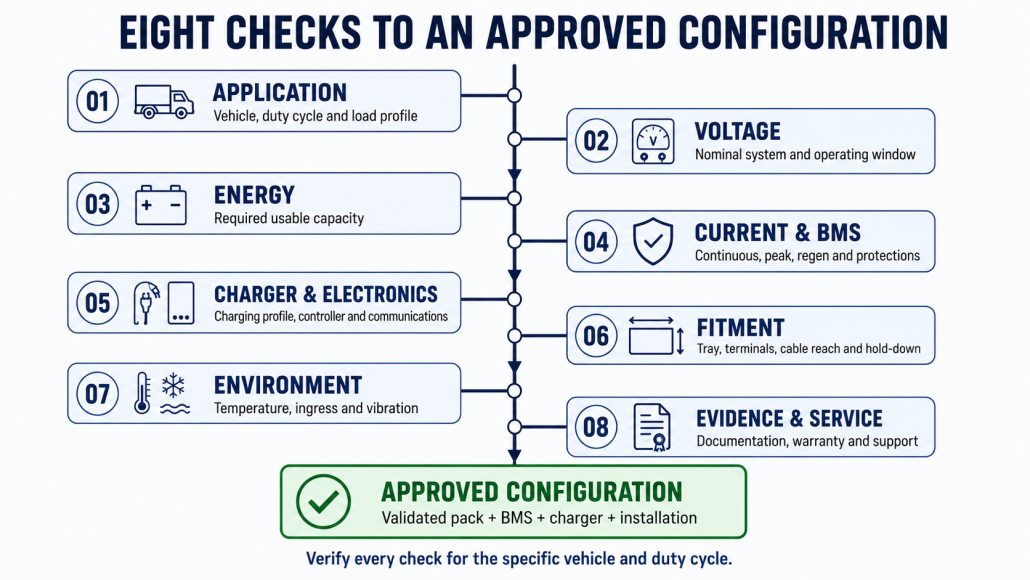
Once the application is defined, evaluate candidates with the same eight checks. Do not compare one battery’s marketing headline with another battery’s fully conditioned test result.
1. Match the Vehicle and System Voltage
Confirm the original electrical system and the voltage range accepted by the controller, motor, contactor, DC-DC converter, charger, and accessories. A battery sold as 48V may use a different nominal chemistry voltage and charge limit than another 48V-class system. The complete voltage window – not the label alone – must be approved for the cart.
2. Compare Energy, Not Amp-Hours Alone
Amp-hours are meaningful only when voltage is known. Nominal energy in kilowatt-hours is approximately nominal volts multiplied by amp-hours, divided by 1,000. Even then, usable energy depends on the manufacturer’s operating window and protection settings. Real range also changes with payload, hills, tires, speed, stops, accessories, temperature, battery condition, and the reserve the operator chooses to keep.
3. Verify Continuous and Peak Current
The BMS must support the controller’s sustained demand and short peaks without nuisance trips. Compare continuous discharge current, peak magnitude, allowed duration, recovery behavior, temperature derating, and regenerative charge current. Lifted carts, larger tires, steep grades, heavy loads, and aggressive controllers can materially change demand. A peak number without a time value is incomplete.
4. Treat the BMS as One Protection Layer
A well-designed BMS monitors cell voltage, current, and temperature and can provide balancing and fault protection. It cannot repair undersized cables, loose terminals, an unsafe charger, poor mounting, or incompatible vehicle electronics. Ask what the BMS measures, its trip and recovery logic, how faults are reported, whether event data are available, and how firmware or replacement service is handled.
5. Confirm the Charger and Vehicle Electronics
Use the existing charger only when the battery manufacturer approves that exact model and charge profile. Verify charge voltage, current, connector, onboard-computer behavior, state-of-charge display, regenerative charging, and any CAN or RS-485 communication. If the cart has 12V lights, audio, or other accessories, confirm the DC-DC converter and wiring are suitable for the new system.
6. Measure Fitment and Mechanical Restraint
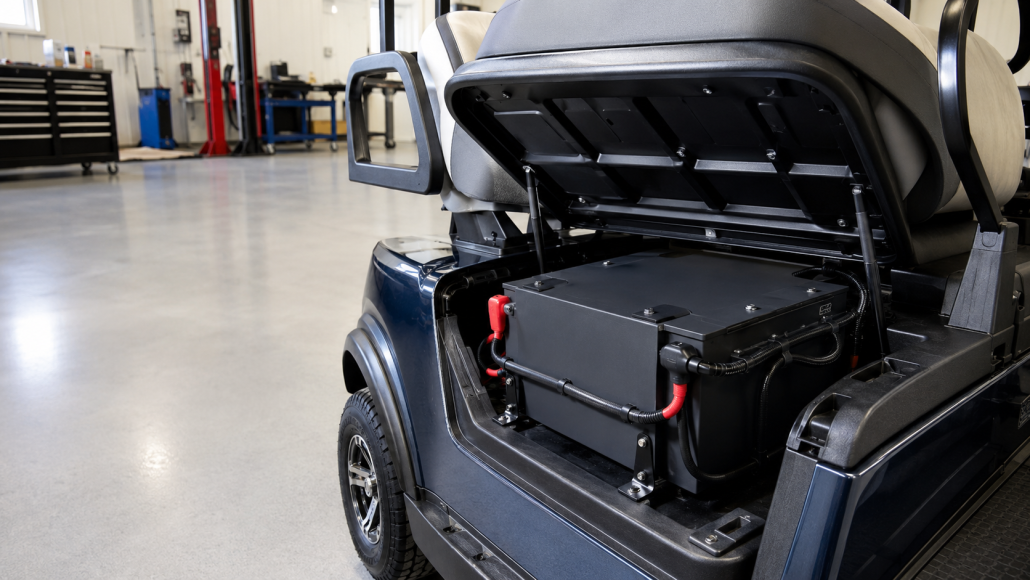
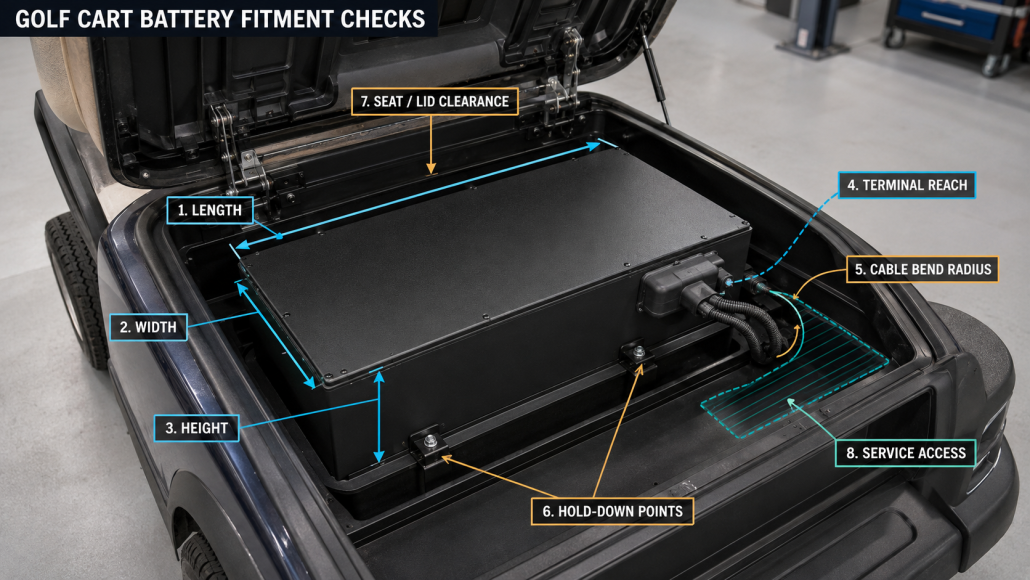
Record tray length, width, height, seat or lid clearance, terminal orientation, cable reach, bend radius, service access, and hold-down points. Check installed mass and weight distribution, not just whether the pack fits in the opening. The battery must remain restrained during turns, rough terrain, towing, and trailer transport. Follow the manufacturer’s installation and cleaning limits for the enclosure and connectors.
7. Check Temperature and Environmental Limits
Charging, discharging, and storage limits are different. Many lithium systems restrict charging near or below freezing unless approved low-temperature protection or heating is active. High ambient temperature can also reduce performance or life. Verify the exact model’s limits, derating, heater power needs, storage state of charge, enclosure rating, and instructions for water exposure. An IP rating is not permission to pressure-wash or submerge a battery.
8. Demand Model-Specific Evidence and Service
A credible supplier should provide a current data sheet, installation manual, charger approval, warranty, serial or batch traceability, and a documented support route. Where a buyer, insurer, fleet policy, or authority requires UL 2271, verify the exact certified model and configuration. UN 38.3 addresses transport testing; ask for the test summary and do not present it as an installation approval.
For U.S. road use, battery selection does not determine whether the completed vehicle is legal. A four-wheeled vehicle with a gross vehicle weight rating below 3,000 pounds and a speed capability above 20 mph but not above 25 mph may fall within the federal low-speed vehicle definition. State and local rules can add equipment, registration, licensing, insurance, and operating limits. Confirm the rules for the finished vehicle and location.
Lead-Acid, AGM, or LiFePO4: Which Is Best?
| Priority | Often suitable choice | Decision boundary |
| Lowest initial cost | Flooded lead-acid | Accept watering, corrosion control, heavier weight, and shorter service intervals. |
| No watering with familiar lead-acid behavior | AGM | Use an approved charge profile and compare actual capacity, current, weight, and warranty. |
| High use, low routine battery labor, lower weight | LiFePO4 | Validate the eight system checks; higher upfront cost does not guarantee compatibility or payback. |
For many frequently used carts and fleets, a properly engineered LiFePO4 system offers the strongest balance of usable energy, consistent power, lower routine battery maintenance, and service life. For very light use or a strict upfront budget, a compatible lead-acid option may remain reasonable. The best choice follows the duty cycle, not a universal slogan.
How to Compare Lifetime Value
Build a total-cost model using quoted purchase price, charger and installation work, preventive maintenance, water and cleaning for flooded systems, electricity, downtime, warranty exclusions, financing, planned ownership period, and replacement assumptions. Keep range and cycle-life inputs tied to the exact products and operating conditions. A transparent model is more credible than a fixed claim that lithium always pays back within a set number of years.
Frequently Asked Questions
Are lithium batteries automatically the best golf cart batteries?
No. LiFePO4 can be an excellent choice, especially for higher use, but the battery, BMS, charger, controller, mounting, environment, and service plan must work as one approved system.
How many amp-hours does my golf cart need?
Amp-hours alone cannot answer the question. Start with voltage and expected daily energy use, then allow for payload, terrain, tires, accessories, temperature, aging, and reserve. Use field data from a comparable cart or a documented manufacturer sizing method whenever possible.
Can I use my existing lead-acid charger with lithium?
Only if the lithium battery manufacturer explicitly approves the exact charger and profile. Otherwise, use the specified lithium-compatible charger and verify any onboard computer, connector, and communication requirements.
What documents should I request before buying?
Request the exact model data sheet, installation and charging instructions, warranty, compatibility statement, safety certification evidence required for the application, UN 38.3 test summary for transport, and a clear U.S. support and claims process.
Choose the Battery as a System
The best golf cart batteries are not defined by the biggest amp-hour number, the longest unsupported life claim, or the word premium. They are defined by verified compatibility, usable energy, current capability, safe charging, secure installation, environmental suitability, transparent evidence, and responsive service.
LEOCH offers lithium golf cart battery systems for a range of voltage and energy needs. Before selecting a model, share your cart and duty information with a battery specialist so the proposed battery, charger, controls, fitment, and support plan can be reviewed together.