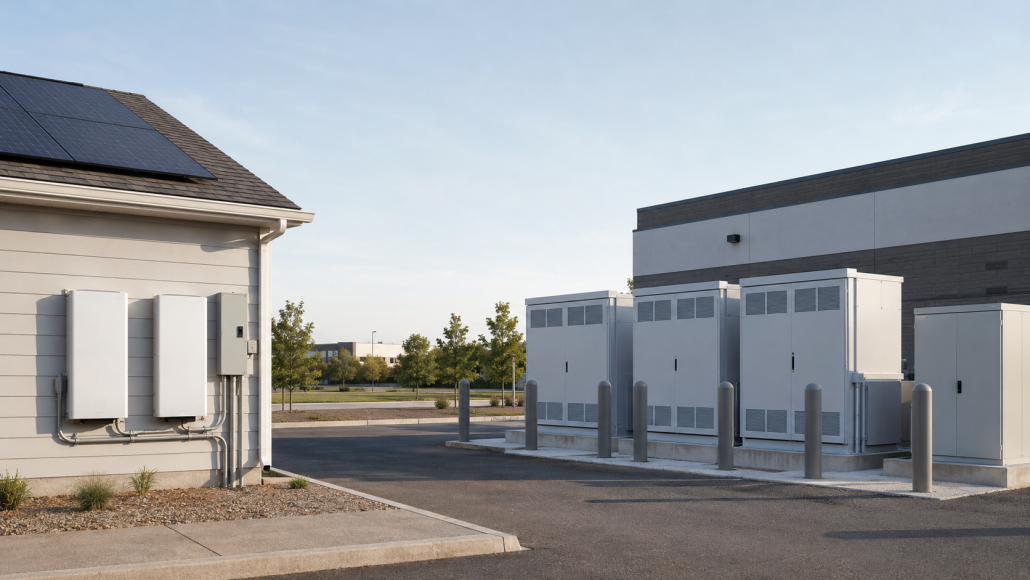
Li-Ion Battery Storage: How Systems Work and What to Evaluate
|
Quick answer Li-ion battery storage usually means a stationary system that stores electricity and returns it through a bidirectional inverter or power conversion system. A complete installation also needs a battery management system, controls, protection, thermal management, and code-compliant integration. Choose it by application, power in kilowatts, usable energy in kilowatt-hours, site conditions, approved system configuration, and lifecycle economics – not by battery capacity alone. |
People often search for li ion battery storage with two different questions in mind: how an energy storage system works, or how to keep unused cells and packs safely. This guide focuses on installed stationary energy storage for homes, businesses, and grid applications. A short section near the end addresses off-service battery storage.
What Is a Lithium-Ion Battery Storage System?
A lithium-ion battery storage system converts electrical energy into chemical energy while charging, holds it in battery cells, and converts it back to usable electricity when discharging. Lithium iron phosphate, or LFP, is one lithium-ion chemistry commonly used for stationary applications because it can offer a useful balance of thermal stability, cycle capability, cost, and service life. The exact result still depends on cell design and the complete system.
The battery management system (BMS) monitors cell voltage, temperature, current, state of charge, and abnormal conditions. A bidirectional inverter or power conversion system (PCS) moves energy between DC batteries and AC loads or the grid. An energy management system (EMS) schedules charging and discharge. Contactors, fuses, switchgear, enclosure, cooling or heating, communications, alarms, and fire-risk controls complete the safety and operating architecture.
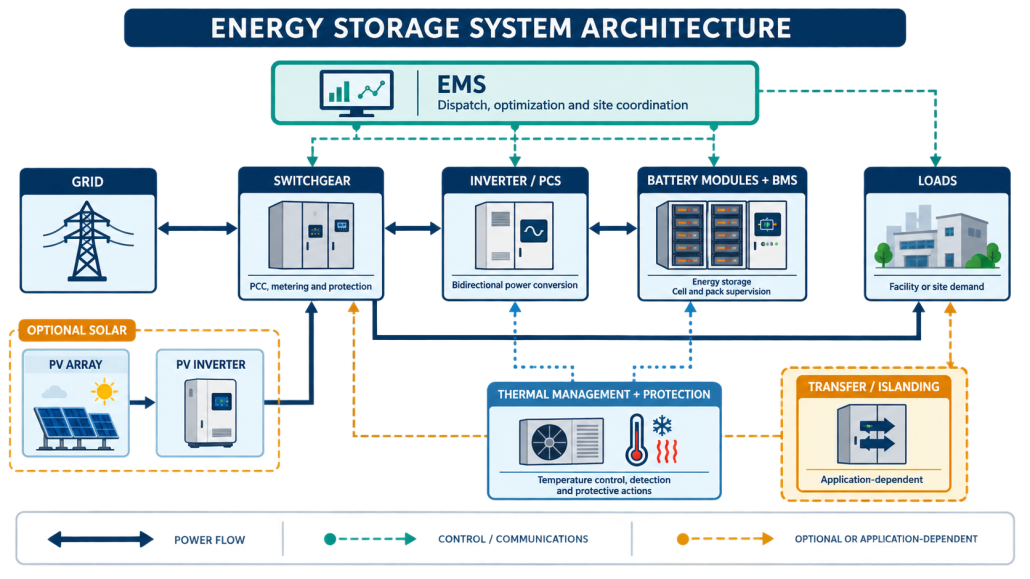
That system boundary matters: a battery rack with a strong cell specification is not automatically a complete, approved energy storage system.
kW and kWh Answer Different Questions
Power, measured in kilowatts (kW), describes how much load the system can support at one time. Energy, measured in kilowatt-hours (kWh), describes how much electricity is stored. A nominal 10 kW/20 kWh system has a two-hour ratio at full rated power before accounting for the approved state-of-charge window, conversion losses, auxiliary loads, temperature, aging margin, and reserve. Actual backup time is based on the changing load, not a simple nameplate promise.
Start with load data and the operating objective, then size kW for simultaneous and starting demand and kWh for the required duration.
Where Li-Ion Battery Storage Fits
| Application | Common objective | Essential project inputs |
| Home | Backup for selected loads, solar self-use, or time-of-use shifting | Bills or interval use, critical-load list, motor starts, solar/inverter details, desired hours |
| Commercial / industrial | Demand management, resilience, solar shifting, power support | Interval data, tariff, peak kW, service voltage, process loads, UPS/generator coordination |
| Utility / microgrid | Renewable integration, capacity, grid services, reserve, local reliability | Interconnection study, dispatch duty, MW/MWh, grid model, controls, site and market requirements |
A home battery does not automatically provide outage power. Backup requires approved islanding or transfer, adequate power and energy, protection, controls, and assigned circuits. A business also needs to define acceptable transition time: equipment that can tolerate a controlled transfer has different requirements from sensitive loads that need a no-break UPS.
For peak shaving, the tariff must contain an addressable demand charge and the EMS must hold discharge across the utility’s measurement interval. For utility projects, use a dedicated utility-scale architecture and interconnection process rather than extending a residential design.
Benefits – and the Boundaries Around Them
Lithium-ion storage can provide compact usable energy, responsive power electronics, flexible controls, and lower routine battery maintenance than flooded lead-acid systems. Modular products may also simplify staged deployment when the manufacturer approves the expansion configuration.
Those advantages are conditional. Whole-system AC round-trip efficiency is lower than a cell-only or DC-path figure because the PCS, thermal system, controls, and other auxiliaries consume energy. Cycle life changes with temperature, charge and discharge rate, state-of-charge window, calendar age, and energy throughput. ‘Maintenance-free,’ ‘zero fire risk,’ and universal savings percentages are not credible project claims.
LFP generally offers greater thermal stability than many nickel-rich lithium-ion chemistries, but it is not noncombustible or immune to thermal runaway. Safety is a system property created by cell quality, BMS logic, electrical protection, thermal design, enclosure, installation, commissioning, monitoring, maintenance, and emergency planning.
How to Evaluate a System Before Buying
1. Define one primary operating objective
Backup, solar shifting, demand reduction, and grid services use different reserve levels and dispatch logic. Decide which objective controls the design and which services are secondary.
2. Use measured loads and the actual tariff
For a home, list critical loads, daily energy, and motor starting demand. For a facility, use interval load data, bills, operating schedules, service voltage, and outage consequences. Savings without a tariff-and-load model are marketing assumptions.
3. Verify the integrated configuration
Confirm the exact battery, BMS, PCS or inverter, controls, firmware, communications, protection, thermal system, and approved expansion rules. Similar voltages do not establish compatibility, listing status, or warranty coverage.
4. Design around the site
Review charging and discharging temperature limits, derating, elevation, flood exposure, corrosion, enclosure rating, ventilation, clearances, fire access, security, communications, and service space. The installation location can change available power, life, permitting, and cost.
5. Compare lifecycle obligations
Evaluate installed cost, engineering, permits, interconnection, auxiliary energy, degradation, preventive maintenance, monitoring, service response, financing, warranty throughput, replacement strategy, decommissioning, and recycling. A low purchase price is not the same as a low lifecycle cost.
U.S. Safety, Code, and Interconnection Checks
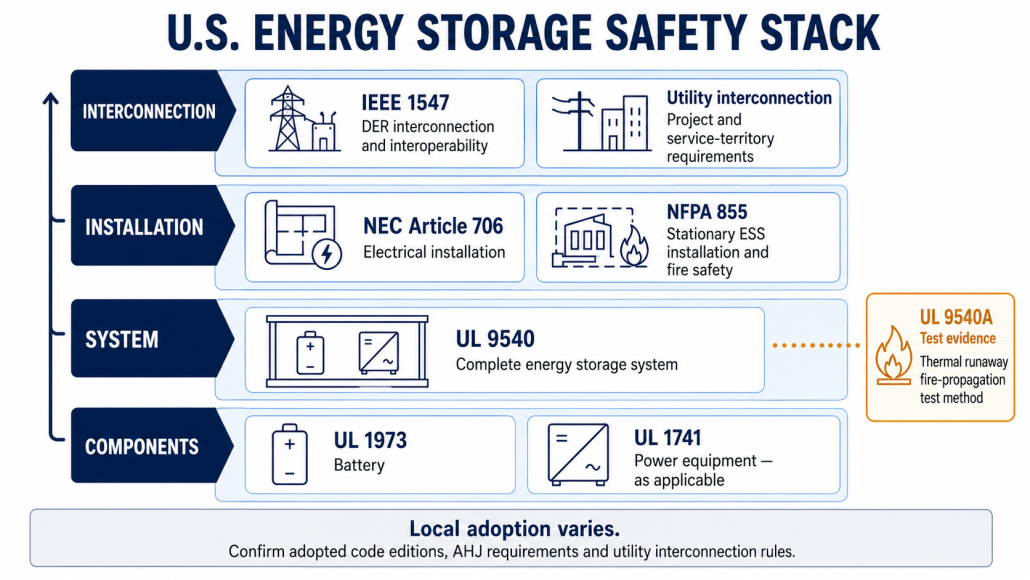
Ask how the exact configuration addresses UL 1973 for stationary batteries, UL 1741 for applicable power-conversion and interconnection equipment, and UL 9540 for the complete energy storage system. UL 9540A is a test method used to evaluate thermal-runaway fire propagation; a test report is not the same as a UL 9540 system certification.
Installation requirements can involve NEC Article 706 and NFPA 855. Grid-connected projects may also involve IEEE 1547, the utility’s interconnection rules, and project-specific studies. Code editions and requirements vary by state and local authority. Confirm the adopted rules with the authority having jurisdiction, utility, fire officials, insurer, installer, and qualified engineer before equipment is ordered.
UN 38.3 addresses transport testing and does not replace product listing, permitting, electrical or fire-code review, or interconnection approval. Product names and certifications should always be tied to an exact model and configuration.
If You Mean Storing Unused Lithium-Ion Batteries
Follow the battery or equipment manufacturer’s storage state-of-charge, temperature, humidity, inspection, and recharge instructions; there is no safe universal setting for every cell, module, or installed ESS. Keep terminals protected from short circuits, prevent physical damage, and separate batteries from heat, ignition sources, and incompatible materials. Do not charge or reuse a swollen, leaking, hot, recalled, or damaged battery; isolate the area and contact the manufacturer or qualified hazardous-materials professional for instructions.
In the United States, lithium-ion batteries should not go into household trash or ordinary curbside recycling. EPA advises separate collection or qualified recycling channels. Medium and large energy-storage batteries should be handled through the manufacturer or installer. Commercial quantities, damaged batteries, and transport can trigger additional fire-code, hazardous-waste, and U.S. Department of Transportation requirements.
Frequently Asked Questions
Can battery storage work without solar?
Yes. A compatible system can charge from the grid for backup or time shifting when the equipment, utility rules, rate plan, and economics support that use. Solar is not a technical requirement for every storage project.
How long will a lithium-ion battery storage system run?
Runtime depends on usable kWh, actual load, conversion losses, reserve, temperature, and battery age. Divide usable energy by average load only for an initial estimate, then model load changes and starting power.
Is LFP the best chemistry for every storage project?
No chemistry is automatically best. LFP is widely used in stationary storage, but the decision should compare safety evidence, energy and power, temperature performance, cycle and calendar aging, footprint, warranty, service, availability, and total cost for the duty profile.
Can capacity be added later?
Only within the manufacturer’s approved architecture. Battery age, firmware, BMS limits, inverter or PCS rating, protection, listing, enclosure, and permit conditions may restrict expansion. Plan likely future capacity during the original design.
Choose the System Around the Application
Li-ion battery storage can support resilience, solar utilization, demand management, and grid flexibility, but reliable value comes from matching the complete system to measured loads, site conditions, local rules, and a defined operating objective. Explore LEOCH residential energy storage solutions or commercial and industrial energy storage solutions, or request an application review with your project data.