Balcony Solar: Why Your Urban System Needs a Smart Battery Hub
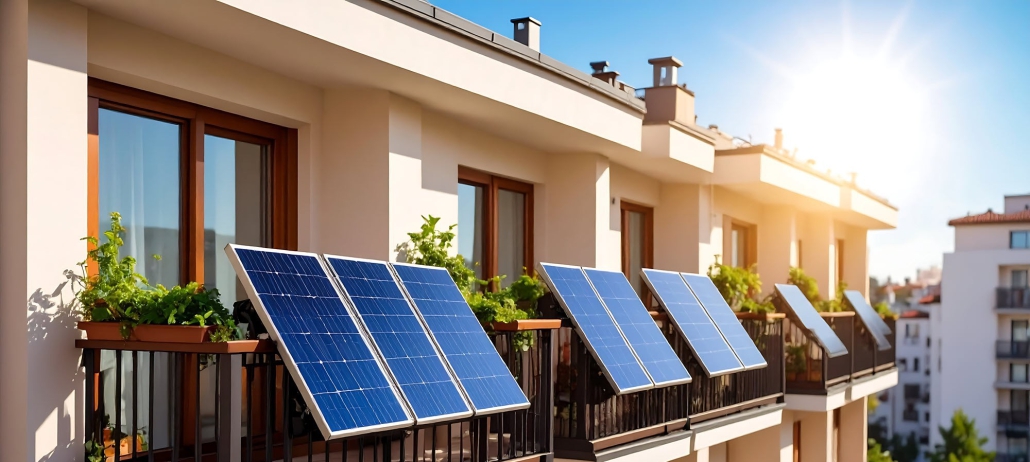
Balcony solar has rapidly become one of the fastest-growing renewable energy solutions for apartment owners, condominium residents, and urban renters. As electricity prices continue to rise and rooftop access remains limited, compact plug-and-play solar systems are giving city dwellers an accessible way to generate their own clean electricity.
However, many first-time users quickly discover a frustrating reality.
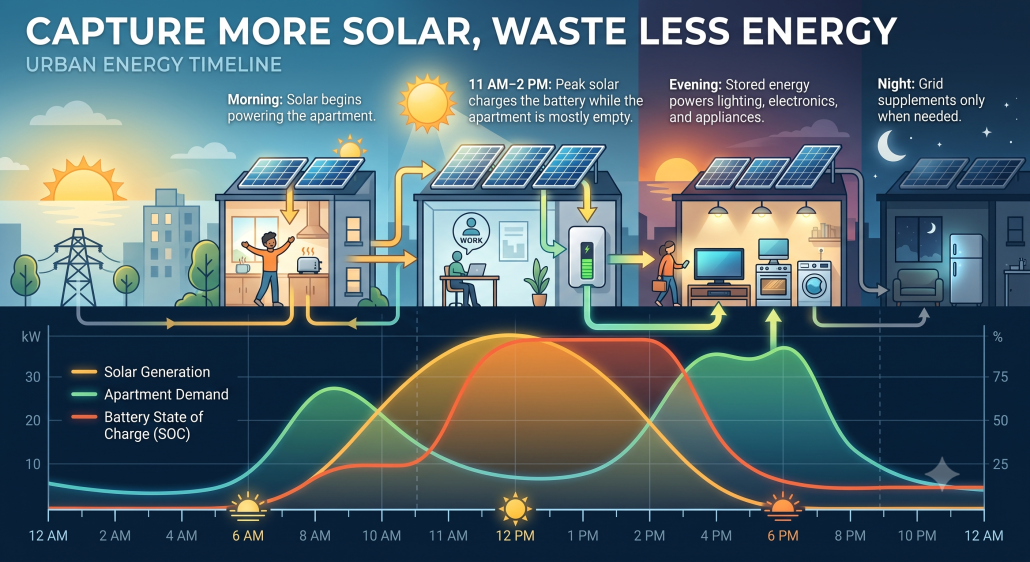
A typical balcony solar system produces its highest output between 11:00 AM and 2:00 PM—precisely when many people are at work and their apartments are consuming very little electricity. Without energy storage, much of this valuable solar generation is either exported back to the grid for little financial return or simply goes unused.
This is why modern balcony solar is evolving beyond panels alone.
The real intelligence of today’s urban energy systems isn’t mounted on the balcony railing—it’s housed inside a compact plug-and-play battery hub that stores, manages, and intelligently distributes energy throughout the day. By capturing excess solar production and supplying electricity when it’s actually needed, battery storage dramatically improves both self-consumption and return on investment.
How Does a Balcony Solar System Work?
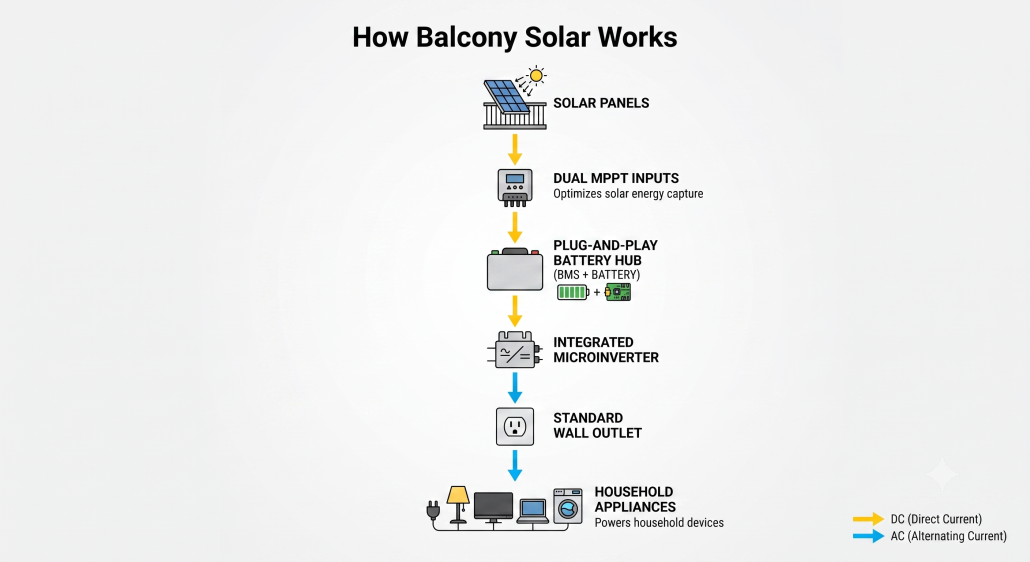
A balcony solar system is a compact residential photovoltaic solution designed for apartments, condominiums, and other buildings without traditional rooftop installations. Solar panels mounted on a balcony generate direct current (DC) electricity, which is routed into a plug-and-play solar battery equipped with an integrated Battery Management System (BMS), charge controller, and microinverter. The battery stores excess energy and converts it into alternating current (AC), allowing electricity to flow safely through a standard household wall outlet to offset the home’s baseline electrical consumption. By storing daytime solar production and delivering it during periods of higher demand, the battery hub maximizes solar self-consumption while minimizing wasted energy.
The simplified energy flow looks like this:
Solar Panels → Battery Storage Hub → Integrated Microinverter → Household AC Circuit → Home Appliances
Unlike traditional rooftop systems that often require dedicated electrical infrastructure, plug-and-play balcony systems are designed to simplify installation while delivering meaningful reductions in daily electricity consumption.
The Battery-First Architecture: Turning Panels into Accessories
When evaluating a balcony solar setup, many consumers focus almost entirely on the solar panels.
In reality, the panels are simply energy collectors.
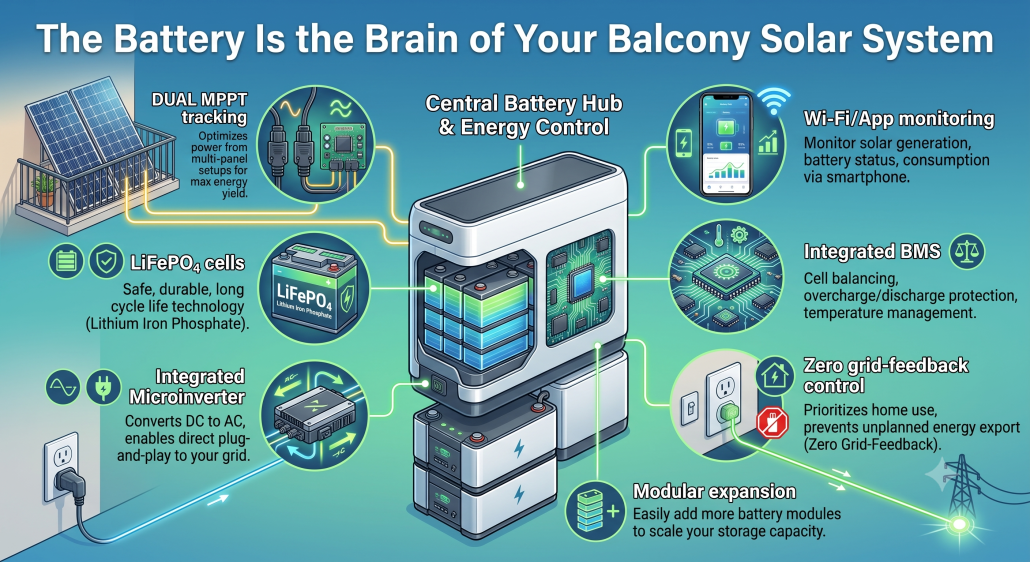
The battery storage hub is where the intelligence resides.
It determines how efficiently energy is harvested, stored, managed, and delivered to household appliances.
Dual MPPT Tracking Maximizes Urban Solar Production
Urban environments create unique challenges for solar generation.
Nearby buildings, balconies above, trees, and architectural features often cause partial shading throughout the day. Even small shadows crossing a panel can significantly reduce output if not managed correctly.
High-quality battery hubs address this issue with dual Maximum Power Point Tracking (MPPT) inputs.
Each MPPT independently optimizes the operating point of connected solar panels, allowing the system to maintain maximum energy harvest even when one panel experiences shading while another remains fully illuminated.
This intelligent power optimization improves energy yield without requiring larger panel arrays.
Zero Grid-Feedback Controls
One of the most important engineering features of a modern apartment battery storage system is intelligent power management.
Many utility providers restrict or regulate electricity exported back to the public grid. Traditional grid-tied solar systems may require permits, utility approvals, or additional metering equipment before excess electricity can be exported.
A smart balcony battery hub continuously monitors household consumption and automatically adjusts power output to match real-time demand.
By preventing unwanted electricity from flowing backward through the utility meter—a feature commonly referred to as zero grid-feedback or zero export—the system helps maintain compliance with local utility requirements while maximizing on-site solar utilization.
For apartment residents, this greatly simplifies system operation and reduces administrative complexity.
Technical Standards for High-Rise Battery Storage
Unlike detached homes, apartment balconies present tighter installation spaces and greater proximity to neighboring residences.
Safety, reliability, and quiet operation therefore become essential engineering priorities.
Lithium Iron Phosphate (LiFePO₄): The Preferred Chemistry
Among all commercially available battery chemistries, Lithium Iron Phosphate (LiFePO₄) has become the preferred choice for residential balcony applications.
Its highly stable crystal structure offers:
- Excellent thermal stability
- Long service life exceeding 6,000 charge-discharge cycles
- High resistance to thermal runaway
- Maintenance-free operation
- Consistent daily cycling performance
These characteristics make LiFePO₄ particularly well suited for close-quarter residential environments where long-term safety is paramount.
Passive, Fanless Cooling
Urban balconies are often places for relaxation, reading, or entertaining guests.
A constantly running cooling fan would quickly become an annoyance.
Well-designed battery hubs therefore utilize passive thermal management systems that eliminate the need for continuous mechanical cooling.
Operating at 20 dB or less, these fanless systems remain virtually silent while maintaining optimal battery temperatures under normal operating conditions.
The result is reliable energy storage without compromising outdoor comfort.
Weatherproof Construction
Balcony battery systems are exposed to year-round environmental conditions.
Rain, humidity, freezing temperatures, summer heat, airborne dust, and UV radiation all place continuous stress on outdoor equipment.
A premium storage hub should therefore feature an IP65-rated enclosure, providing protection against dust ingress and low-pressure water exposure while helping preserve battery performance across a wide operating temperature range.
Robust enclosure design also contributes to longer service life and lower maintenance requirements.
Load Balancing: What Can a 2 kWh Balcony Battery Offset?
One of the most common questions from homeowners is how much electricity a compact balcony battery can realistically provide.
Although actual runtime depends on appliance efficiency and operating patterns, a 2 kWh battery storage hub can comfortably support many essential household loads.
| Household Baseline Load | Average Power Draw | Estimated Runtime on a 2 kWh Storage Hub |
| Wi-Fi Router & Smart Home Hub | 20W | ~100 Hours |
| Home Office Laptop & Monitor | 60W | ~30 Hours |
| Standard LED Television | 100W | ~20 Hours |
| Energy-Efficient Refrigerator | 150W (Cycle Dependent) | ~12 – 15 Hours |
*Actual refrigerator runtime varies depending on compressor duty cycle, ambient temperature, and door-opening frequency.
Rather than powering an entire apartment simultaneously, balcony batteries are designed to offset continuous baseline loads and maximize the use of self-generated solar electricity throughout the day.
Scaling to Whole-Home Independence
Looking for true grid independence?
A plug-and-play balcony battery hub is an ideal solution for apartment residents and renters looking to reduce daily electricity costs and improve solar self-consumption.
However, if you own your home and need to support high-power loads such as HVAC systems, water pumps, induction cooktops, or electric vehicle chargers during extended grid outages, a balcony micro-system is only the first step.
For whole-home backup and long-duration energy resilience, explore our comprehensive guide: Solar Batteries for Home: An Engineering Guide to Residential Storage.
Frequently Asked Questions: Balcony Solar and Storage
Do you need an electrician to install balcony solar storage?
In many regions, no.
True plug-and-play solar battery systems are designed to operate within standard household electrical limits and connect using conventional wall outlets. Because they do not require permanent modifications to a home’s electrical infrastructure, installation often does not require an electrician or complex permitting procedures.
However, regulations differ by country, utility provider, and local building codes. Homeowners should always verify local requirements before installation.
Can you expand the storage capacity of a balcony battery?
Yes.
Modern balcony battery systems increasingly feature modular expansion capabilities.
Many products begin with a compact 2 kWh storage module that can later be expanded by adding compatible battery units as household energy requirements increase.
Depending on the manufacturer, total capacity may scale to 10 kWh or more, allowing users to extend evening energy usage, improve solar self-consumption, and adapt their storage system without replacing the original battery.
This modular flexibility makes balcony energy storage particularly attractive for renters and homeowners whose energy needs may evolve over time.
Maximizing the Value of Every Watt
Balcony solar is transforming the way urban residents participate in the clean energy transition.
Yet solar panels alone cannot solve the mismatch between daytime electricity generation and evening household demand.
While the panels capture sunlight, the battery storage hub determines how effectively that energy is used. Intelligent features such as dual MPPT tracking, zero-export control, modular expansion, and safe LiFePO₄ battery technology enable homeowners to maximize self-consumption, reduce grid dependence, and improve the long-term value of every kilowatt-hour generated.
Whether you’re an apartment resident seeking greater energy independence, a property developer designing sustainable multi-family housing, or a regional distributor expanding your renewable energy portfolio, a high-quality plug-and-play lithium battery solution provides the intelligence that turns a simple balcony solar installation into a reliable, localized power plant.
Ready to optimize your balcony solar system? Contact our energy storage specialists to explore plug-and-play lithium battery hubs engineered for safe, efficient, and scalable urban energy storage.