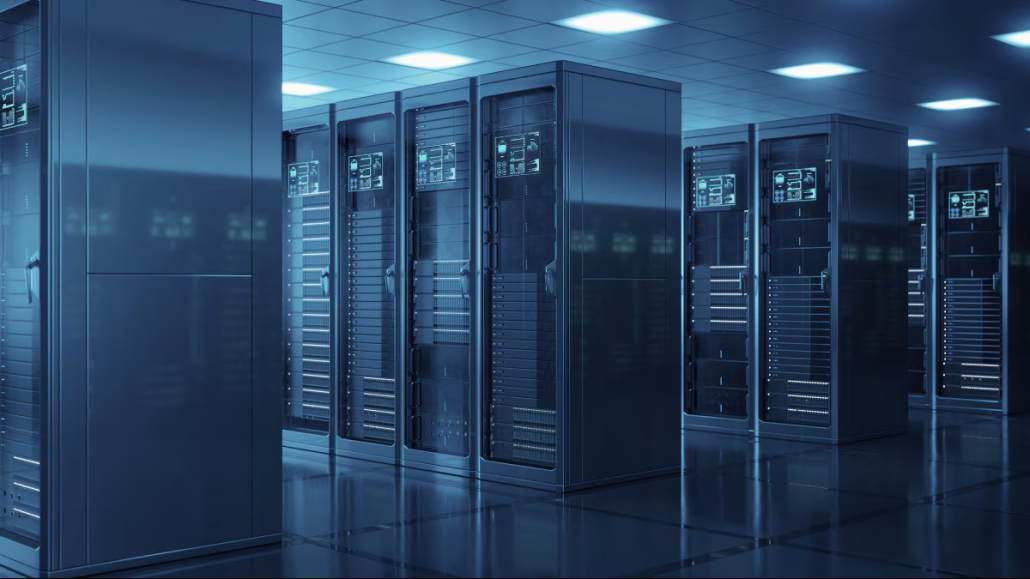
Top Data Center Power Solutions: UPS, Batteries, Generators & More
Artificial intelligence, cloud computing, hyperscale infrastructure, and edge computing are transforming how modern data centers are designed. Today’s facilities are expected to deliver uninterrupted availability while supporting significantly higher rack densities, increasing power consumption, and tighter sustainability targets than ever before.
At the center of this transformation is power resilience.
Even a momentary interruption in utility power can disrupt mission-critical workloads, corrupt data, interrupt financial transactions, or trigger costly downtime. As AI clusters and GPU servers continue pushing rack power beyond traditional limits, the role of the data center UPS has become more critical than ever.
Modern data center power solutions are no longer built around batteries alone—they combine intelligent UPS architecture, advanced Battery Management Systems (BMS), high-efficiency power electronics, and increasingly, Lithium Iron Phosphate (LiFePO₄) battery technology to deliver higher reliability, greater energy density, and lower total cost of ownership.
The Quick Answer
The foundation of every modern data center power solution is an Online Double-Conversion Uninterruptible Power Supply (UPS) paired with a Lithium Iron Phosphate (LiFePO₄) battery cabinet. During a utility outage, the lithium UPS battery delivers power with zero transfer time, providing critical 5–15 minutes of ride-through for IT equipment while standby diesel generators start, synchronize, and assume the facility load without interrupting operations.
The Core Anatomy of Data Center Power Resilience
A resilient power infrastructure is built around multiple layers of redundancy, ensuring continuous operation even when utility power fails.
In a typical enterprise or hyperscale facility, electrical power flows through the following sequence:
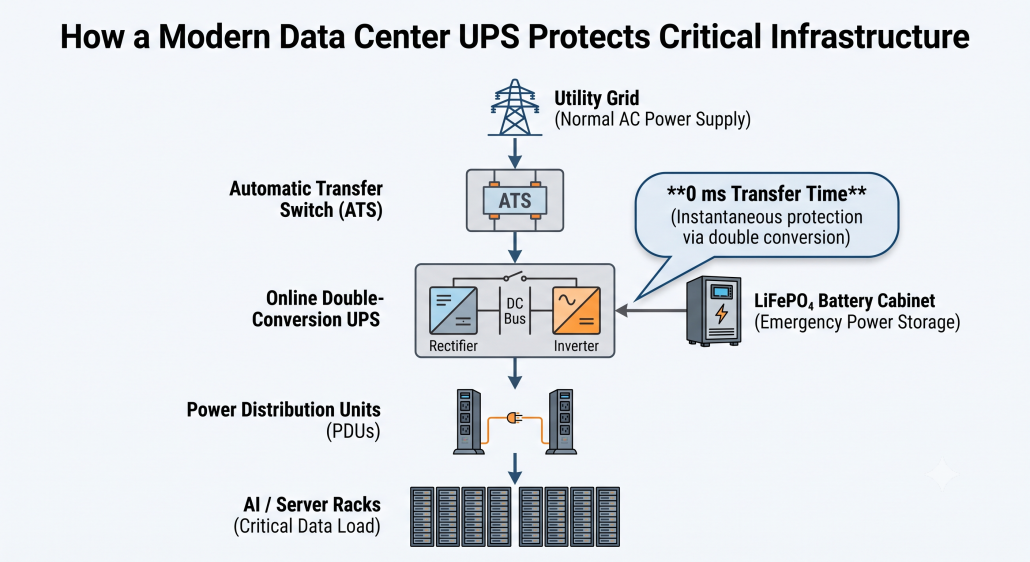
Each component performs a distinct function, but the UPS battery cabinet serves as the critical bridge between utility failure and generator availability.
When utility power is lost, generators require several seconds to start, stabilize engine speed, synchronize voltage and frequency, and connect to the electrical bus.
Without stored energy during this transition, servers would immediately lose power.
The data center battery backup prevents this scenario by maintaining uninterrupted power until standby generation is fully online, eliminating downtime during the most vulnerable phase of an outage.
Why Online Double-Conversion UPS Systems Matter
Unlike standby or line-interactive UPS designs commonly used in offices, modern data center UPS systems almost exclusively employ an online double-conversion topology.
In this architecture, incoming AC utility power is continuously converted into DC power through a rectifier before being inverted back into clean, regulated AC output.
Because IT equipment is always powered through the inverter, the battery can immediately support the DC bus whenever utility power disappears.
This design provides several critical advantages:
- Zero transfer time during outages
- Continuous voltage regulation
- Frequency stabilization
- Isolation from utility disturbances
- Protection against voltage sags, surges, harmonics, and electrical noise
For mission-critical applications where even milliseconds of interruption are unacceptable, double-conversion technology remains the industry standard.
VRLA vs. Lithium UPS Batteries: The 2026 Performance Matrix
Battery chemistry significantly influences the reliability, operating costs, and scalability of a UPS system.
For decades, Valve-Regulated Lead-Acid (VRLA) batteries dominated data center installations. Today, however, lithium technology is rapidly becoming the preferred choice for new facilities and UPS upgrades.
| UPS Battery Parameter | Lithium Iron Phosphate (LiFePO4) | Traditional VRLA (Valve-Regulated Lead-Acid) |
| Physical Footprint (Space) | 40% – 60% smaller (Allows more IT server racks) | Massive (Often requires dedicated battery rooms) |
| Total Weight Loading | Up to 70% lighter (Ideal for multi-story data floors) | Extremely heavy (Requires reinforced raised flooring) |
| Design Life & Cycles | 10–15 Years / 3,000+ Cycles | 3–5 Years / 300–500 Cycles |
| Thermal Tolerance | Excellent (Requires less aggressive HVAC cooling) | Poor (Degrades rapidly above 77°F / 25°C) |
| Total Cost of Ownership (TCO) | Lowest over 10 years (Zero replacement cycles) | High (Requires 2 to 3 complete replacements) |
Although lithium batteries generally require a higher initial investment, their extended service life, reduced maintenance, and lower cooling demands frequently result in substantially lower lifecycle costs.
Why AI and High-Density Racks Require Lithium Upgrades
The rapid adoption of AI is changing the electrical profile of modern data centers.
Traditional enterprise server racks typically consumed around 5–10 kW of power. Today’s AI infrastructure, however, often supports GPU clusters exceeding 50 kW per rack, with some next-generation deployments pushing even higher.
These concentrated loads introduce new challenges for UPS systems:
- Higher peak discharge currents
- Faster transient load changes
- Increased thermal density
- Greater cooling requirements
- Reduced tolerance for voltage instability
Lithium Iron Phosphate batteries are particularly well suited to these environments because they deliver high discharge power while maintaining stable voltage under demanding operating conditions.
Compared with VRLA batteries, lithium systems provide:
- Faster high-rate discharge capability
- Better voltage stability under heavy loads
- Improved thermal performance
- Lower internal resistance
- Reduced cooling requirements
These characteristics make lithium batteries an ideal companion for AI infrastructure where consistent power quality directly affects server reliability and computational performance.
Scalability: Modular UPS Systems for Edge Computing
Not every data center is a hyperscale campus.
Edge computing facilities, modular colocation sites, healthcare networks, manufacturing plants, and regional telecom facilities increasingly require compact, scalable UPS architectures that can grow alongside demand.
Modern modular data center UPS systems are designed around expandable power modules and lithium battery cabinets that support incremental capacity increases.
Rather than replacing an entire UPS installation, operators can simply add battery modules or power conversion units as IT loads expand.
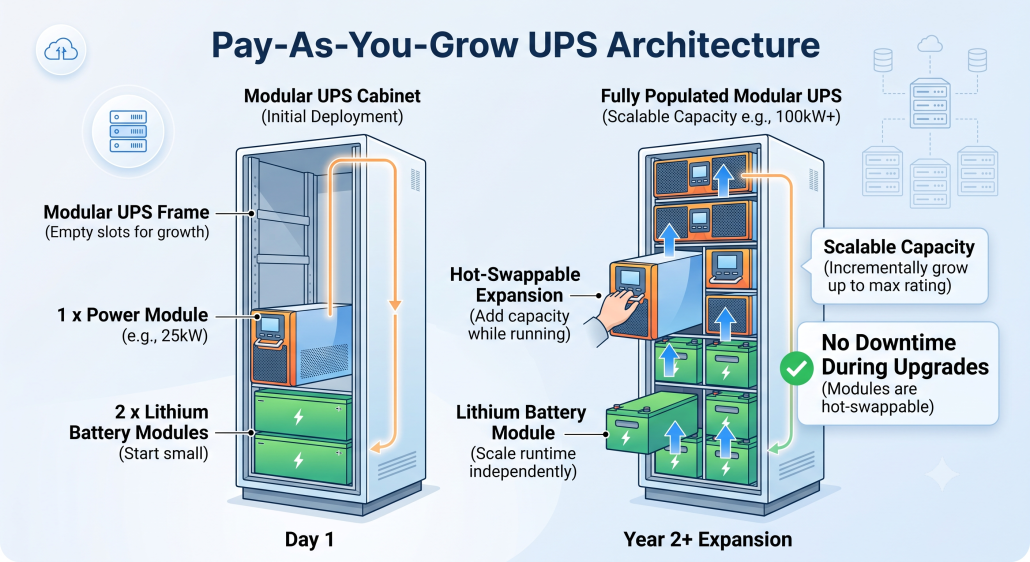
This “pay-as-you-grow” architecture offers several operational benefits:
- Lower initial capital expenditure
- Simplified future expansion
- Reduced deployment time
- Improved redundancy planning
- Hot-swappable battery modules without interrupting the critical load
For facilities expecting gradual growth, modular UPS platforms provide greater flexibility while minimizing disruption to ongoing operations.
Thermal Management: An Often-Overlooked Design Consideration
As power density increases, thermal management becomes one of the defining factors in UPS reliability.
Traditional VRLA batteries are highly sensitive to elevated temperatures. Operating above the recommended ambient temperature can significantly shorten battery life and increase replacement frequency.
LiFePO₄ batteries exhibit much greater thermal stability, allowing facilities to reduce cooling intensity while maintaining predictable battery performance.
Combined with intelligent Battery Management Systems (BMS), modern lithium cabinets continuously monitor:
- Cell voltage
- Cell temperature
- Current
- State of Charge (SOC)
- State of Health (SOH)
This real-time monitoring improves reliability, supports predictive maintenance, and reduces the likelihood of unexpected battery failures.
Securing Your Enterprise Infrastructure
Enterprise Power Resource
If you’re an electrical engineer, consulting engineer, facility architect, or data center operator planning a multi-megawatt UPS deployment, evaluating battery footprint, rack density, thermal performance, and lifecycle cost is essential.
Explore our Data Center & UPS Battery Solutions to compare modular lithium battery cabinets, communication protocols, Battery Management System (BMS) capabilities, UL certifications, and scalable architectures designed for enterprise and hyperscale facilities.
For a side-by-side analysis of these battery chemistries, see our comparison guide: VRLA vs Lithium Battery for UPS: A Practical Guide for Data Center Backup Power
For more on the transition to advanced UPS battery systems, read: Why Lithium UPS Battery Systems Are the Future of Data Center Backup Power
Frequently Asked Questions: Data Center Battery Backups
How long does a data center battery backup last during an outage?
A data center UPS battery is not intended to power the facility for hours.
Instead, it is engineered to provide high-rate discharge for approximately 5–15 minutes, supplying uninterrupted “ride-through” power while standby diesel generators start, synchronize, and assume the facility’s electrical load.
The exact runtime depends on UPS capacity, battery size, redundancy configuration, and the critical IT load being supported.
Why do data centers use double-conversion UPS systems?
Double-conversion UPS systems continuously convert incoming AC utility power into DC power before inverting it back into clean AC output.
Because connected equipment is always powered through the inverter, there is zero transfer time when utility power fails.
This architecture also protects sensitive servers from:
- Voltage sags
- Brownouts
- Frequency fluctuations
- Electrical noise
- Harmonic distortion
- Utility transients
For mission-critical environments where uninterrupted operation is essential, online double-conversion technology provides the highest level of power quality and reliability.
Building the Next Generation of Data Center Power
As AI, cloud computing, and edge infrastructure continue driving higher rack densities and greater power demands, the importance of resilient data center power solutions has never been greater.
While online double-conversion UPS technology remains the foundation of uninterrupted power protection, Lithium Iron Phosphate (LiFePO₄) batteries are redefining what modern UPS systems can achieve. Their compact footprint, lighter weight, extended lifespan, superior thermal stability, and lower total cost of ownership make them an increasingly attractive alternative to traditional VRLA batteries.
Whether you’re designing a new hyperscale facility, upgrading an enterprise UPS, or expanding an edge computing site, selecting the right battery architecture is essential for ensuring long-term reliability, operational efficiency, and scalability.
Planning your next UPS deployment? Connect with trusted battery suppliers in the USA to source scalable and proven lithium battery systems for data center UPS applications.