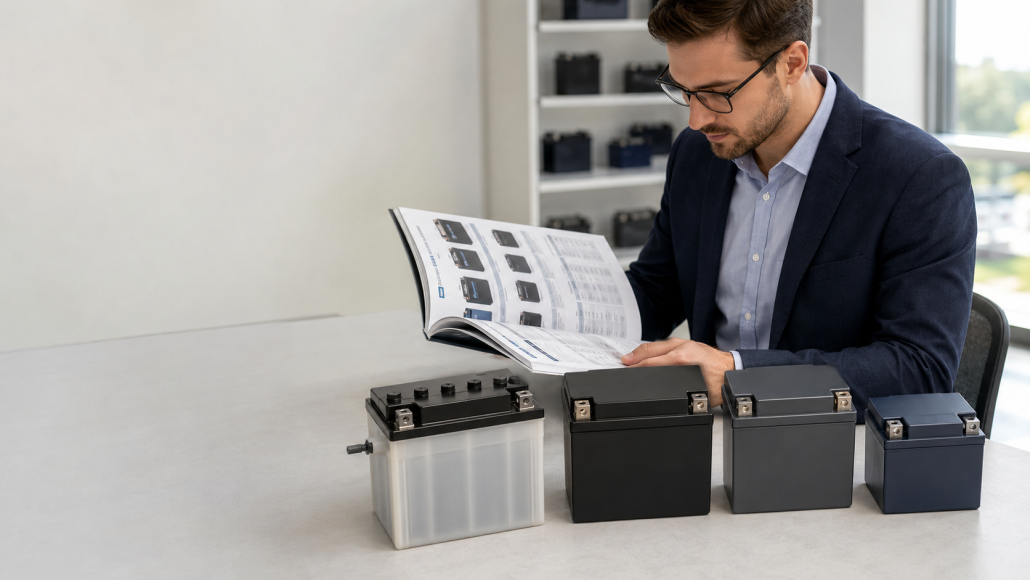
Motorcycle Battery Wholesale Guide: Build the Right Product Range
|
Quick answer A strong motorcycle battery wholesale catalog is not the one with the most SKUs. It is the range that covers verified local applications with complete fitment data, comparable electrical ratings, clear chemistry and activation choices, required documentation, and a repeatable warranty process. Build the core range from actual demand, then add supporting and premium products where they solve a defined channel need. |
Motorcycle battery wholesale buying is different from choosing a battery for one motorcycle. A dealer or distributor must cover many makes, model years and engines while controlling inventory, installation errors, shelf maintenance, warranty exposure and replenishment. The catalog is therefore a working procurement tool—not simply a list of battery models.
Use this guide to compare product ranges, read technical specifications and prepare a better request for quotation. Exact fitment and availability should always be confirmed through the current manufacturer cross-reference and regional product documentation.
Start With Market Coverage, Not SKU Count
Define the market before selecting products. Use sales history, registered vehicle or service-parc data, dealer feedback, seasonality and target service levels to identify the applications that matter. A national distributor, a regional service chain and an online seller may need very different assortments.
Build three tiers. Core SKUs support frequent replacements and high service availability. Supporting SKUs fill meaningful fitment gaps. Premium products address a defined requirement such as factory activation, gel construction, higher verified starting output or LiFePO4 weight reduction. There is no universal number of SKUs that covers ‘most motorcycles’; the right count depends on the verified cross-reference and local demand.
How to Read a Motorcycle Battery Wholesale Catalog
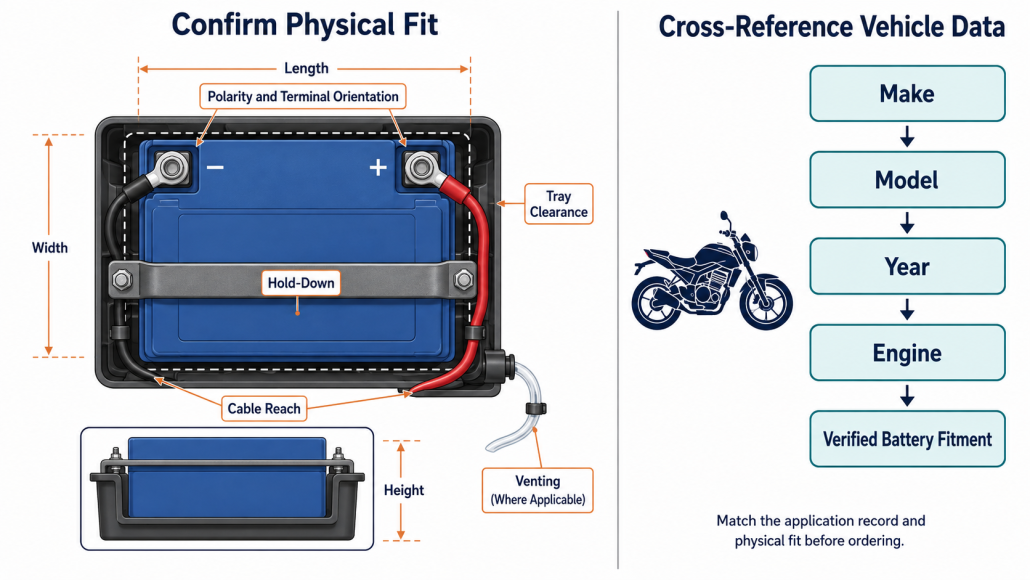
Begin with the exact make, model, year and engine, then confirm the replacement reference. Physical fit comes next: case length, width and height; terminal position and type; cable reach; hold-down; seat clearance; permitted mounting position; and venting where applicable. Voltage alone never proves compatibility.
Compare electrical data on the same basis. Record nominal voltage, actual amp-hours and watt-hours, and the stated starting rating. CCA should include its test method and temperature; it should not be treated as interchangeable with CA, MCA, peak current or a short proprietary pulse rating. Also capture weight, charging limits, operating-temperature range, warranty and the revision date of the datasheet.
Choose Chemistry and Activation Format by Channel Need
A complete wholesale program may include several technologies. The useful question is not which chemistry wins, but which role each product serves in the target market.
| Product type | Typical portfolio role | Wholesale checks |
| Conventional flooded | Price-sensitive and legacy applications that specify a serviceable design | Venting, upright mounting, electrolyte service, activation and local handling rules |
| Dry-charged AGM | Channels that value storage flexibility and can activate batteries correctly | Correct electrolyte pack, activation procedure, commissioning charge, staff training and traceability |
| Factory-activated AGM | Fast counter or workshop installation with familiar OEM-style fitment | Receipt voltage, rotation, storage charging, verified CCA/Ah and warranty process |
| Gel | Selected applications approved for gel starter batteries | Fitment, starting requirement and gel-compatible charging profile |
| LiFePO4 | Premium or weight-sensitive upgrades with verified compatibility | Actual Ah/Wh, starting rating, BMS protections, charge limits, low-temperature behavior, UN 38.3 test summary and shipping documents |
Within the LEOCH range, buyers may encounter Starting Lithium; dry-charged and factory-activated LT or EB options; factory-activated MX; HPG gel; and conventional N or LB families. Treat these as portfolio categories, not universal substitutions. Confirm current regional availability, model-level specifications and approved applications before ordering.
Build a Complete Wholesale Specification Record
A model row should let sales, technical, warehouse and warranty teams identify the same product without interpretation. At minimum, record the model code, chemistry, activation state, nominal voltage, actual Ah and Wh, starting rating and test basis, dimensions, weight, terminal diagram, mounting or venting limits, charge voltage/current, operating and storage temperatures, warranty, packaging quantity, barcode or SKU identifier, cross-reference revision and datasheet revision.
For lithium products, also request the stated cell chemistry, BMS protections and current limits, low-temperature behavior, SDS, the applicable UN 38.3 test summary, and shipping documents. UN 38.3 supports transport compliance; it is not a blanket performance certification.
Turn the Catalog Into an Inventory Plan
Map each approved SKU to demand, lead time, minimum order quantity, service target, storage requirements and warranty risk. Eliminate unexplained duplication only after checking that dimensions, terminals, capacity and application coverage are truly equivalent. A slower-selling model may still be necessary when it protects an important dealer account or fills a critical regional fitment gap.
Separate initial assortment decisions from supplier evaluation. Once the range is defined, audit manufacturing control, batch traceability, change notification, compliance documents, delivery performance, warranty handling and technical support. A well-designed catalog cannot compensate for inconsistent product or incomplete records.
What to Include in a Motorcycle Battery RFQ
- Target countries, buyer type, sales channels and estimated annual volume by chemistry or product family.
- Required application coverage, current cross-reference, core model list and any competitor references used for matching.
- Required electrical, dimensional, terminal, activation, packaging, labeling and barcode fields.
- Required datasheets, SDS, quality records, warranty process and lithium transport documentation.
- Forecast, mixed-SKU requirements, MOQ expectations, delivery schedule and preferred Incoterms.
- OEM or private-label scope, artwork responsibilities, approval samples, change control and technical contacts.
Frequently Asked Questions
How many motorcycle battery SKUs should a distributor stock?
There is no universal number. Use verified local demand, application coverage, lead time, seasonality and service targets. Start with high-turnover core fitments, then add supporting and premium SKUs only where they close a defined gap or serve a valuable segment.
Is a higher Ah or CCA rating always better?
No. Meet the approved application’s starting and capacity requirements, then confirm physical fit and charging compatibility. Do not under-specify, but do not pay for a higher number that uses a different test method or creates an inventory duplicate without additional coverage.
What documents are needed for wholesale lithium motorcycle batteries?
Request the model datasheet, SDS, warranty terms, quality and traceability records, the applicable UN 38.3 test summary, and the documents required for the planned transport mode and destination. Requirements vary, so confirm them with the supplier and logistics provider before shipment.
A Better Catalog Creates a Better Wholesale Program
The best motorcycle battery wholesale catalog connects market demand to verified fitment, comparable specifications, disciplined inventory and complete documentation. It helps sales teams recommend confidently, warehouses handle products correctly, technicians install the right battery and buyers evaluate suppliers on more than unit price.
For LEOCH motorcycle battery sourcing, request the current regional catalog, application cross-reference, datasheets and quotation together. That gives both teams the information needed to define the range before discussing volume, customization or long-term supply.
|
Request motorcycle battery wholesale support Dealers, distributors, importers, OEMs and private-label partners can contact LEOCH for current product availability, application coverage, technical documents and quotation support. |