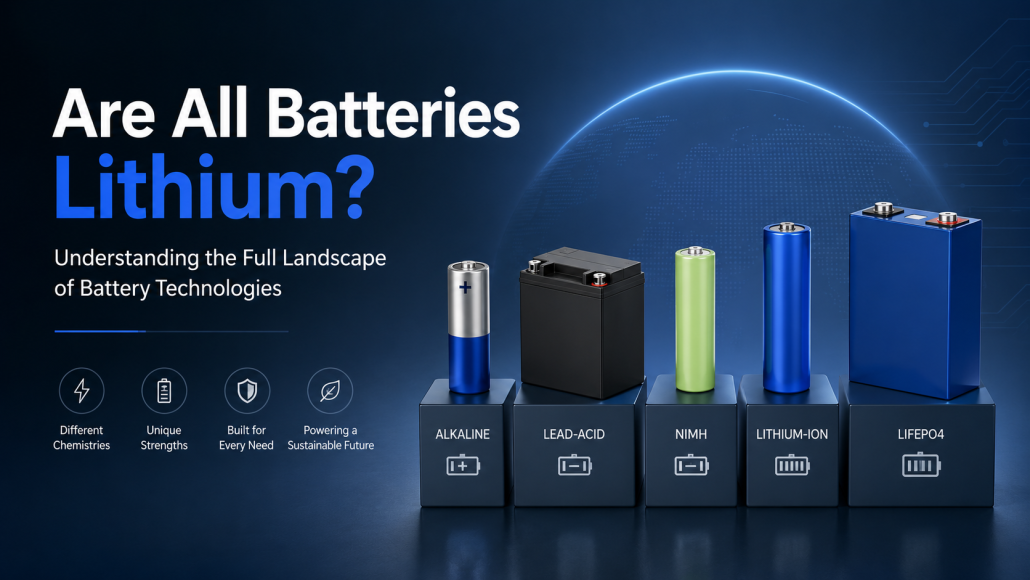
Are All Batteries Lithium? Understanding the Full Landscape of Battery Technologies
Lithium batteries have become one of the most recognizable energy storage technologies today. They power smartphones, electric vehicles, renewable energy systems, industrial equipment, and backup power infrastructure.
Because lithium technology has expanded so rapidly, many people now associate the word “battery” with lithium. This naturally leads to a common question:
Are all batteries lithium?
The answer is no.
Lithium batteries represent only one category within a much broader battery technology landscape. Different battery chemistries have been developed to solve different engineering challenges, including energy density, power output, safety, lifespan, operating conditions, and cost.
Understanding these differences is essential when selecting the right battery for a specific application.
Quick Answer: Are All Batteries Lithium?
No, not all batteries are lithium.
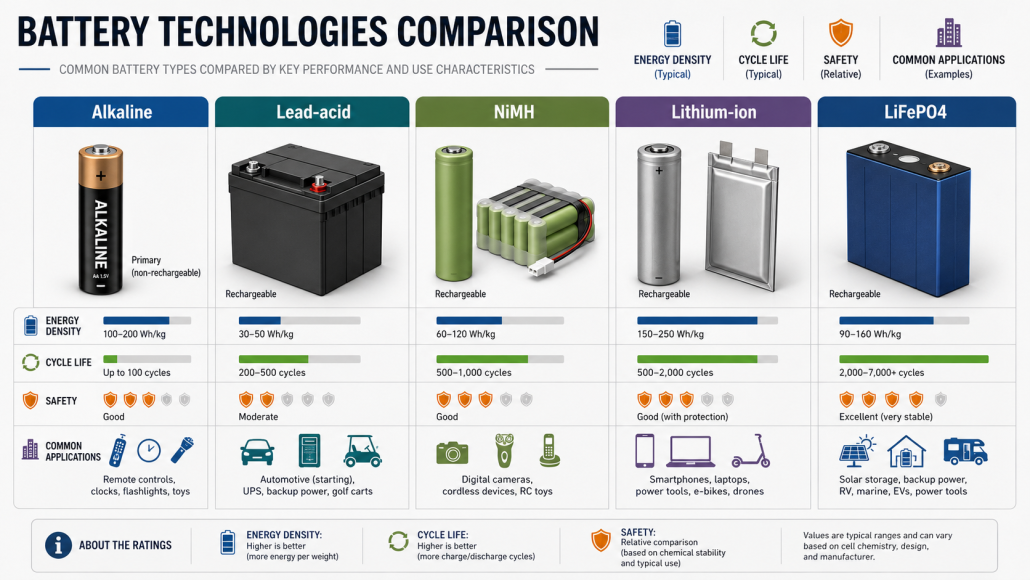
Batteries are available in many different chemistries, including alkaline, zinc-carbon, lead-acid, nickel-based, and lithium-based technologies. Lithium batteries have gained widespread adoption because they offer high energy density, long cycle life, lightweight design, and advanced battery management capabilities. However, other battery technologies remain important in applications where cost, high-current performance, existing infrastructure, or specific operating requirements are more important.
Understanding Battery Chemistry: Why Different Batteries Perform Differently
Every battery works through an electrochemical reaction that converts stored chemical energy into electrical energy.
Although battery technologies vary significantly, most rechargeable batteries contain four fundamental components:
- Cathode: the positive electrode where ions are stored
- Anode: the negative electrode that releases electrons during discharge
- Electrolyte: the medium that allows ions to move between electrodes
- Separator: a protective layer that prevents internal short circuits
The materials used in these components determine how a battery behaves.
For example:
- A battery designed for a vehicle starter must deliver a very high current for a few seconds.
- A solar storage battery must withstand thousands of charge and discharge cycles.
- A UPS battery must provide reliable standby power for critical infrastructure.
Because these requirements are different, multiple battery chemistries continue to coexist.
The Major Types of Battery Technologies
Alkaline and Zinc-Carbon Batteries: Reliable Primary Power
Alkaline and zinc-carbon batteries are among the most common non-rechargeable battery technologies.
Their main advantage is simplicity. They are inexpensive, widely available, and provide stable energy for low-power devices.
However, because they cannot be recharged efficiently, they are not suitable for applications requiring repeated energy cycling.
Typical applications include household electronics, remote controls, clocks, and basic consumer devices.
Lead-Acid Batteries: A Proven Rechargeable Technology
Lead-acid batteries are one of the oldest rechargeable battery technologies and remain widely used today.
Their continued popularity comes from several advantages: mature manufacturing, relatively low cost, and excellent high-current discharge capability.
Different forms of lead-acid batteries serve different applications:
| Type | Characteristics | Typical Applications |
| Flooded Lead-Acid | Lowest cost, requires maintenance | Automotive, industrial equipment |
| AGM | Sealed structure, improved vibration resistance | UPS, telecom, vehicles |
| Gel | Deep-cycle capability | Renewable energy, mobility |
| Pure Lead | Higher performance and longer service life | UPS, data centers, telecom |
The limitation of lead-acid batteries is mainly related to energy density and cycle life. Compared with lithium technologies, they are heavier and generally provide fewer deep discharge cycles.
Nickel-Based Batteries: Durable Industrial Solutions
Nickel-based batteries include technologies such as Nickel-Cadmium (NiCd) and Nickel-Metal Hydride (NiMH).
NiCd batteries were historically valued for durability and strong performance in harsh environments, although their use has declined due to environmental concerns related to cadmium.
NiMH improved upon NiCd by increasing energy density and eliminating cadmium.
Today, nickel-based batteries are still used in applications such as hybrid vehicles, industrial equipment, and specialized systems.
Lithium Batteries: A Family of Advanced Energy Storage Technologies
Although people often refer to “lithium batteries” as a single technology, lithium actually represents a family of different chemistries.
Common lithium technologies include:
- Lithium-ion (Li-ion)
- Lithium Iron Phosphate (LiFePO₄)
- Lithium Polymer (LiPo)
- Nickel Manganese Cobalt (NMC)
Each chemistry has different characteristics.
For example, NMC chemistry prioritizes high energy density, which makes it attractive for applications where reducing weight and size is critical.
LiFePO₄ chemistry focuses more on safety, thermal stability, and long cycle life, making it increasingly popular in energy storage, UPS, industrial, and motive applications.
In conclusion
LiFePO₄ vs. NMC: Two Important Lithium Chemistries
| Performance Factor | LiFePO₄ | NMC |
| Primary Advantage | Safety and cycle life | Energy density |
| Thermal Stability | Excellent | Requires more thermal management |
| Typical Cycle Life | 4,000–6,000+ cycles | Generally lower |
| Energy Density | Moderate | Higher |
| Safety Performance | Very high | Requires additional protection design |
| Common Applications | ESS, UPS, telecom, industrial, motive | EVs, portable electronics |
Neither chemistry is universally better.
The correct choice depends on the application requirements. A compact electric vehicle may prioritize energy density, while a stationary energy storage system may prioritize safety, reliability, and lifetime performance.
Why Lithium Batteries Have Become So Popular
Lithium technology has expanded rapidly because it addresses several limitations of traditional battery systems.
Higher Energy Density
Lithium batteries can store more energy in a smaller and lighter package compared with lead-acid alternatives.
This advantage is especially important in applications where weight and space directly affect performance, such as electric vehicles, portable devices, and mobile energy systems.
Longer Cycle Life
Many lithium chemistries can withstand thousands of charge and discharge cycles.
For applications such as solar storage, forklifts, golf carts, and UPS systems, longer cycle life can significantly reduce replacement frequency and total ownership costs.
Lower Maintenance Requirements
Unlike flooded lead-acid batteries, lithium systems do not require electrolyte checks or watering.
Modern lithium batteries also integrate Battery Management Systems (BMS) that monitor voltage, current, temperature, and cell balance to improve safety and reliability.
Why Lithium Does Not Replace Every Battery
Although lithium technology offers significant advantages, battery selection is always an engineering trade-off.
A battery with the highest energy density is not automatically the best choice for every application.
For example, automotive starting batteries require extremely high short-duration current output, while many consumer devices prioritize low cost and long shelf life. In these cases, traditional battery technologies remain practical solutions.
The best battery technology depends on balancing:
- Performance requirements
- Operating environment
- Lifetime expectations
- Maintenance requirements
- Total cost of ownership
Battery Technology Selection by Application
| Application Requirement | Suitable Battery Technology |
| Low-cost household devices | Alkaline |
| Vehicle starting power | Lead-acid or lithium starter batteries |
| Renewable energy storage | LiFePO₄ |
| UPS backup systems | VRLA, Pure Lead, or Lithium |
| Telecom backup | AGM, Pure Lead, or Lithium |
| High-cycle industrial equipment | LiFePO₄ |
| Electric vehicles requiring maximum range | High-energy lithium chemistries |
How to Choose the Right Battery Chemistry
Selecting a battery begins with understanding the application rather than choosing a technology first.
A system designer should consider:
Energy requirement:
How much energy must the battery store?
Power requirement:
How much current must the battery deliver at one time?
Cycle requirement:
How frequently will the battery charge and discharge?
Environment:
Will it operate in extreme heat, cold, vibration, or outdoor conditions?
Lifecycle cost:
Does the application prioritize low initial investment or long-term operating value?
A well-designed battery system matches chemistry with real-world operating conditions.
LEOCH Battery Expertise Across Multiple Technologies
Battery technology selection depends on application requirements, and no single chemistry is ideal for every scenario. As a lithium battery manufacturer in the Americas, LEOCH develops both lithium and lead-acid battery solutions, including LiFePO₄ systems for energy storage, motive power, and backup applications, as well as advanced AGM, pure lead, and other lead-acid technologies for UPS, telecom, and industrial systems.
By combining multiple battery chemistries with application-focused engineering, LEOCH helps customers select solutions that balance reliability, performance, safety, and lifecycle value.
Frequently Asked Questions
Are all batteries lithium?
No. Lithium is only one category of battery technology. Other common chemistries include alkaline, lead-acid, nickel-based, and zinc-carbon batteries.
Is lithium the best battery technology?
Lithium offers excellent performance in many applications, especially where energy density, cycle life, and weight reduction are important. However, the best battery depends on the specific application requirements.
What is the difference between lithium-ion and LiFePO₄ batteries?
LiFePO₄ is a type of lithium-ion battery chemistry. Compared with some other lithium chemistries, it provides higher thermal stability and longer cycle life, while other lithium chemistries may provide higher energy density.
Why are lead-acid batteries still used?
Lead-acid batteries remain popular because they are cost-effective, reliable, widely available, and capable of delivering high current output for applications such as vehicle starting and backup power.
Conclusion: The Future of Batteries Is Diverse, Not Single-Technology
The rise of lithium batteries does not mean all batteries are becoming lithium.
Instead, the battery industry is becoming more specialized. Different chemistries continue to serve different needs, from small consumer devices to large-scale energy storage systems and mission-critical infrastructure.
Lithium technologies, especially LiFePO₄, will continue to play an increasingly important role in applications requiring long life, efficiency, and reliability. At the same time, established technologies such as lead-acid will remain valuable where their specific strengths provide practical advantages.
The future of energy storage is not about replacing every battery with lithium—it is about selecting the right technology for the right application.
For a broader breakdown of how these chemistries fit into the full market landscape, see our guide, The Complete Guide to Battery Classification: Understanding All Types of Lithium Batteries and Beyond.