
AGM vs. Lithium Motorcycle Battery: Which Delivers the Better Ride?
The AGM vs. lithium motorcycle battery decision is not simply old technology versus new. It is a choice between two different ownership experiences. AGM offers familiar, widely supported starting performance at a lower initial price. A compatible lithium iron phosphate, or LiFePO4, starter battery can remove meaningful weight and deliver strong cranking output for its size. The better ride begins with the battery that fits the motorcycle and its electrical system—not the chemistry with the boldest claim.
|
Quick answer Choose AGM when you want a straightforward OEM-style replacement, familiar charging and service, predictable cold-weather practice, and a lower purchase price. Choose an approved LiFePO4 starter battery when reducing weight has real value and its cranking output, actual capacity, charging limits, temperature behavior, and BMS match the motorcycle. For either choice, verify the application, case, terminals, ratings, and charger before buying. |
What Are You Comparing?
AGM stands for absorbent glass mat. It is a valve-regulated lead-acid design in which electrolyte is held in glass-mat separators. AGM batteries do not need routine water top-ups, and their construction suits the vibration and starting demands of powersports equipment.
Most motorcycle batteries sold as lithium starters use LiFePO4 chemistry. Many include a battery management system, but the protection functions and thresholds vary by model. “Lithium” should not be used as a shortcut for every lithium-ion chemistry, and “BMS-equipped” does not mean universally compatible.
AGM vs. Lithium Motorcycle Battery: Quick Comparison
| Factor | AGM | LiFePO4 | Decision rule |
| Weight | Heavier | Often substantially lighter | Compare two approved replacement models |
| Starting | Strong, familiar output | High output relative to size and mass | Match the OEM requirement and rating method |
| Cold use | Usually the simpler, familiar practice | Starting and charging behavior are model-specific | Use documented low-temperature data |
| Reserve | Often familiar Ah for the OEM fitment | Compact starters may have lower actual Ah | Check alarms, trackers, and engine-off loads |
| Charging | Needs the approved AGM profile | Needs compatible LiFePO4 limits/profile | Vehicle and external charger must both agree |
| Storage | Avoid prolonged undercharge and sulfation | Low self-discharge helps, but parasitic loads remain | Plan around the connected motorcycle |
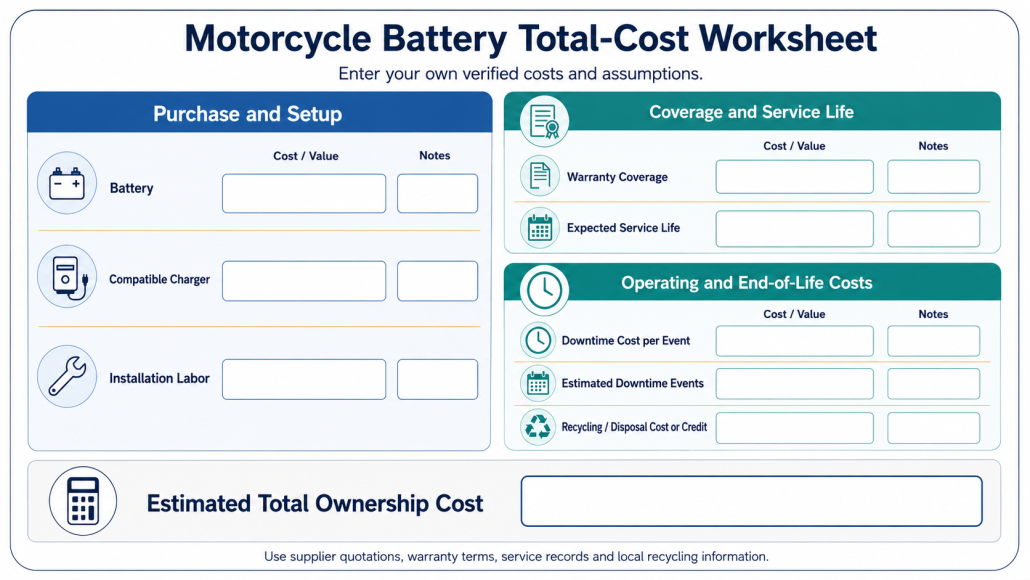
| Cost | Usually lower upfront | Usually higher upfront | Compare exact products, warranty, charger, and service life |
How the Choice Changes the Ride
Weight and handling
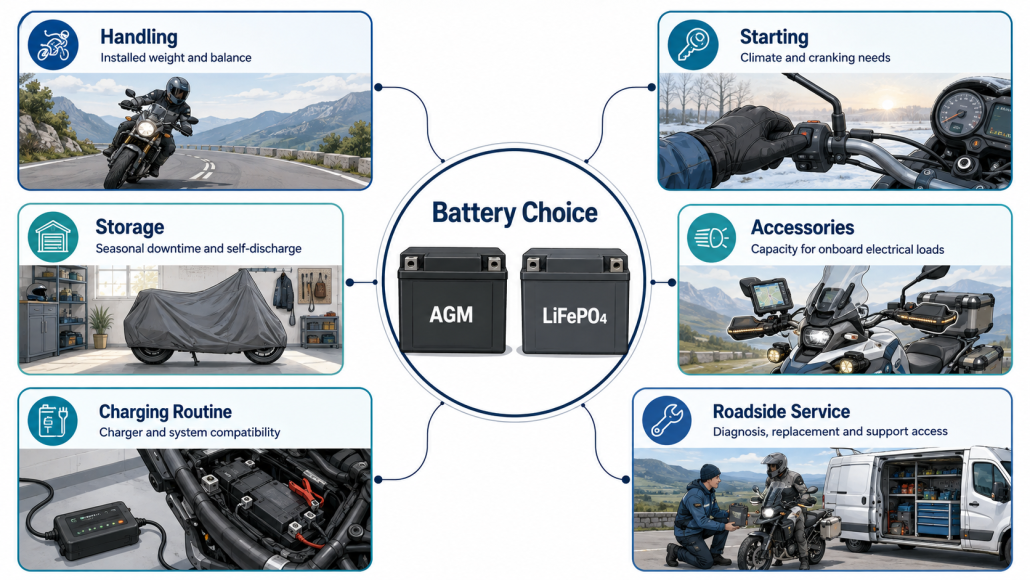
Weight is lithium’s clearest rider-visible advantage. Removing several pounds can matter on a lightweight sport, off-road, or competition motorcycle, especially when the battery sits high in the chassis. On a large cruiser or touring bike, reserve energy, accessory loads, roadside availability, and cold-start margin may matter more. Publish a weight-saving percentage only when the two models are approved equivalents and both weights are verified.
Starting confidence and cold conditions
AGM behavior is familiar to riders and technicians, but a weak, undersized, or undercharged AGM can still crank slowly. LiFePO4 can deliver strong starting current for its mass, yet cold performance and charge acceptance vary by product. Some manufacturers specify a brief load before starting; others use different controls or limits. Follow the exact manual instead of treating one warming routine or temperature threshold as universal.
Storage, accessories, and reserve
Lithium cells typically self-discharge slowly, which can help a stored motorcycle. The motorcycle’s alarm, tracker, clock, keyless system, or other parasitic load can still drain the pack. Also, a small lithium starter may have impressive cranking output but less actual Ah or Wh than the AGM it replaces. Riders who use accessories with the engine off should treat reserve capacity as a primary specification, not an afterthought.
Charging and ownership
Both chemistries are low-maintenance, not no-maintenance. AGM still needs correct state of charge and benefits from a compatible maintainer during storage. LiFePO4 requires a charger and motorcycle charging system that stay within the battery maker’s limits. Do not use an unapproved lead-acid desulfation, repair, recovery, or recondition mode on lithium. A BMS adds protection, but it cannot correct an incompatible charging source.
Which One Should You Choose?
AGM is usually the practical starting point when the motorcycle was designed around an AGM battery, winter starting is common, the electrical system is older or unverified, service availability matters, accessory reserve is important, or purchase price is the main constraint. It is also a sensible choice when the rider wants a familiar charger and a straightforward replacement path.
LiFePO4 makes the strongest case on sport, track, off-road, adventure, and custom motorcycles where lower mass has real value. It can also suit seasonal use when parasitic loads are controlled. Choose it only when a motorcycle-starting model is approved for the application and its actual capacity, cranking rating, terminals, charging limits, low-temperature behavior, BMS, and warranty conditions are understood.
Before Switching from AGM to Lithium
Start with the motorcycle and battery application guides. Confirm nominal voltage, case dimensions, terminal orientation and hardware, cable reach, hold-down, positive-terminal protection, and any venting changes. Then compare cranking ratings using the same standard whenever possible; CCA, CA, PCA, pulse current, and proprietary equivalent ratings are not interchangeable. Check actual Ah or Wh for reserve demand. Finally, test the regulator-rectifier across the specified operating conditions and confirm the external charger, temperature limits, storage procedure, and BMS recovery instructions. If any of those checks is uncertain, retain the approved original chemistry until qualified fitment support resolves it.
Frequently Asked Questions
Is a lithium motorcycle battery a direct replacement for AGM?
Not automatically. Matching 12V labels and case size is not enough. The lithium battery must be approved for motorcycle starting and compatible with the motorcycle’s cranking demand, actual reserve needs, terminal layout, charging system, temperature range, and mounting requirements.
Does lithium last longer than AGM?
It can, but a generic lifespan promise is not reliable. Heat, vibration, depth of discharge, parasitic drain, charging voltage, storage, product design, and installation quality all affect service life. Compare model-level warranty and test data rather than universal cycle or year claims.
Which battery is better for cold-weather riding?
An approved AGM is often the simpler choice because its behavior and service practice are familiar. A LiFePO4 model may still perform well when it has verified low-temperature starting data and the rider follows its instructions. Charging restrictions at low cell temperature also deserve attention.
Final Verdict
For most riders seeking a dependable, lower-cost, OEM-style replacement, AGM remains a strong choice. For riders who can verify compatibility and will benefit from a lighter motorcycle, LiFePO4 can deliver the more noticeable performance upgrade. The best ride experience does not come from choosing a chemistry in isolation; it comes from matching the correct battery to the bike, climate, electrical loads, storage routine, and owner.
Explore LEOCH LiFePO4 motorcycle starting batteries or contact the regional team for an application-compatible cross-reference, catalog, or quotation before changing chemistry.