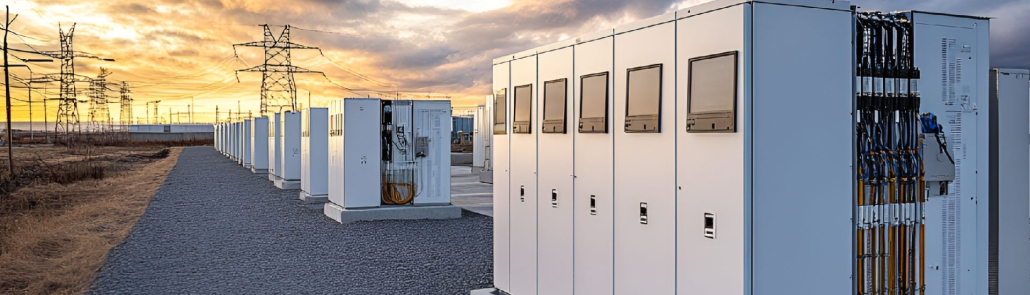
Utility Battery Power Solutions: How Modern BESS Systems Strengthen Grid Reliability and Reduce Operational Costs
Introduction: Why Utilities Are Turning to Battery Power Solutions
Across the United States, utilities are under growing pressure to maintain grid reliability while managing rising peak loads, rapid renewable energy adoption, and aging transmission and distribution (T&D) infrastructure. Traditional solutions—like substation upgrades or new transmission lines—require years of planning and millions of dollars in investment.
This is why utility-scale battery power solutions are rapidly becoming a strategic tool for power providers. Battery Energy Storage Systems (BESS) give utilities new flexibility: they can stabilize the grid, reduce operational costs, support renewable energy, and strengthen resilience during outages.
In this article, we break down what utility-focused battery solutions truly offer, how they’re engineered, and what factors utilities should consider before deployment.
What Are Utility Battery Power Solutions?
Utility battery power solutions refer to grid-connected, large-scale energy storage systems designed to support generation, transmission, and distribution operations. Unlike commercial or residential storage systems, utility-scale BESS focuses on:
- Grid stability and reliability
- Peak load management
- Frequency regulation
- Renewable energy smoothing
- Reserve capacity and black start capability
- Infrastructure deferral (postponing expensive upgrades)
Most systems today are based on lithium iron phosphate (LFP) chemistry due to its long cycle life, high thermal stability, and strong safety profile—key requirements for utility deployments.
Core Applications for Utilities
Battery storage is no longer only a renewable integration tool. Utilities now rely on BESS across a wide range of operational scenarios:
- Peak Shaving and Load Shifting
During peak demand periods, utilities can discharge stored energy instead of activating costly peaker plants. This reduces operating costs and improves system efficiency.
- Frequency Regulation
Modern grids require fast and precise frequency control. BESS responds in milliseconds, outperforming traditional spinning reserves and reducing fuel use.
- Renewable Energy Integration
Solar and wind introduce intermittency. Utility battery systems smooth fluctuations, prevent ramp-rate issues, and help meet renewable portfolio standards (RPS).
- Transmission and Distribution Support
BESS can defer or offset the need for costly T&D upgrades by providing capacity at constrained nodes in the grid.
- Black Start Capability
During grid outages, BESS can restart power plants without relying on diesel generators—improving resilience and reducing emissions.
- Resilience for Extreme Weather
Storms, heat waves, and wildfires increase outage events. Battery systems enable targeted grid reinforcement in vulnerable areas.
Technology Options: LFP, NMC, and Cooling Approaches
Utility-scale battery installations require attention to safety, lifespan, and operational stability. The two most common lithium chemistries—LFP and NMC—offer different profiles:
| Feature | LFP (LiFePO₄) | NMC |
| Thermal stability | Excellent | Moderate |
| Cycle life | Very high | High |
| Energy density | Moderate | High |
| Utility use suitability | ★★★★★ | ★★★★ |
Most utilities now prefer LFP because of its safety margin and predictable degradation.
Cooling Technologies
Two main cooling technologies support battery longevity:
- Air cooling → simpler, lower CAPEX, but less efficient under high load
- Liquid cooling → superior thermal uniformity, ideal for large utility-scale systems, improves round-trip efficiency and lifespan
Liquid cooling is quickly becoming the industry standard for systems above 1 MWh.
System Architecture: How a Utility-Grade BESS Is Designed
A complete utility-scale BESS typically includes:
- Battery racks / containers
- Power conversion system (PCS)
- Energy management system (EMS)
- Battery management system (BMS)
- Thermal management / fire suppression
- Integration with SCADA and grid control systems
To see an example of how these components are implemented in real-world deployments, you can review the utility-oriented battery solutions here:
👉 Utility Battery Energy Storage Solutions
This type of system architecture represents the design direction utilities are adopting worldwide—modular, scalable, safe, and optimized for long-term grid service.
Deployment Considerations for Utilities
When planning a utility-level BESS installation, engineering teams must evaluate several critical factors:
- Grid Interconnection Requirements
Interconnection studies determine the system’s impact on power quality, fault current levels, and grid stability.
- Sizing and Operating Profile
Proper capacity sizing depends on usage:
- 1–2 hours → peak shaving
- 2–4 hours → renewable firming
- 4–8 hours → bulk energy shifting
- Fast response → frequency services
- Round-Trip Efficiency (RTE)
Higher RTE (85–92%) reduces operational losses and improves ROI.
- Thermal Management
Thermal instability remains a top cause of performance decline. This makes cooling strategy selection essential for lifespan and safety.
- Project Lifespan and Degradation
Utilities typically design for 15–20+ years, requiring predictable aging curves and high cycle life.
- Fire Safety and Compliance
NFPA 855, UL 9540, UL 9540A, and IEEE standards dictate installation requirements and test protocols.
- Scalability and Modularity
Utilities benefit from containerized, plug-and-play configurations that allow phased expansion as grid needs evolve.
- O&M Requirements
Condition-based monitoring, automated fault alerts, and predictive analytics reduce maintenance costs.
Economic Value: ROI for Utilities
Utility-scale storage delivers measurable financial and operational benefits:
- Deferred Infrastructure Upgrades
Instead of spending tens of millions on substation expansion, a BESS can address peak load constraints.
- Fuel Cost Reduction
Less reliance on gas peaker plants lowers fuel consumption and emissions.
- Increased Renewable Penetration
BESS allows utilities to integrate more solar and wind without destabilizing the grid.
- Revenue Stacking Opportunities
Utilities can earn value through:
- Capacity markets
- Ancillary services
- Energy arbitrage
- Voltage support
- Compliance With Regulatory Requirements
Many states now mandate energy storage or require clean peak standards (e.g., California, Massachusetts).
Payback Period
Depending on policy incentives, utility-scale storage projects often achieve ROI within 5–10 years, with continued value thereafter.
Case Studies (Generalized Examples)
- Rural Electric Cooperative – Peak Management
A midwestern cooperative deployed a 5-MWh BESS at a feeder head to avoid transformer replacement.
Result: Saved $3.2M in deferred upgrades and reduced peak demand charges.
- Coastal Utility – Renewable Integration
A 50-MWh storage installation reduced solar curtailment and stabilized output.
Result: Enabled 22% higher renewable utilization and lowered grid variability.
- Regional ISO Support – Frequency Regulation
A 20-MWh BESS responded 20× faster than traditional gas peakers.
Result: Improved system frequency stability and reduced ancillary service costs.
Recommended Next Steps
If your goal is to understand how utility-scale battery storage improves grid operations—from thermal management to system architecture—the following resources provide deeper technical guidance:
- BESS Cooling Systems: Why Thermal Management Shapes the Future of Energy Storage
Learn how liquid cooling and thermal controls shape system safety, efficiency, and long-term reliability.
👉 https://leochlithium.us/bess-cooling-systems-why-thermal-management-shapes-the-future-of-energy-storage/ - Top Data Center Power Solutions: UPS, Batteries, Generators & More
A look at high-reliability power systems in data centers, offering useful parallels to utility-grade resilience.
👉 https://leochlithium.us/top-data-center-power-solutions-ups-batteries-generators-more/
Conclusion
Battery power solutions are transforming how utilities manage the modern grid. By providing flexible capacity, fast response, and cost-efficient alternatives to traditional infrastructure upgrades, utility-scale BESS has become an indispensable part of grid planning and operation.
As renewable penetration grows and load patterns shift, the utilities that adopt advanced battery technologies will gain the strongest operational resilience, the lowest long-term costs, and the highest adaptability to future energy demands.