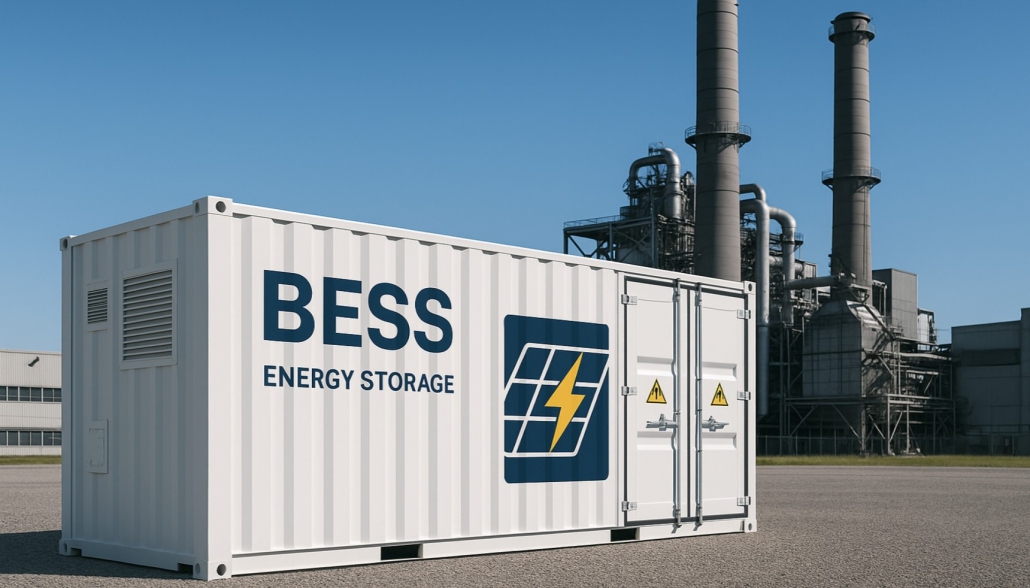
BESS Factory: Manufacturing Capabilities Behind Utility-Scale and C&I Energy Storage Systems
A battery energy storage system is only as reliable as the manufacturing process behind it.
For utility-scale and commercial & industrial (C&I) projects, performance guarantees, delivery timelines, and long-term system stability are determined not just by system design — but by manufacturing capability.
This page explains what a BESS factory is, how large-scale energy storage systems are manufactured, and why factory-level capabilities matter when evaluating suppliers for mission-critical energy storage projects.
What Is a BESS Factory?
A BESS factory is a dedicated manufacturing facility where battery cells, modules, power electronics, control systems, and enclosures are integrated into complete battery energy storage systems.
Unlike simple assembly operations, a true BESS factory manages the full manufacturing lifecycle, including:
- Component qualification and incoming inspection
- Battery module and system-level integration
- Electrical, thermal, and safety design execution
- Factory acceptance testing (FAT) and quality assurance
For readers seeking a deeper technical breakdown of how these systems are structured beyond the factory floor, see
👉 BESS Storage System Explained: Architecture, Components, and When a Battery Energy Storage System Makes Sense
https://leochlithium.us/bess-storage-system-explained-architecture-components-and-when-a-battery-energy-storage-system-makes-sense/
Who a BESS Factory Is Designed to Serve
Factory-based BESS manufacturing primarily supports stakeholders who require scalability, repeatability, and risk control, including:
- Utility-scale renewable energy developers
- Commercial and industrial energy users
- EPC contractors and system integrators
- Infrastructure investors and project owners
- Grid support and public-sector energy projects
In large-scale solar-plus-storage deployments, factory capability directly influences how projects source and standardize systems at scale.
A practical sourcing perspective is discussed in:
👉 Wholesale Solar Battery Storage: How Large-Scale Solar Projects Source Reliable Energy Storage Systems
https://leochlithium.us/wholesale-solar-battery-storage-how-large-scale-solar-projects-source-reliable-energy-storage-systems/
Manufacturing Scope and System Coverage
A modern BESS factory supports multiple system configurations to meet diverse project requirements across different markets and use cases.
Supported System Types
- Utility-scale BESS (multi-megawatt-hour deployments)
- Commercial and industrial battery storage systems
- Solar-plus-storage integrated solutions
- Grid support, peak shaving, and backup applications
Architecture Options
- AC-coupled BESS
- DC-coupled BESS
- Modular and containerized system designs
The choice between system architectures is often determined during early-stage system integration and site design.
For a project-level view of how these decisions are implemented in real deployments, see:
👉 Solar Storage System Integration: From Design to Commissioning in Commercial and Utility Projects
https://leochlithium.us/solar-storage-system-integration-from-design-to-commissioning-in-commercial-and-utility-projects/
Inside the BESS Factory: From Cells to Complete Systems
Manufacturing transparency is critical for understanding system reliability.
A standardized BESS factory process typically includes the following stages:
- Cell sourcing and incoming inspection
Verification of electrical consistency, safety characteristics, and traceability. - Module assembly and electrical integration
Precision assembly, welding, insulation, and mechanical fixation to ensure uniform performance. - Battery management system (BMS) integration
Configuration, calibration, and validation of protection and communication logic. - Power conversion system (PCS) and EMS integration
Coordination between batteries, inverters, and energy management software. - Thermal design and containerization
Implementation of cooling systems, fire protection measures, and mechanical enclosures. - Factory acceptance testing (FAT)
Electrical testing, aging simulations, safety verification, and system-level validation.
Quality, Safety, and Compliance
For large-scale energy storage projects, compliance is non-negotiable.
A qualified BESS factory operates under structured quality management systems and aligns manufacturing processes with applicable international standards, such as:
- IEC and UL safety standards
- NFPA fire protection requirements
- UN38.3 transportation compliance
- Documented QA/QC procedures and batch traceability
From an operator’s perspective, factory QA processes are closely tied to long-term system reliability and operational risk exposure.
This relationship is analyzed in more detail here:
👉 Operational Risks and Long-Term Performance in Solar Battery Storage Systems
https://leochlithium.us/operational-risks-and-long-term-performance-in-solar-battery-storage-systems/
Manufacturing Scale and Delivery Capability
Beyond technical performance, project success depends on delivery certainty.
A true BESS factory demonstrates:
- Stable annual production capacity
- Capability to support parallel large-scale projects
- Controlled and predictable lead times
- Long-term component sourcing and supply stability
These factors are especially critical for utility-scale and portfolio-based deployments, where delays or inconsistencies can cascade across multiple sites.
BESS Factory vs. System Integrator: Why Manufacturing Matters
Not all energy storage suppliers operate manufacturing facilities.
While system integrators play an important role in project delivery, a factory-based manufacturing model provides distinct advantages for utility-scale and C&I projects, including:
- Deeper quality control across the full system lifecycle
- Greater customization capability for project-specific requirements
- Improved cost stability through standardized production processes
- Stronger long-term support for system expansion, replacement, and O&M
How Manufacturing Capability Impacts Project ROI
Manufacturing decisions influence more than upfront system cost.
Factory-driven consistency contributes to:
- Reduced operational risk through uniform build quality
- Lower downtime via standardized components and documentation
- Improved degradation control and performance predictability
- More accurate lifecycle cost modeling
For stakeholders evaluating large-scale projects, these manufacturing factors directly feed into financial modeling and investment decisions.
A structured ROI perspective is discussed in:
👉 Cost Modeling and ROI for Wholesale Solar Battery Storage Projects
https://leochlithium.us/cost-modeling-roi-for-wholesale-solar-battery-storage-projects/
The Role of BESS Factories in Modern Energy Infrastructure
As energy storage deployment accelerates globally, the industry is shifting from ad-hoc system assembly toward industrialized manufacturing.
BESS factories form the backbone of this transition, enabling scalable deployment, supporting renewable energy integration, and positioning energy storage systems as long-term infrastructure assets rather than experimental installations.
Evaluating BESS Factory Capability for Your Project
For stakeholders assessing large-scale energy storage solutions, understanding manufacturing capability is a critical step in supplier evaluation.
A transparent, factory-based approach provides the foundation for confident decision-making — from early-stage feasibility studies to long-term system operation.