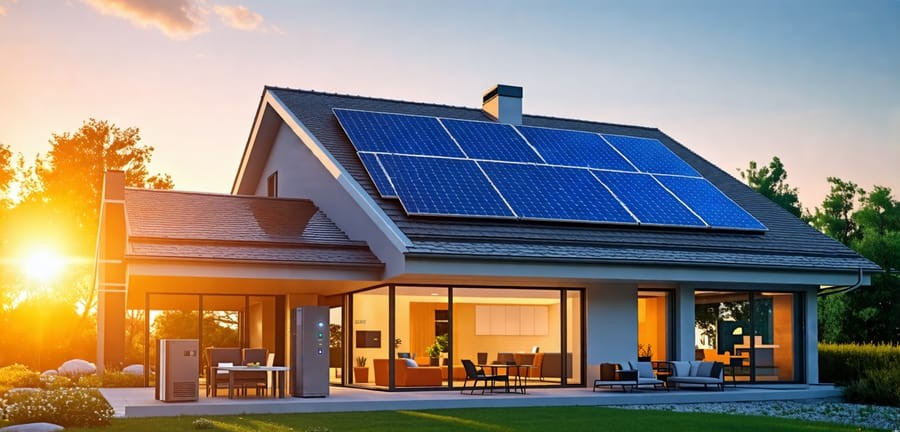
Battery Energy Storage System for House: Cost, Sizing, and Is It Worth It?
What Is a Battery Energy Storage System for a House?
A battery energy storage system (BESS) for a house is a residential energy solution that stores electricity for later use. It is commonly paired with solar panels but can also operate with grid power alone, allowing homeowners to better manage energy usage, reduce electricity costs, and maintain power availability during outages.
Unlike traditional backup-only systems, modern home battery solutions are designed to support energy flexibility, cost optimization, and power continuity within a single integrated system.
How Does a Home Battery System Work?
A residential battery system stores electricity from either:
- Solar panels (during the day)
- The grid (during off-peak hours)
This stored energy can then be used:
- At night when solar generation is unavailable
- During peak electricity pricing periods
- When grid power is unavailable
In practical terms, the system continuously manages when to store and when to use energy, improving overall efficiency and reducing reliance on the grid.
Do You Need Solar Panels to Use a Home Battery?
No, a home battery system can function without solar panels. However, the value proposition differs depending on the setup:
With Solar Panels
- Store excess solar energy
- Increase self-consumption
- Reduce grid dependency
Without Solar Panels
- Store electricity when rates are lower
- Use energy during peak pricing periods
- Provide limited backup capability
👉 Key takeaway:
Solar integration enhances long-term value, but batteries can still provide benefits independently.
How Much Does a Home Battery System Cost?
The cost of a residential battery energy storage system depends on several factors:
- Battery capacity (kWh)
- Battery type (lithium vs lead-acid)
- Installation complexity
- System integration (solar + inverter)
Typical Cost Range:
- Small systems: $5,000 – $8,000
- Mid-size systems: $8,000 – $15,000
- Large systems: $15,000+
👉 Important insight:
The battery itself is only part of the total cost—installation, inverter systems, and system design also play a significant role.
Is a Home Battery System Worth It?
Whether a home battery is worth it depends on your priorities:
It is typically worth it if you:
- Have solar panels and want to maximize self-consumption
- Live in areas with high electricity price variation
- Experience frequent outages
- Want greater energy independence
It may be less attractive if:
- Electricity prices are stable and low
- There is no solar integration
- Backup power is rarely needed
👉 In many cases, the value is not only financial but also operational—greater control over how and when energy is used.
How to Choose the Right Battery Capacity
Choosing the right system size depends on your household energy usage and intended application.
Typical Guidelines:
- 5–10 kWh
Basic energy shifting and small backup needs - 10–20 kWh
Medium homes with partial backup capability - 20 kWh+
Larger homes or extended backup requirements
👉 Practical approach:
Rather than oversizing, most systems are designed based on critical loads and usage patterns.
How Long Can a Home Battery Power Your House?
Backup duration depends on:
- Battery capacity
- Power consumption
- Whether only essential loads are supported
Example:
- 10 kWh battery → 6–12 hours (essential loads)
- 20 kWh battery → 12–24 hours (partial home load)
👉 Important note:
Home battery systems are typically designed to support priority circuits, not the entire house continuously.
Lithium vs Lead-Acid for Home Energy Storage
Lithium Batteries
- Longer lifespan
- Higher energy density
- More compact design
- Lower maintenance
Lead-Acid Batteries
- Lower upfront cost
- Larger footprint
- Shorter lifespan
👉 Industry trend:
Lithium batteries are increasingly preferred due to their long-term performance and system integration advantages.
What to Look for in a Home Battery System
When evaluating a residential energy storage system, consider:
- System compatibility (solar, inverter, hybrid systems)
- Lifecycle performance
- Safety and thermal stability
- Scalability for future expansion
In residential energy storage systems, battery selection is not only about capacity, but also about system compatibility, lifecycle performance, and integration with solar or hybrid setups.
For installers and distributors evaluating lithium battery solutions for home energy storage applications, a range of residential battery configurations designed for real-world deployment can be explored here:
https://leochlithium.us/residential/
Common Mistakes to Avoid
- Oversizing the system
- Leads to higher upfront cost without proportional benefits
- Ignoring installation conditions
- Space, ventilation, and integration matter
- Focusing only on price
- Lower-cost systems may have shorter lifespan
- Not planning for future expansion
- Systems should allow scalability
Planning Your Home Energy Storage System
A well-designed residential battery system balances capacity, cost, and long-term usability. It should align with both current energy usage and future needs, especially if solar integration is planned.
If you are planning a residential energy storage project or sourcing battery solutions for home applications, discussing system requirements such as capacity, installation scenarios, and integration options can help define the right configuration.
Start a conversation here:
https://leochlithium.us/contact-us/